13 July 2026 · 3 min read
The 1.1-Billion-Year-Old Salt That Collapsed a Continent
In the Amadeus Basin, 1.1-billion-year-old evaporite beds dissolved beneath Central Australia, triggering the collapse that formed the MacDonnell Ranges and opened pathways for mineral deposits.
Beneath the red dust of Central Australia, a billion-year-old salt bed dissolved away, and the ground above it fell. That collapse — slow, patient, stretching across tens of millions of years — created the MacDonnell Ranges, the long east-west ridges that define the landscape around Alice Springs. The salt is gone now, flushed out by ancient groundwater, but its absence still shapes the continent.
The Salt That Never Saw the Sea
The Bitter Springs Formation was never a salt mine in the modern sense. It was a layered sequence of evaporite minerals — halite, gypsum, carbonate — deposited in a shallow, landlocked basin around 1.1 billion years ago, when Central Australia sat near the equator. The climate was arid enough to concentrate brines, and the basin periodically dried out, leaving behind beds of salt up to several hundred metres thick.
These were not the white crusts of a coastal salt pan. The Bitter Springs evaporites formed in a continental interior, a vast saline lake system that expanded and contracted over millions of years. The salt beds were later buried under kilometres of sediment, compressed into rock, and held in place by the weight of the overlying sequence. For most of their history, they did nothing remarkable — they simply sat there, buried, invisible.
When the Floor Gave Way
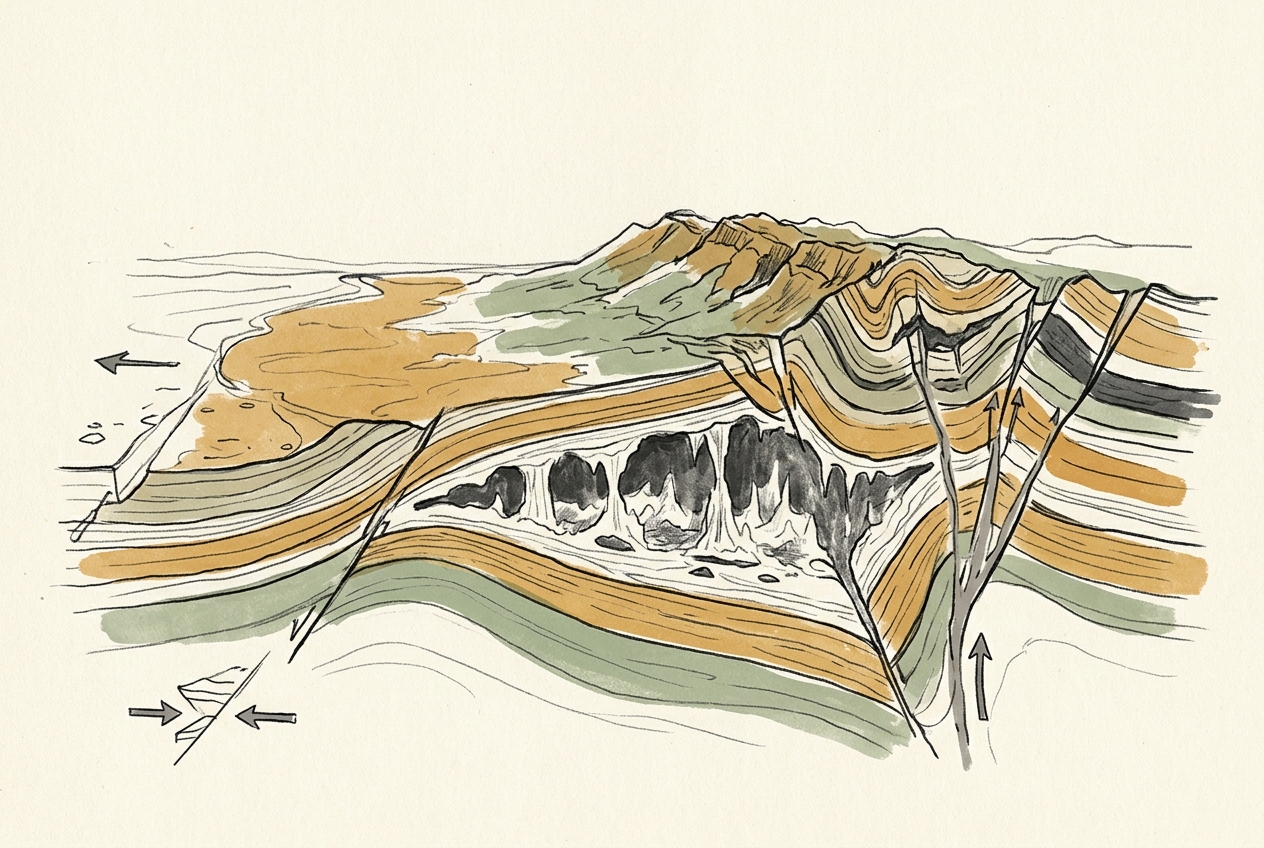
Around 400 million years ago, the Alice Springs Orogeny began pushing the crust together. The buried salt beds, weak and plastic under pressure, became a lubricated horizon. As compression mounted, the overlying rock layers began to slide and fault along the salt layer, detaching from the basement below. Geologists call this a décollement — a detachment surface — and the Bitter Springs Formation provided one of the most effective in Australian geology.
The salt acted like a sheet of grease between rigid layers. The rocks above buckled into folds and thrust faults, forming the MacDonnell Ranges. But the salt itself did not survive the process. Groundwater seeped through fractures, dissolving the halite and carrying it away in solution. What remained were breccias — jumbled masses of broken rock that mark where the salt used to be. The ranges we see today are the product of that dissolved foundation: ridges of quartzite and sandstone that stood firm while the salt beneath them vanished.
The MacDonnell Ranges exist because a salt bed disappeared.
A Hollow Highway for Minerals
The removal of the salt did more than shape ridges. It created space. As the evaporite beds dissolved, they left behind voids, fractures, and permeable zones — a network of underground cavities that later became conduits for mineralising fluids. These pathways allowed hot, metal-bearing brines to move through the crust, depositing copper, gold, and uranium in structural traps along the salt horizon.
The same dissolution process also formed the Amadeus Basin's sub-surface topography — a buried landscape of collapse structures, solution breccias, and sinkholes that still controls groundwater flow today. The water that now supplies Alice Springs and the surrounding communities moves through the ghost of an ancient salt lake. The salt itself is gone, but its hydrological legacy remains.
The Invisible Architecture
The Bitter Springs Formation is not a visible landmark. You cannot walk on it, photograph it, or hammer a sample from an outcrop. Its outcrops are rare and weathered, reduced to rubble and clay-rich residue. Yet it is one of the most structurally important rock units in Central Australia. Without it, the MacDonnell Ranges would not have formed as they did. The pattern of ridges and valleys, the orientation of faults, the location of mineral deposits — all of them are tied to a bed of salt that no longer exists.
This is the paradox of evaporite tectonics: the most influential layers are often the ones that vanish. They leave behind a negative imprint — a void that shapes the rocks above it, a weakness that controls deformation, a memory preserved not in what remains but in what was removed.
More like this
- The 585-Million-Year-Old Embryos That Refuse to DecayIn the Ediacaran hills of South Australia, 585-million-year-old fossils preserve the earliest known animal embryos, their cells still visible in phosphate.
- The 270-Million-Year-Old Earthquakes Frozen in SandstoneAlong the New South Wales coast, 270-million-year-old sandstones preserve the record of ancient earthquakes that turned the seafloor to liquid.
- The 340-Million-Year-Old Reef That Slid Off a CliffIn the Kimberley, a 340-million-year-old reef slid intact off a cliff, preserving an entire Carboniferous coral ecosystem as a single rotated slab.