26 June 2026 · 3 min read
The 1.8-Billion-Year-Old Rift That Bent a Continent
How 1.8-billion-year-old tectonic forces in the Mount Isa region created the world's richest silver-lead-zinc deposit—a 1,000-kilometre scar where a failed rift preserved metal in ancient seafloor mud
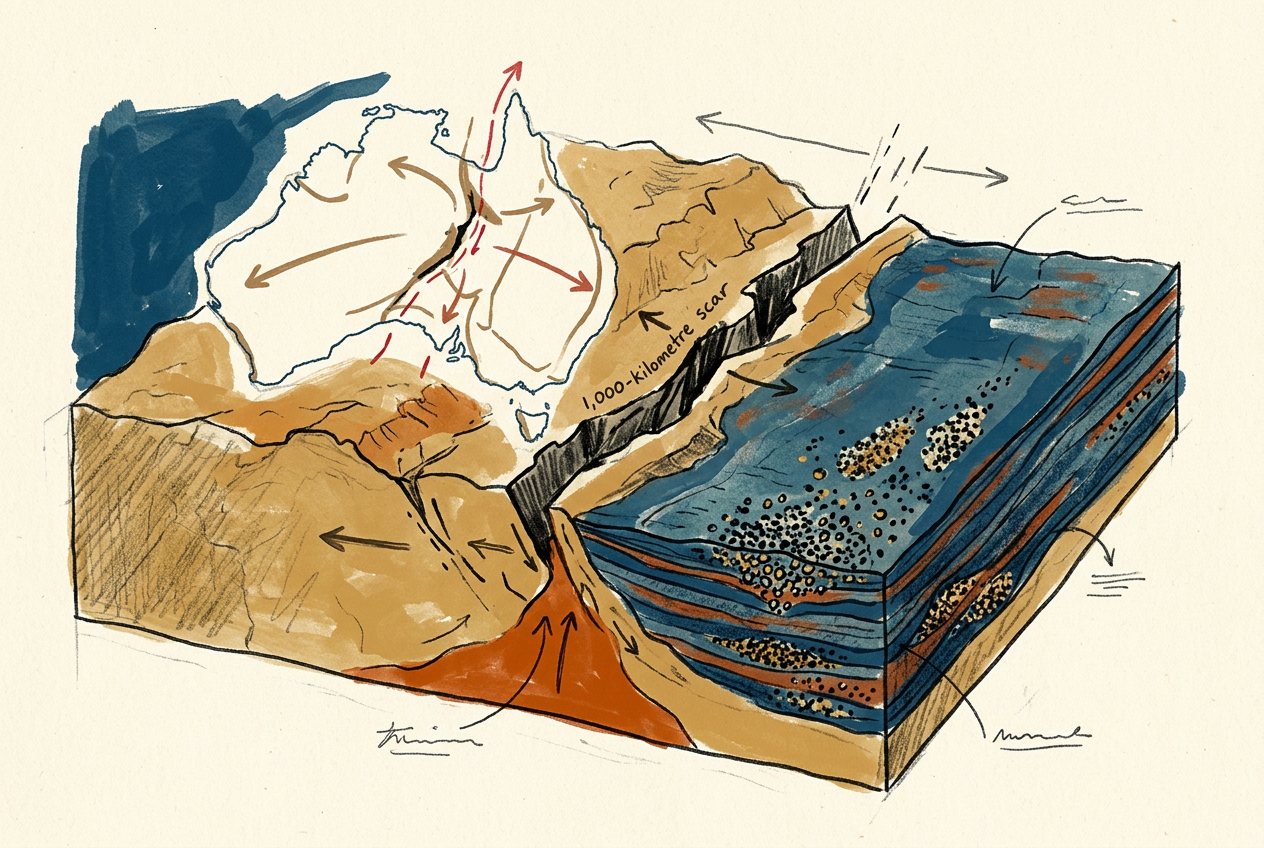
Beneath the red dirt of northwest Queensland, the continent holds a wound that never healed. One point eight billion years ago, a rift began tearing Australia apart. It failed. But in that failure it created something extraordinary: the Mount Isa deposit, the world's richest known concentration of silver, lead, and zinc—a metal reef born from a continent that could not split.
The Rift That Stopped
Rodinia was not yet assembled. The land that would become Australia was still a collection of cratons, drifting across an Archaean sea. Then, around 1.8 billion years ago, a great tearing began. The crust stretched, thinned, and sank, forming a deep basin that stretched more than 1,000 kilometres from what is now Mount Isa to the McArthur River.
The rift never reached the open ocean. It stalled. Magma rose but did not break through in force. Instead, the basin filled with sediment and seawater, creating a series of restricted basins—isolated, stagnant, and chemically strange.
A failed rift leaves no ocean. But it can leave metal.
In these basins, layers of carbonaceous shale and dolomite accumulated for tens of millions of years. The water was stratified: oxygenated at the surface, anoxic and sulphide-rich at depth. That chemical boundary became the engine of mineralisation.
The Metal Trap
Hydrothermal fluids, heated by the still-warm crust below, circulated through the basin. They leached metals from the surrounding volcanic and sedimentary rocks—lead, zinc, silver, copper—and carried them upward along faults. When these hot brines reached the anoxic bottom waters, they encountered hydrogen sulphide produced by bacterial activity.
Metal sulphides precipitated instantly. Layer by layer, the seafloor accumulated bands of galena, sphalerite, and chalcopyrite—black, grey, and brassy minerals that would later be called the Mount Isa lead-zinc-silver orebodies.
What makes Mount Isa remarkable is not just the quantity of metal—more than 150 million tonnes of ore—but the geometry. The sulphides did not form in veins or pods, but as stratiform layers, parallel to the original bedding, extending for kilometres. The basin itself became a metal factory, operating silently on the seafloor for millions of years.
The Metamorphic Overprint
The story did not end with sedimentation. Around 1.6 billion years ago, the Isan Orogeny compressed the basin, folding and faulting the sedimentary layers. The once-flat beds were tilted, sheared, and recrystallised. The sulphide minerals coarsened, making them easier to separate during processing—a geological gift that modern miners would not discover for another 1.6 billion years.
This deformation also created the distinctive silver content that makes Mount Isa ores so valuable. Silver atoms, originally dispersed through the galena lattice, were mobilised and concentrated into discrete silver-rich mineral phases like freibergite and tetrahedrite.
The 20th-Century Discovery
In 1923, a prospector named John Campbell Miles noticed weathered outcroppings of heavy black rock near a cattle station called Mount Isa. He recognised the galena. Within a decade, the Mount Isa Mines company was operating the deepest mine in Australia.
The deposit has been in continuous production ever since. It has yielded more than 300 million ounces of silver, 25 million tonnes of zinc, and 10 million tonnes of lead. The underground workings now extend more than 1,800 metres below the surface, following the tilted ore horizons downward.
Mining has reshaped the landscape around Mount Isa. The smelter stack rises 270 metres above the red plains, visible from 40 kilometres away. But below ground, the original structure remains intact: a 1.8-billion-year-old failed rift, frozen in time, still yielding its metal.
More like this
- The 560-Million-Year-Old Garden That Never Saw a PredatorIn South Australia's Flinders Ranges, 560-million-year-old Ediacara surfaces preserve entire seafloor communities of fronds, discs, and quilts — a garden of soft-bodied life that flourished before pre
- The 1.75-Billion-Year-Old Reef That Outranks the BarrierA 1.75-billion-year-old microbial reef in the Kimberley is the largest biological structure ever built by a single species, preserving a world without predators.
- The 3.5-Billion-Year-Old Cones That Still Catch LightIn the Pilbara's Dresser Formation, 3.5-billion-year-old stromatolites preserve the oldest direct evidence of life on Earth—microbial mats that built layered domes in a volcanic caldera.