26 June 2026 · 3 min read
The 1.6-Billion-Year-Old Breath That Rusted a Continent
How 1.6-billion-year-old stromatolites in the McArthur Basin released enough oxygen to turn Northern Territory sandstones into red beds—the first great rusting of the Australian interior.
Somewhere beneath the dusty plains of the Northern Territory, the first breath of free oxygen on the Australian continent is still preserved in stone. It came not from plants or animals, but from microbial mats that spread across shallow seas 1.6 billion years ago—long before there was anything alive that could use the gas they produced.
The Ripple That Changed the Atmosphere
In the McArthur Basin, near the Gulf of Carpentaria, the Barney Creek Formation preserves a world that existed when the continent was still part of the supercontinent Nuna. The rocks are fine-grained dolomite and shale, dark and organic-rich, but between them run thin bands of red—the signature of oxidised iron.
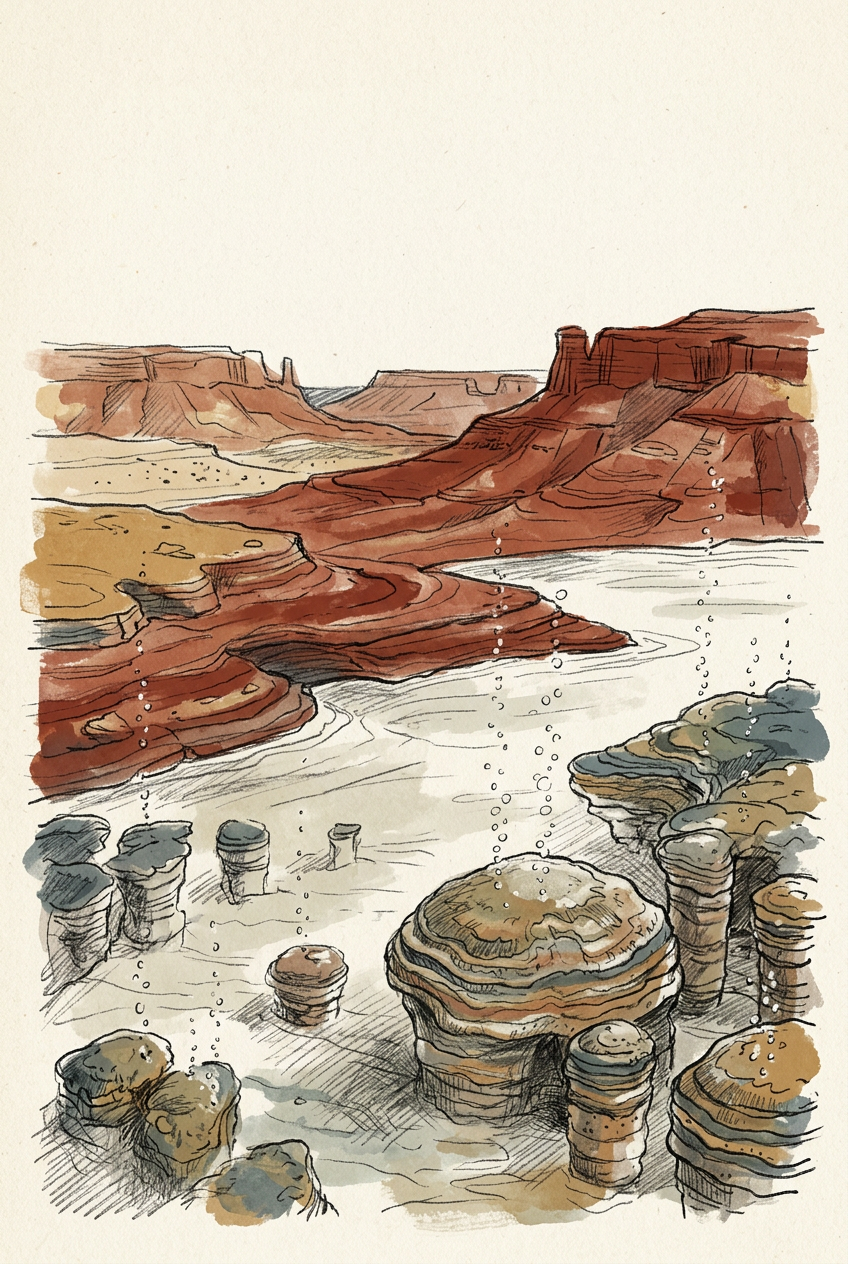
Those red bands are the work of cyanobacteria. The microbes lived in vast, layered mats on the seafloor, building stromatolites that grew in shallow, sunlit waters. As they photosynthesised, they released oxygen into seawater that had never known it. The oxygen reacted with dissolved iron to form rust, which settled as thin red layers on the sediment.
The Barney Creek Formation is not the oldest evidence of oxygen on Earth—that honour belongs to the Pilbara's 2.7-billion-year-old banded iron formations. But it records something different: the moment when oxygen production became persistent enough to leave its mark on the continental interior, not just on the iron-rich oceans of the Archaean.
The first rust on the continent was not the work of wind or rain, but of microbes that could not see, move, or die in any sense we recognise.
A Sea That Stayed Quiet
The McArthur Basin was a peculiar place 1.6 billion years ago. The sea was shallow, restricted, and stratified—the bottom waters were anoxic and rich in hydrogen sulfide, while the top few metres were oxygenated by the stromatolite mats. This layered chemistry was essential. Without it, the iron that settled from the oxygenated surface would have been redissolved in the deep waters below.
What makes the Barney Creek Formation remarkable is the preservation of this delicate balance. The sediments were buried quickly, sealed by evaporite deposits that formed as the shallow sea periodically dried out. The result is a rock record that captures the very first red beds on the Australian continent—sandstones stained by iron that was oxidised not by the atmosphere, but by living organisms.
These red beds are scattered across the McArthur Basin, from the Batten Fault Zone in the east to the Wearyan Shelf in the west. They are not dramatic cliffs or colourful gorges; they are subtle bands of rust in grey dolomite, easy to overlook. Yet they mark a turning point in the history of the continent.
The Long Exhale
For the next billion years, the Australian interior remained mostly red. The oxygen that the McArthur Basin microbes released was a tiny fraction of what the atmosphere would eventually hold, but it was enough to begin staining the continent. When the sediments were later exposed by uplift and erosion, the iron oxides they contained gave the Australian outback its characteristic colour—the deep red of the Kimberley, the ochre of the Olgas, the rust of the Flinders Ranges.
Every red sandstone in the Australian interior owes its colour, in part, to those 1.6-billion-year-old microbes. The iron was already in the sand; the oxygen to rust it came from the stromatolites of the McArthur Sea.
A Quiet Revolution
The microbes of the Barney Creek Formation did not change the world quickly. Their oxygen output was modest, and the atmosphere did not reach modern levels for another billion years. But they established a pattern that would repeat across the continent: life altering the chemistry of the land, slowly and invisibly, until the colour of an entire continent had changed.
The red of the Australian outback is not just the colour of dry earth. It is the colour of the first breath.
More like this
- The 110-Million-Year-Old River That Runs Backwards UndergroundWestern Australia's 110-million-year-old dune system has been slowly dissolving into a labyrinth of caves where an ancient river still flows, carrying the taste of a Cretaceous desert.
- The 560-Million-Year-Old Garden That Never Saw a PredatorIn South Australia's Flinders Ranges, 560-million-year-old Ediacara surfaces preserve entire seafloor communities of fronds, discs, and quilts — a garden of soft-bodied life that flourished before pre
- The 1.75-Billion-Year-Old Reef That Outranks the BarrierA 1.75-billion-year-old microbial reef in the Kimberley is the largest biological structure ever built by a single species, preserving a world without predators.