25 June 2026 · 3 min read
The 2.5-Billion-Year-Old Lava That Built a Nickel Fortune
How 2.5-billion-year-old komatiite lava flows in Western Australia's Yilgarn Craton created the Kambalda nickel deposits—sulfide droplets that settled from the hottest lavas Earth has ever erupted.
The hottest lavas Earth has ever erupted did not flow as rivers of orange-red rock. They flowed as pale, incandescent streams at 1,600 degrees Celsius—hot enough to melt steel—and they left behind the richest nickel deposits on the continent.
The Hottest Magma on Earth
Komatiite is a volcanic rock almost extinct today. It formed only in the Archean, when Earth's mantle was 200 degrees hotter than it is now. These lavas erupted at temperatures that would vaporise any modern volcanic rock on contact.
The name comes from the Komati River in South Africa, but the best exposures on Earth lie in Western Australia's Yilgarn Craton. There, around the town of Kambalda, 2.7-billion-year-old komatiite flows extend for hundreds of kilometres, frozen in time as dark, serpentine-green rock.
A Settling of Sulfides
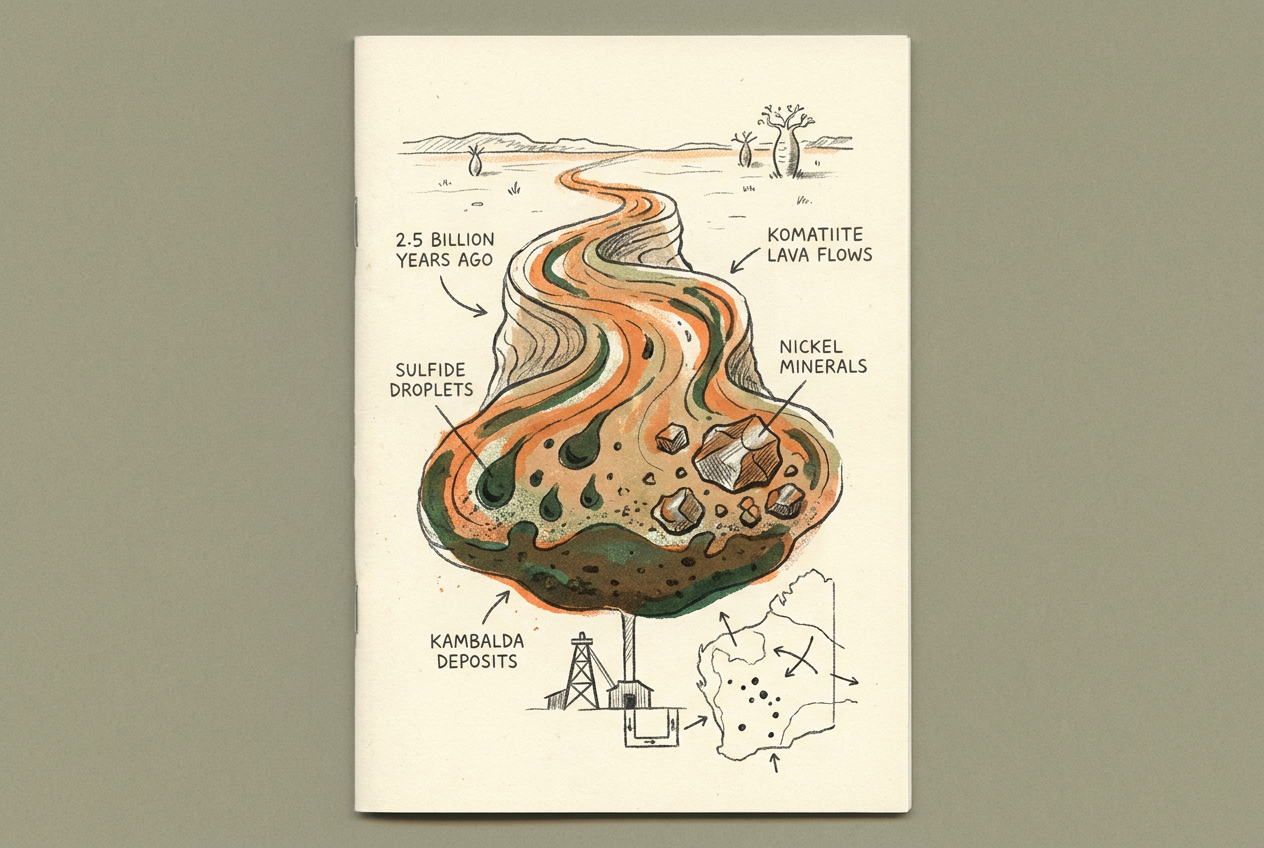
What makes komatiite valuable is not the rock itself but what it carries. When these ultra-hot lavas flowed across the ancient seafloor, they picked up sulfur from the surrounding sediments. Sulfur and nickel are a powerful combination.
As the lava cooled, droplets of nickel-iron sulfide separated from the melt, like oil droplets in water. Being dense, they sank to the bottom of the flow. There they concentrated into lenses and pods of nearly pure nickel sulfide ore.
The Kambalda dome, discovered in 1966, became one of the world's richest nickel camps. The deposits occur not in the komatiite's main body but at its base, where the molten rock scoured the underlying basalt and formed deep thermal erosion channels.
A single lava flow at Kambalda, the Juan shoot, produced more than 200,000 tonnes of nickel metal before it was mined out.
Channels of Fire
The komatiite flows did not spread as uniform sheets. They moved as turbulent, channelised rivers, eroding the seafloor beneath them like water cutting through mud. These thermal erosion channels—some 10 metres deep and 100 metres wide—became the traps where nickel sulfides accumulated.
Geologists have mapped these channels across the Kambalda region. The flows can be traced for 20 kilometres or more, thinning at the edges and thickening in the channels. Where the lava ponded in depressions, the sulfides settled thickest.
The result is a deposit geometry unlike any other: nickel ore concentrated in ribbons along the base of ancient lava tubes, folded and faulted by 2.7 billion years of tectonic deformation.
A Greenstone Legacy
Kambalda sits within the Norseman-Wiluna greenstone belt, a 700-kilometre-long arc of Archean volcanic rocks that runs through the heart of the Yilgarn Craton. This belt contains more than 150 nickel sulfide deposits, most of them associated with komatiite flows.
The greenstone belt formed when the Yilgarn Craton was still an active volcanic arc, before it stabilised into continental crust. Komatiite eruptions were the last gasp of this volcanic phase, marking the transition from Earth's early chaotic mantle to the cooler, layered mantle we know today.
The Nickel That Powers the Present
Today, Kambalda's nickel is in high demand for electric vehicle batteries. The deposits are still being mined, nearly 60 years after their discovery. New exploration targets are being found beneath younger cover rocks, using magnetic surveys that detect the characteristic iron content of komatiite.
But the rock itself remains a geological curiosity. Komatiite flows are among the few direct samples of Earth's early mantle we can touch. They tell us that the early Earth was violently hot, that its lavas flowed like water, and that in those flows, the seeds of modern industry were sown.
More like this
- The 5,000-Year-Old Volcanoes That Still Smoke in the SouthIn Victoria's Newer Volcanics Province, 400 volcanic vents erupted as recently as 5,000 years ago—the youngest volcanic field in mainland Australia, where craters still hold blue lakes and scoria cone
- The 300-Million-Year-Old Forest That Died Standing UpIn New South Wales, a 300-million-year-old fossil forest preserves dozens of trees buried upright by a Permian volcanic eruption—an entire ecosystem frozen in ash.
- The 1.85-Billion-Year-Old Caldera That Still Feeds the FurnaceIn South Australia's Middleback Ranges, a 1.85-billion-year-old volcanic caldera collapsed and later became one of the world's richest iron ore deposits.