5 July 2026 · 3 min read
The 2.5-Billion-Year-Old Ash That Mapped a Craton's Heart
How 2.5-billion-year-old volcanic ash beds in Western Australia's Pilbara Craton became the continent's oldest geological clock—zircons that date the birth of continental crust itself.
The oldest piece of Earth ever found is a zircon crystal 4.4 billion years old, from Western Australia's Jack Hills. But the rock that held it—a 2.5-billion-year-old ashfall bed in the Narryer Gneiss Terrane—tells a more specific story: the moment the Pilbara Craton, the planet's best-preserved fragment of primordial crust, finally stabilised and became a continent.
The Ash That Became a Clock
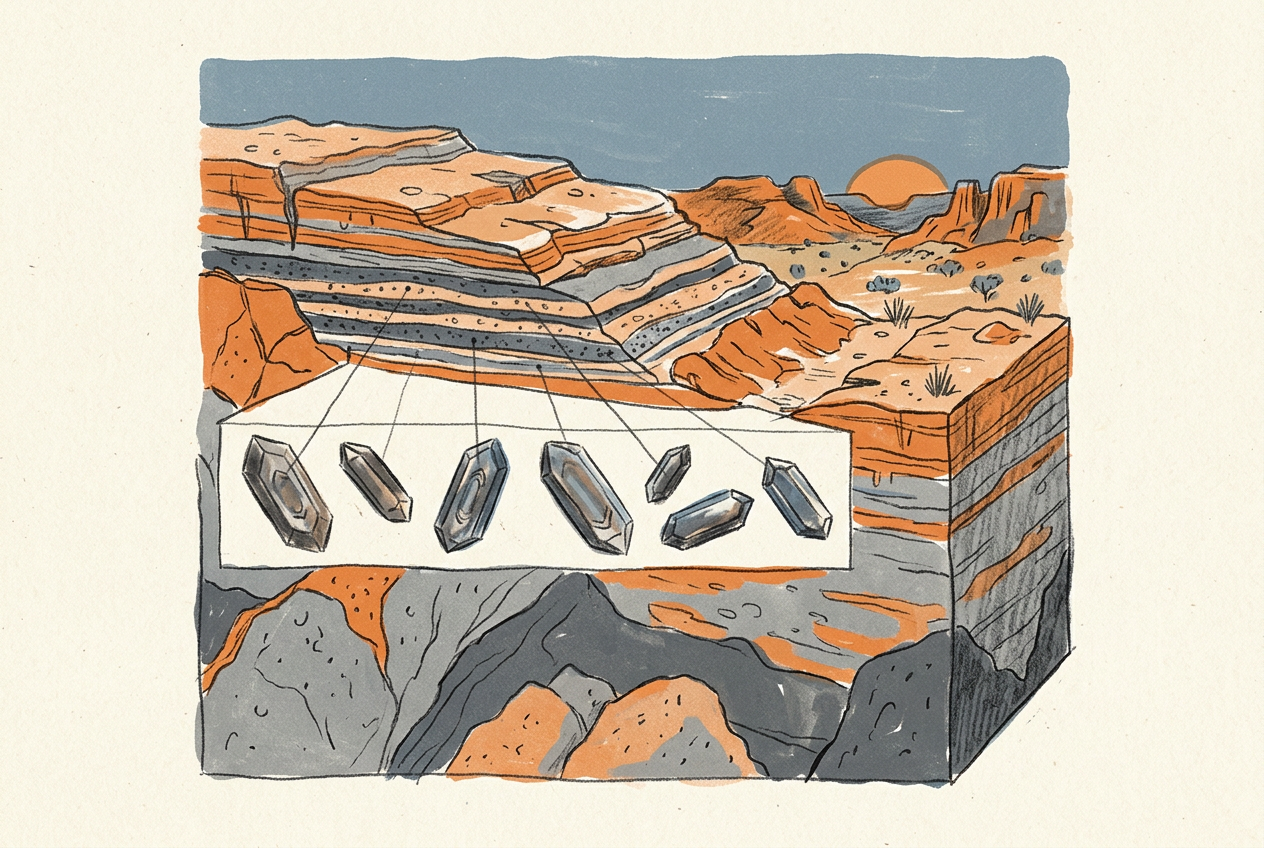
In the Murchison district of Western Australia, about 800 kilometres north of Perth, low hills of banded gneiss rise from red dirt. Among them are thin layers of metavolcanic rock—ash that fell from Archaean eruptions, later compressed and metamorphosed into something that looks like dark, streaky quartzite.
These are the supracrustal rocks of the Narryer Gneiss Terrane, and they contain zircons. Zircon is a mineral so durable that it survives the melting and reworking of its parent rock. Each grain acts as a sealed capsule, recording the age of the magma from which it crystallised. The zircons from the Jack Hills are the oldest known terrestrial material—grains that formed when the Earth was barely 150 million years old.
But the ash bed itself is younger. Uranium-lead dating places its eruption at approximately 2.5 billion years ago, near the boundary between the Archaean and Proterozoic eons. That date is not arbitrary. It marks the end of a 500-million-year period during which the Pilbara Craton grew by accreting volcanic arcs and microcontinents, like a coral reef assembling itself from drifting fragments.
What the Ash Preserved
The ash beds of the Narryer Gneiss Terrane are not continuous layers. They occur as lenses and pods within the gneiss, deformed by later tectonic events. But where they survive, they preserve something remarkable: a record of the volcanic arc system that built the craton's eastern edge.
Geochemical analysis of the ash shows it originated from a continental volcanic arc—the same kind of volcanism that today produces the Andes or the Cascade Range. The magma was rich in silica, meaning it came from a thick crust that had already been through multiple cycles of melting and remelting. This is the signature of mature continental crust, not the thin, basaltic crust of the early Archaean.
A single ash bed can hold the chemical fingerprint of an entire vanished mountain range.
The zircons within the ash also contain inclusions—tiny crystals of other minerals trapped during growth. These inclusions preserve information about the temperature and pressure at which the zircon formed. They tell us that the magma chambers beneath these Archaean volcanoes were 15 to 25 kilometres deep, consistent with a crust already thickened by collision.
The Craton That Refuses to Sink
The Pilbara Craton covers about 60,000 square kilometres of northwest Australia. It is one of only two surviving Archaean cratons on the continent (the other is the Yilgarn Craton in the southwest). What makes the Pilbara special is its lack of deformation: the rocks have remained largely undisturbed for 2.5 billion years.
The ash beds contributed to this stability. When volcanic ash falls into water, it weathers into clay minerals that cement surrounding sediment into hard rock. The Narryer ash beds acted as impermeable seals, preventing fluids from penetrating and altering the underlying crust. They helped lock the craton in place.
Today, the old ash layers are exposed in creek beds and road cuttings, often overlooked by travellers heading to the more famous attractions of Kalbarri National Park or the Pinnacles Desert. But geologists walk these outcrops with hand lenses, looking for the dull grey grains that contain the oldest clock on Earth.
A Continent Written in Ash
The Narryer Gneiss Terrane is not a scenic landscape. It is flat, dry, and studded with spinifex grass. The rocks are dark and weathered, and the ash beds themselves are barely distinguishable from the surrounding gneiss. But this unpromising terrain contains the most complete record of continental formation on the planet.
Each ash bed is a snapshot of a volcanic eruption that occurred on a specific day, 2.5 billion years ago. The ash fell, settled into water, and was buried. Later, the rock was heated and compressed, but the zircons survived. And when geologists crack them open and measure their uranium and lead, they are reading the original date of eruption—the moment the Pilbara Craton added another layer to its growing mass.
There is no grand monument here, no tourist trail. Just the quiet work of ash, time, and the oldest crystals on Earth.
More like this
- The 5,000-Year-Old Volcanoes That Still Smoke in the SouthIn Victoria's Newer Volcanics Province, 400 volcanic vents erupted as recently as 5,000 years ago—the youngest volcanic field in mainland Australia, where craters still hold blue lakes and scoria cone
- The 300-Million-Year-Old Forest That Died Standing UpIn New South Wales, a 300-million-year-old fossil forest preserves dozens of trees buried upright by a Permian volcanic eruption—an entire ecosystem frozen in ash.
- The 1.85-Billion-Year-Old Caldera That Still Feeds the FurnaceIn South Australia's Middleback Ranges, a 1.85-billion-year-old volcanic caldera collapsed and later became one of the world's richest iron ore deposits.