5 July 2026 · 3 min read
The 1.8-Billion-Year-Old River That Still Runs Below the Red Centre
How 1.8-billion-year-old river gravels beneath central Australia became the source of the continent's finest pink diamonds—diamonds coloured by plastic deformation during a 320-million-year-old collis
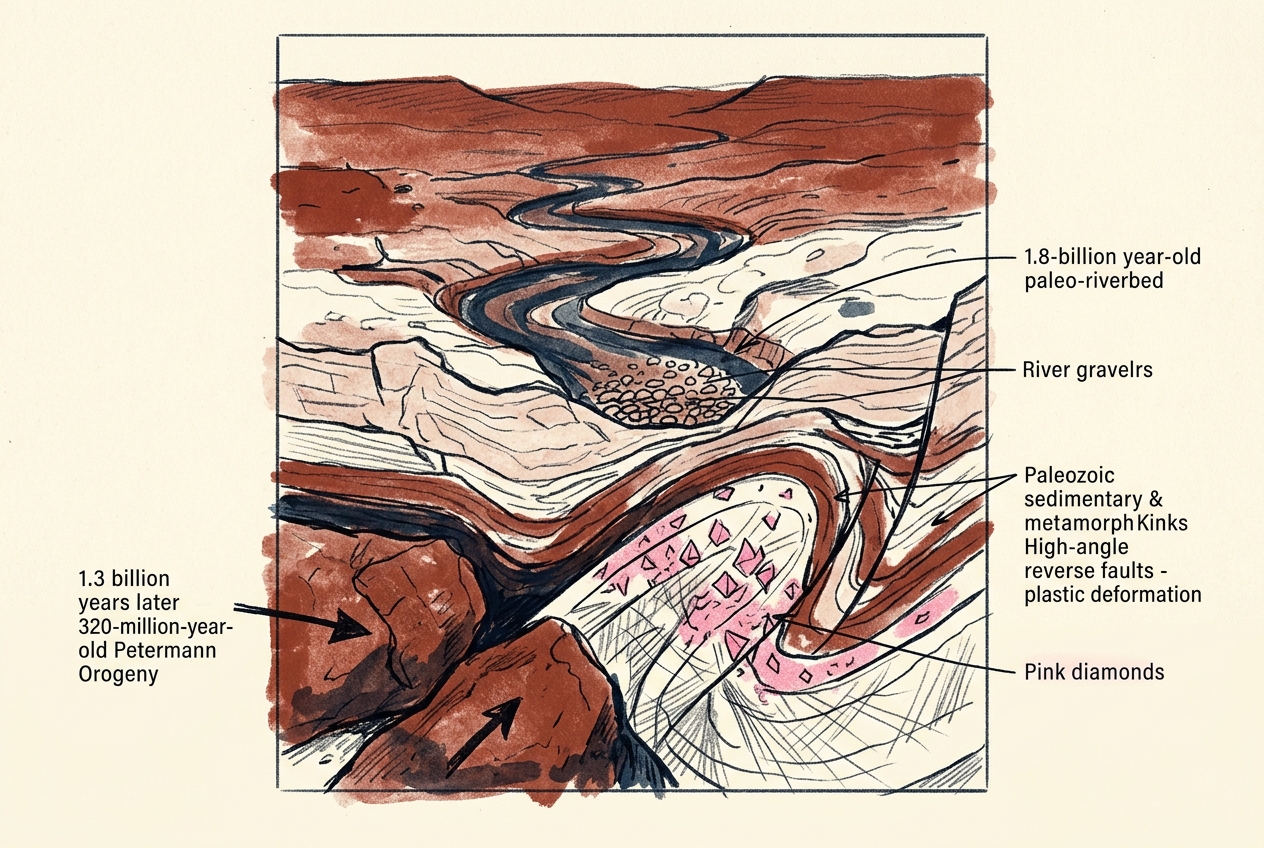
Beneath the red dust of central Australia, a river ran 1.8 billion years ago. It deposited rounded pebbles of schist and quartzite into a channel now buried three kilometres deep. Those gravels never saw the sun again—but they became the only known source on Earth of pink diamonds.
The River That Became a Diamond Pipe
The Argyle diamond pipe in Western Australia's Kimberley region is famous for its pink diamonds. But the Argyle lamproite erupted 125 million years ago. The colour of its diamonds was set much earlier, in a different place—beneath the Stuart Shelf of South Australia, near the town of Coober Pedy.
There, 1.8 billion years ago, a braided river system carried sediment from the eroding Gawler Craton into a shallow basin. The gravels were buried, compressed, and metamorphosed into the rocks now called the Mount Babbage Inlier. These ancient river deposits contain no diamonds themselves. But they record the geological conditions that would later create them.
Diamonds form under extreme pressure in the mantle, 150 kilometres down. Most are colourless. A pink diamond gets its colour not from impurities but from plastic deformation—the crystal lattice being bent and twisted under stress. The stress that coloured Argyle's diamonds came from a collision 320 million years ago, when the Kimberley Block slammed into the rest of Australia.
The Pressure That Painted Them Pink
The collision was part of the Alice Springs Orogeny, a mountain-building event that lasted from 400 to 300 million years ago. It thickened the crust across central Australia, folding and faulting rocks that had lain flat for more than a billion years.
The diamonds already sat inside the Argyle lamproite pipe, waiting. When the orogeny squeezed the region, the diamonds experienced directed stress—pressure from one side, not all sides. This deformed their crystal structure along planes called glide twins, creating the lattice defects that absorb green light and reflect pink.
The same collision that coloured the diamonds also uplifted the ancient river gravels of the Mount Babbage Inlier, exposing them at the surface near Coober Pedy. Today, miners dig those gravels not for diamonds but for opal—the region's other famous gem. The pink diamonds stayed in the Kimberley, 2,000 kilometres north.
The colour of a pink diamond is not a chemical impurity. It is a memory of pressure—a crystal lattice permanently bent by a collision that happened 320 million years ago.
A River That Still Shapes the Land
The 1.8-billion-year-old river channel is invisible at the surface. But its legacy appears in the landscape above it. The Stuart Shelf is flat, almost featureless—a plain of weathered rock and gibber stones. But beneath that plain, the ancient river system controls the flow of groundwater.
The rounded gravels of the Mount Babbage Inlier are porous. Water moves through them, dissolving silica from the surrounding sandstone and depositing it in voids. That process created the opal fields of Coober Pedy—not in the river gravels themselves, but in the rocks that overlie them.
So a single river, flowing 1.8 billion years ago, left two different gems in two different parts of Australia: pink diamonds in the Kimberley, and precious opal in the Red Centre. The river never carried either gem. It carried only the structural conditions that later, under different pressures, would produce them.
The diamonds and the opal are separated by distance, time, and geological process. But they share an origin: a river that ran before most of Australia existed, whose gravels still hold the shape of the continent's deep past.
More like this
- The 2.5-Billion-Year-Old Volcano That Still Holds 3,000 Tonnes of CopperIn South Australia's Olympic Dam, a 2.5-billion-year-old volcanic-hydrothermal system created the largest uranium deposit on Earth and a copper resource so vast it reshaped an industry.
- The 520-Million-Year-Old Trench That Still Holds a Continent TogetherHow the 520-million-year-old Kanmantoo Trench off South Australia—a subduction zone that jammed—stitched the Australian continent together and left a belt of metamorphic rock still exposed today.
- The 3.5-Billion-Year-Old Lava That Still Tastes of the MantleIn the Pilbara, 3.5-billion-year-old komatiite lavas preserve the chemical fingerprint of the Earth's pristine mantle—unaltered by plate tectonics or crustal contamination.