9 July 2026 · 3 min read
The 550-Million-Year-Old Tubes That Became the First Skeletons
In the Flinders Ranges, 550-million-year-old Cloudina fossils preserve the first animal skeletons on Earth—calcareous tubes that changed the seafloor forever.
The first animals to build skeletons on Earth did not leave their bones in the ground. They left their bones on the seafloor—pale, calcareous tubes that rose from the microbial mat like chimneys. And in the Flinders Ranges of South Australia, those 550-million-year-old tubes are still standing.
The First Architects
For most of life's history, the seafloor was a soft world. Microbes wove sticky mats across the sediment, but nothing built rigid structures—no shells, no tubes, no skeletons. That changed in the late Ediacaran period, around 550 million years ago, when a strange group of organisms began secreting calcium carbonate.
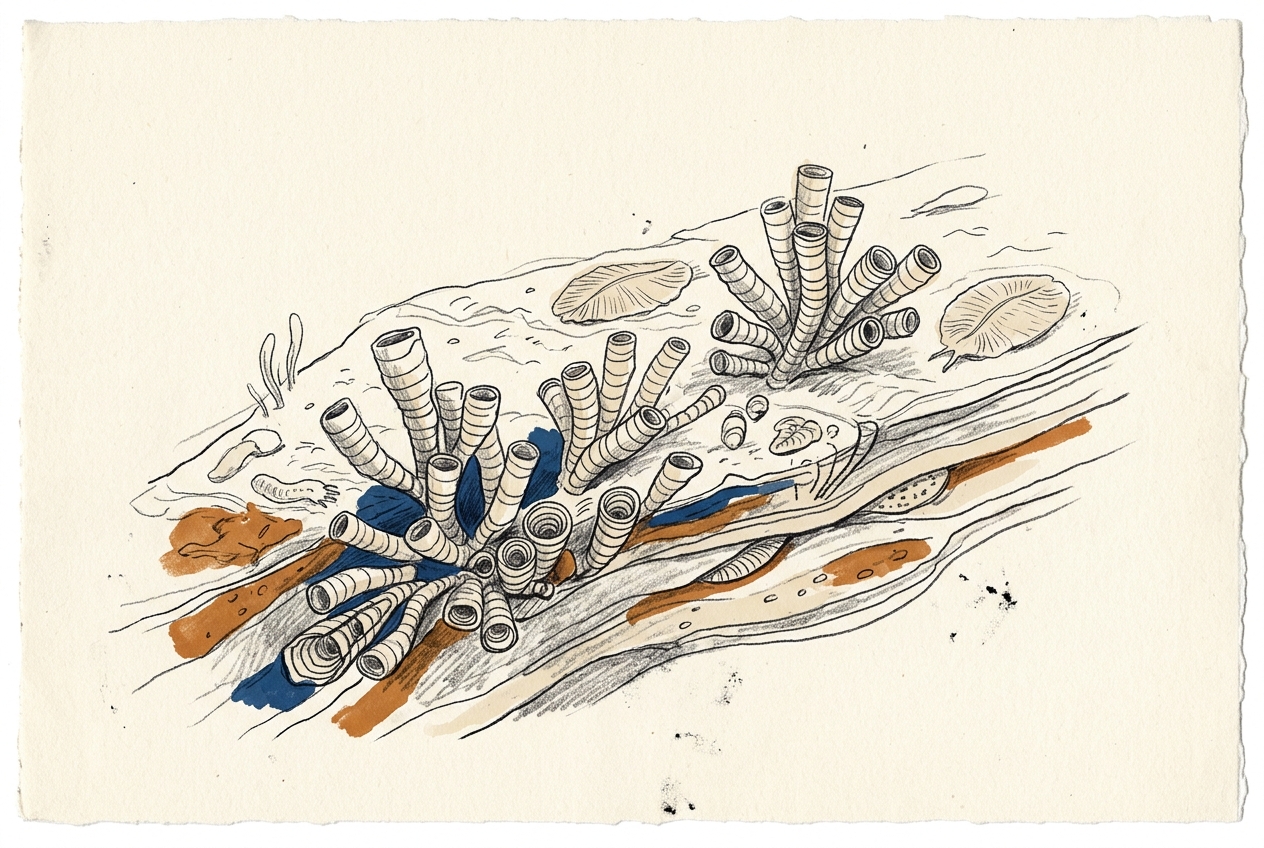
The most famous of these is Cloudina, a filter-feeder that grew a series of nested, cone-shaped tubes, each stacked inside the next like a stack of paper cups. It was the first animal on Earth to biomineralize—to harden its body with a mineral skeleton.
In the Flinders Ranges, the Rawnsley Quartzite preserves entire seafloors where Cloudina tubes stand upright in life position, embedded in sandstone that once was sand. The fossils are tiny—most no longer than a fingernail—but they represent a revolution. Before Cloudina, no animal had the metabolic machinery to build a skeleton. After it, the arms race was on.
A World Without Predators
Why build a skeleton in a world without predators? The Ediacaran seafloor had no jaws, no claws, no burrowing hunters. The first skeleton builders likely did not need armor.
The more plausible answer is structural support. Cloudina lived in shallow, wave-agitated waters where currents could tear a soft body apart. A calcified tube anchored in the microbial mat was a way to stand upright and filter nutrients from the water column. It was architecture, not armor.
The first skeleton was not a shield. It was a pillar.
But once the technology existed, evolution found other uses for it. Within 20 million years, the Cambrian explosion would produce arthropods with exoskeletons, molluscs with shells, and predators with grasping appendages. Cloudina opened a door that could not be closed.
The World's Oldest Reef Builders
Cloudina did not just build individual tubes. In places, it built reefs. At the base of the Rawnsley Quartzite, slabs of rock reveal dense clusters of Cloudina tubes packed together in life position, forming small bioherms—the oldest known skeletal reefs on Earth.
These were not the sprawling barrier reefs of the Devonian. They were modest structures, perhaps a few centimetres high, built by thousands of individuals growing in concert. But they changed the seafloor permanently. By creating hard substrates where none had existed, Cloudina reefs provided new habitats for other Ediacaran organisms and altered local sediment dynamics.
In Namibia, China, and Brazil, Cloudina appears in similar shallow-water deposits, suggesting it was a globally distributed genus—the first animal with a mineralised skeleton to achieve a worldwide range. The Flinders Ranges contain some of the best-preserved examples, with tubes still showing their original microstructure.
The Silhouette of a Revolution
When you walk the ridges of the Flinders Ranges today, you see red quartzite that was once sand and sea. The Cloudina fossils appear as pale, wavy lines on the rock surfaces—ghosts of tubes that have been recrystallised and flattened by 550 million years of burial.
Yet the shape is unmistakable. The nested cones, the slight curvature of the tube, the way they cluster together. These are not trace fossils or chemical artefacts. They are the actual remains of the first animals to build skeletons on Earth.
The innovation was simple: a tube of calcium carbonate. But that tube set in motion a cascade that would lead to trilobite carapaces, dinosaur bones, coral reefs, and human skeletons. Every hard part in every animal that followed owes something to the Ediacaran experiment that began in a shallow sea in what is now South Australia.
More like this
- The 560-Million-Year-Old Garden That Never Saw a PredatorIn South Australia's Flinders Ranges, 560-million-year-old Ediacara surfaces preserve entire seafloor communities of fronds, discs, and quilts — a garden of soft-bodied life that flourished before pre
- The 300-Million-Year-Old Forest That Died Standing UpIn New South Wales, a 300-million-year-old fossil forest preserves dozens of trees buried upright by a Permian volcanic eruption—an entire ecosystem frozen in ash.
- The 1.75-Billion-Year-Old Reef That Outranks the BarrierA 1.75-billion-year-old microbial reef in the Kimberley is the largest biological structure ever built by a single species, preserving a world without predators.