6 July 2026 · 3 min read
The 200-Million-Year-Old Ice That Still Burns
Beneath the Great Australian Bight, 200-million-year-old gas hydrates preserve Jurassic seawater and air in crystalline cages—the oldest ice on Earth.
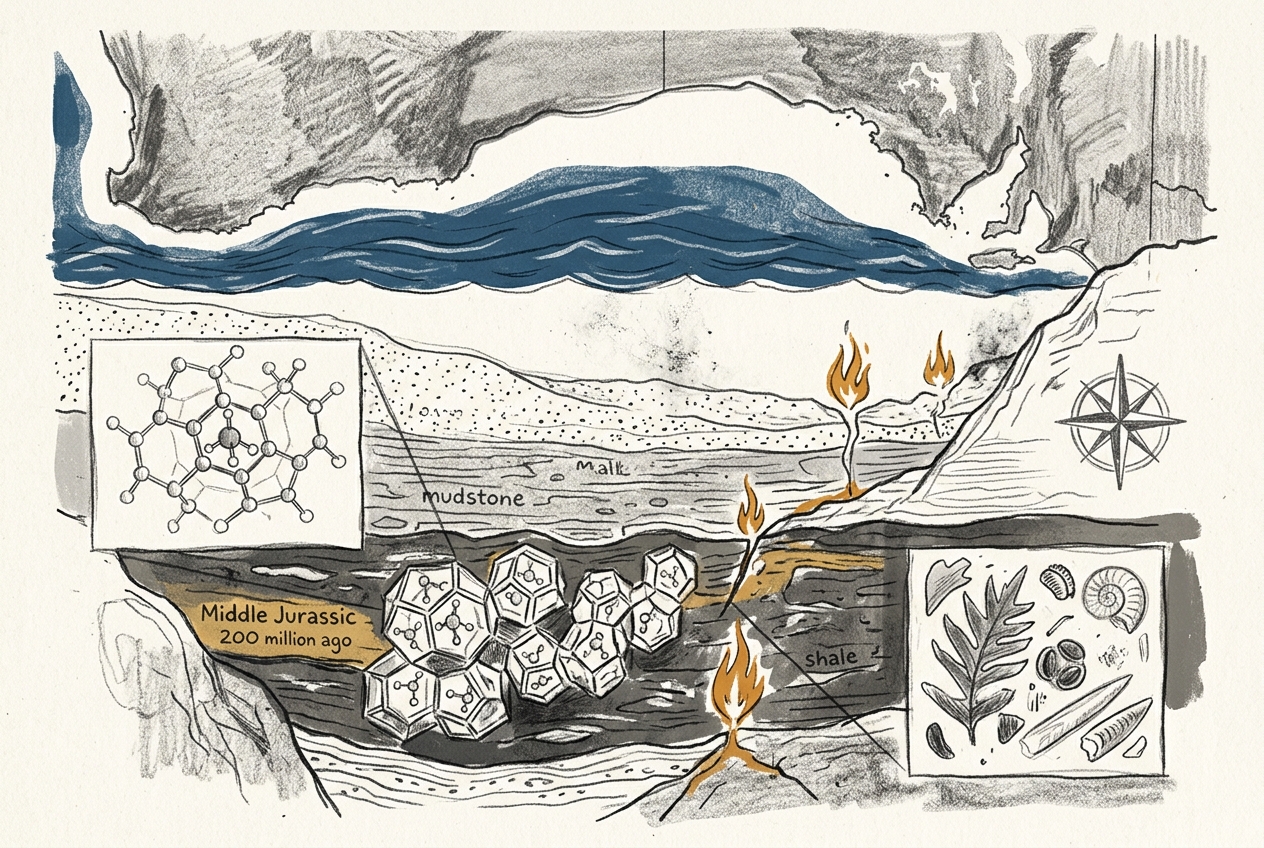
It is the coldest thing on Earth that never melts. In 2016, geologists drilling in the Great Australian Bight pulled up a core of ice that had been buried under 3.5 kilometres of seawater and sediment for 200 million years—a sliver of the Jurassic atmosphere trapped in a crystal cage.
The Ice That Was Never Supposed to Exist
Gas hydrates are not what most people picture when they think of ice. They are clathrates: cage-like lattices of water molecules that trap methane molecules inside, forming a solid that looks like snow but burns. On the seafloor, they exist only under high pressure and near-freezing temperatures.
Beneath the Ceduna Sub-basin, a deep sedimentary trough off South Australia, those conditions have held steady since the Jurassic. The hydrates there are not young seeps from decomposing organic matter. They are relict structures—fossil ice—that formed when Australia was still part of Gondwana.
When the drill bit hit the hydrate zone at 3,500 metres depth, the core came up fizzing. Gas bubbles streamed from the sediment as the clathrates began to dissociate in the warmth of the deck.
A Continental Rift Frozen in Time
The Ceduna Sub-basin formed during the breakup of Gondwana, around 160 to 140 million years ago. As Australia separated from Antarctica, the crust stretched and thinned, creating a deep basin that filled with sediment washed off the eroding continent.
That sediment buried organic-rich layers to depths where heat and pressure cooked them into methane. The gas then migrated upward until it hit the hydrate stability zone—a cold, high-pressure layer near the seafloor where clathrates could form.
The result is a methane trap unlike any other. Most gas hydrates are dynamic; they form and dissociate as ocean temperatures shift. The Ceduna hydrates have remained stable for tens of millions of years because the basin has never been disturbed by tectonic uplift or warming currents.
The Methane Bomb That Didn't Go Off
Gas hydrates have a reputation as a climate time bomb. If warming ocean waters cause them to dissociate, the released methane—a greenhouse gas 25 times more potent than CO₂—could accelerate warming catastrophically.
The Ceduna hydrates tell a different story. Their longevity suggests that deep-sea hydrates can remain locked in sediment for geological timescales, even through periods of global warming. The key is depth. The Ceduna deposits sit at depths where bottom water temperatures have never risen enough to destabilise them.
This does not mean hydrates are safe everywhere. Shallower deposits on continental slopes remain vulnerable. But the Ceduna example shows that the threat is not uniform.
The coldest ice on Earth has been waiting 200 million years to be found. It may wait another 200 million yet.
What the Ice Holds
The trapped methane is not the only prize. The clathrate cages also preserve trace amounts of ancient seawater and atmospheric gases—samples of Jurassic air that predate the oldest ice cores from Antarctica by 199 million years.
Geochemists are now analysing these gas bubbles for clues about the Mesozoic atmosphere: the concentration of oxygen, the composition of greenhouse gases, the isotopic signature of ancient rainfall. The hydrates are not just a curiosity. They are a vault.
In the Ceduna Sub-basin, the Jurassic is not a layer of rock. It is a layer of ice, still cold, still waiting.
More like this
- The 560-Million-Year-Old Garden That Never Saw a PredatorIn South Australia's Flinders Ranges, 560-million-year-old Ediacara surfaces preserve entire seafloor communities of fronds, discs, and quilts — a garden of soft-bodied life that flourished before pre
- The 300-Million-Year-Old Forest That Died Standing UpIn New South Wales, a 300-million-year-old fossil forest preserves dozens of trees buried upright by a Permian volcanic eruption—an entire ecosystem frozen in ash.
- The 1.75-Billion-Year-Old Reef That Outranks the BarrierA 1.75-billion-year-old microbial reef in the Kimberley is the largest biological structure ever built by a single species, preserving a world without predators.