26 June 2026 · 3 min read
The 1.9-Billion-Year-Old Volcano That Left a Lithium Ghost Town
How 1.9-billion-year-old pegmatites in Western Australia's Pilbara Craton created the world's largest known tantalum deposit—and a town that rose and fell with the metal that powered the Apollo progra
In the remote Pilbara of Western Australia, a rocky ridge called Mount Cassiterite holds the world's largest known deposit of tantalum—a metal so heat-resistant that it lined the engines of the Apollo lunar modules. But the ridge itself is the cooled stump of a 1.9-billion-year-old volcano, its molten heart crystallised into something rare.
The Magma That Refused to Mix
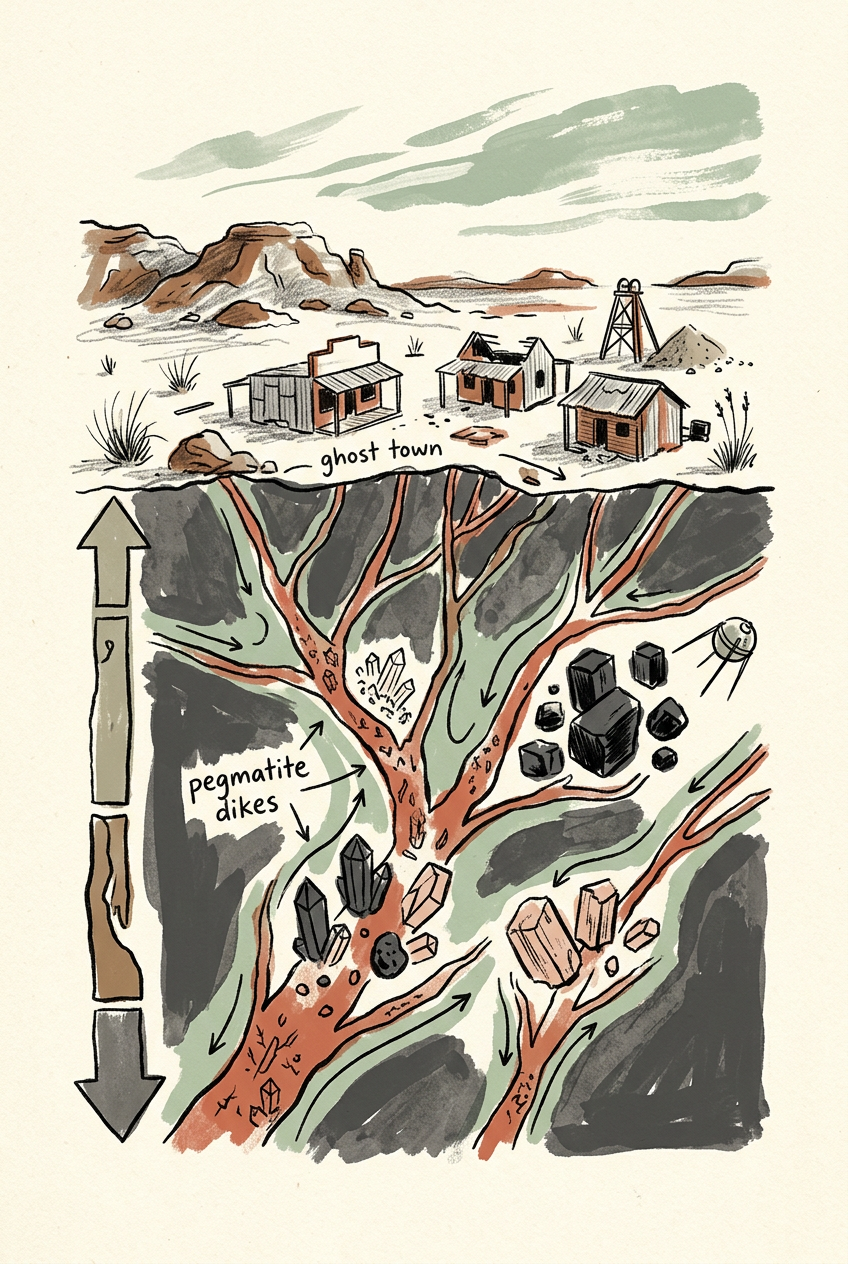
The story begins in the Paleoproterozoic, 1.9 billion years ago, when a series of volcanic eruptions in what is now the Pilbara Craton left behind not lava flows but something stranger: pegmatites. These are coarse-grained igneous rocks that form when the last, water-rich fraction of magma cools slowly underground, concentrating rare elements that don't fit into common minerals.
In the Wodgina district, a single pegmatite body stretches for nearly two kilometres. It is one of the most chemically evolved granitic melts ever recorded—so enriched in incompatible elements that it crystallised spodumene (a lithium mineral), pollucite (a cesium mineral), and the tantalum-bearing mineral tantalite. The magma had to be unusually viscous and water-saturated to hold these elements without losing them to earlier crystallising phases.
Geologists call these LCT pegmatites—lithium-cesium-tantalum. They are the rarest of all pegmatite types, and Wodgina is their global type locality.
The Metal That Left No Trace
Tantalum is a paradox. It resists corrosion better than platinum, withstands temperatures above 3,000°C, and can hold an electrostatic charge with remarkable stability. Yet it is virtually invisible in the Earth's crust—its average abundance is just 1 part per million, roughly the same as uranium. To form a deposit, natural processes must concentrate it by a factor of several hundred.
At Wodgina, the concentration happened through a process called fractional crystallisation. As the parent magma cooled, common minerals like feldspar and quartz crystallised first, pulling silicon and aluminium out of the melt while leaving tantalum, lithium, and cesium behind. The remaining fluid became progressively more exotic, eventually saturating with minerals that are rare anywhere else on Earth.
The result: a pegmatite containing up to 0.04% tantalum oxide—not rich by most mining standards, but enough to make Wodgina the world's largest known tantalum resource.
The Town That Lived on a Chip
For decades, Wodgina was barely a name on a map. Then, in the 1960s, the Apollo program needed tantalum capacitors for its guidance computers—components that could survive the vibration of launch and the vacuum of space. The mine opened in 1967, and a town of several hundred people appeared in the red dust.
Wodgina's residents called it "the chip"—a reference to the tantalum capacitor chips that paid for everything. The town had a school, a shop, a swimming pool, and a dirt airstrip that received weekly flights from Port Hedland. Miners blasted the pegmatite out of open pits, crushed it, and separated the dense black tantalite grains using gravity and magnetic separators.
But tantalum is a niche metal. When the Cold War ended and electronics miniaturised, demand shifted to smaller, cheaper capacitors. Wodgina closed in 2008. The town was dismantled and the site rehabilitated. Now only the pits remain, slowly filling with rainwater in the Pilbara heat.
The pegmatite is still there—1.9 billion years old, rich in rare metals, waiting for a future that may need it again.
The Ghost in the Ground
In 2018, a Canadian company reopened Wodgina, this time targeting lithium rather than tantalum. The same pegmatite that holds the world's largest tantalum resource also holds one of the largest hard-rock lithium deposits. But the lithium market is volatile, and the mine has cycled through care and maintenance multiple times since.
The pegmatite itself is indifferent to these fortunes. It remains what it has always been: a 1.9-billion-year-old snapshot of the last gasp of a volcano, when the magma was so evolved that it could no longer make common rock. Instead, it made something rare, valuable, and strange—a deposit so unusual that geologists still use Wodgina as the textbook example of what happens when a magma chamber refuses to mix and instead concentrates the rarest elements in the crust.
More like this
- The 5,000-Year-Old Volcanoes That Still Smoke in the SouthIn Victoria's Newer Volcanics Province, 400 volcanic vents erupted as recently as 5,000 years ago—the youngest volcanic field in mainland Australia, where craters still hold blue lakes and scoria cone
- The 300-Million-Year-Old Forest That Died Standing UpIn New South Wales, a 300-million-year-old fossil forest preserves dozens of trees buried upright by a Permian volcanic eruption—an entire ecosystem frozen in ash.
- The 1.85-Billion-Year-Old Caldera That Still Feeds the FurnaceIn South Australia's Middleback Ranges, a 1.85-billion-year-old volcanic caldera collapsed and later became one of the world's richest iron ore deposits.