24 June 2026 · 3 min read
The 290-Million-Year-Old Cliff of Rust: Tasmania's Permian Red Beds
Tasmania's Permian red beds record the only known time a continent drifted over the South Pole while surrounded by ice, preserving fossilised polar seafloors and glacial dropstones in rust-stained roc
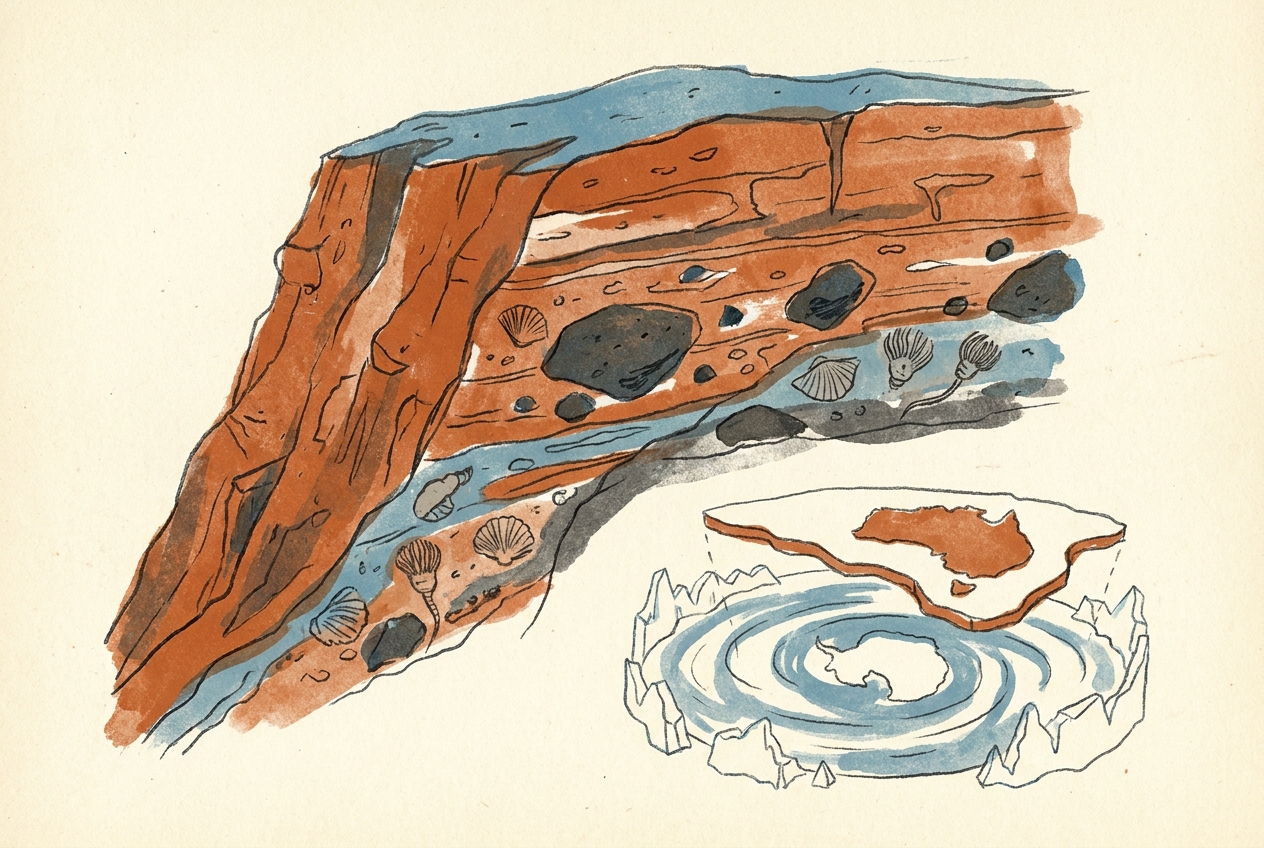
On a windswept headland in southern Tasmania, the sea has cut a natural section through a 290-million-year-old seabed. The rock is not grey or brown but deep crimson, blotched with white, as if the cliff itself had bled and scarred. This is the Tasmanian Permian red beds—a sequence of sedimentary rock that records the only known time in Earth's history when a continent drifted over the South Pole while surrounded by ice.
The View from the Pole
During the Permian Period, between about 300 and 250 million years ago, Tasmania sat at roughly 80° south latitude—closer to the pole than Antarctica sits today. The continent of Gondwana had assembled, and what is now Tasmania was pinned against the margin of East Antarctica, buried under ice sheets kilometres thick.
The red beds formed in the brief interglacial intervals. When the ice retreated, meltwater rivers carried ground-down rock flour into shallow basins. The sediment was rich in iron minerals scraped from the underlying dolerite and quartzite. Once exposed to air, the iron oxidised—rusted—turning the muds and sands blood-red.
The colour is not pigment added later. It is the original stain of a polar atmosphere, locked in rock for a quarter of a billion years.
Each red layer is a warm spell. Each grey or green layer between them is a return of ice. The cliff face is a pulse chart of Permian climate, written in iron.
A Fossilised Polar Sea
Near the town of Cygnet, about 40 kilometres southwest of Hobart, the red beds contain something rarer than colour: fossils. The shallow seas that occasionally flooded the basin hosted a peculiar fauna adapted to cold, dark water. Brachiopods with thick shells. Slow-growing bryozoans. The occasional starfish arm.
But the most remarkable fossils are the glacial dropstones. These are pebbles and boulders that calved from ice shelves and fell into the soft mud below, punching through the layers like a stone dropped into wet cement. In the red beds at Adventure Bay on Bruny Island, dropstones the size of human heads sit suspended in fine siltstone, the sediment layers bending around them. Each one marks the passage of an iceberg.
Palaeontologists have also found the tracks of tetrapods—four-legged vertebrates—in the red beds near the town of Newtown. These are among the oldest evidence of land animals in Australia, left by creatures that crossed the muddy flats during one of the warm intervals. They had no idea they were walking on the floor of a polar sea.
The Rust That Remains
What makes the Tasmanian Permian red beds geologically significant is that they are not just sedimentary—they are a chemical archive. The iron oxide that colours them is hematite, the same mineral that gives Mars its rusty hue. Hematite forms under oxidising conditions, which at the Permian South Pole meant one thing: the ice retreated far enough that the sediment surface was exposed to air for centuries or millennia at a stretch.
Geochemists have measured the oxygen isotope ratios in the red beds to estimate water temperatures. The numbers suggest summer seawater temperatures of around 5–10 °C—cold by modern standards, but astonishingly warm for a continent sitting at 80° south. This was a polar region with seasons, with meltwater, with life. The red beds prove that even at the height of an ice age, the edges of the ice sheet were dynamic, breathing in and out with the rhythm of the planet's orbit.
A Cliff That Keeps Secrets
The red beds are best exposed at a place called Pirates Bay, near the Tasman Peninsula, where the sea has carved a series of sea caves and arches into the coloured strata. The contrast is stark: black dolerite columns from the Jurassic frame the red and white bands of Permian sediment. Tourists come for the rock formations—the Tessellated Pavement, the Blowhole—but the real story is in the colour.
Inland, the red beds are less visible, buried under younger basalt and soil. But wherever they emerge, they tell the same story: a continent parked at the bottom of the world, its shores lapped by icebergs, its muds rusting under a pale polar sun. The Tasmanian red beds are not a dramatic mountain range or a glittering gemfield. They are a quiet cliff of rust, and they hold the memory of the coldest Australia has ever been.
More like this
- The 560-Million-Year-Old Garden That Never Saw a PredatorIn South Australia's Flinders Ranges, 560-million-year-old Ediacara surfaces preserve entire seafloor communities of fronds, discs, and quilts — a garden of soft-bodied life that flourished before pre
- The 300-Million-Year-Old Forest That Died Standing UpIn New South Wales, a 300-million-year-old fossil forest preserves dozens of trees buried upright by a Permian volcanic eruption—an entire ecosystem frozen in ash.
- The 1.75-Billion-Year-Old Reef That Outranks the BarrierA 1.75-billion-year-old microbial reef in the Kimberley is the largest biological structure ever built by a single species, preserving a world without predators.