26 June 2026 · 3 min read
The 1.6-Billion-Year-Old Slime That Leaked Gold
How 1.6-billion-year-old microbial mats in Australia's Pine Creek Geosyncline concentrated uranium into the world's richest deposit—metal refined by living slime.
In the Northern Territory, 250 kilometres south-east of Darwin, a slab of 1.6-billion-year-old mudstone holds more uranium than any rock on Earth. The Ranger deposit did not form in a violent volcanic explosion or a deep hydrothermal vent. It was built by something far quieter: a film of living slime that pulled dissolved metal from ancient river water, atom by atom.
The Basin That Caught a Continent's Weathering
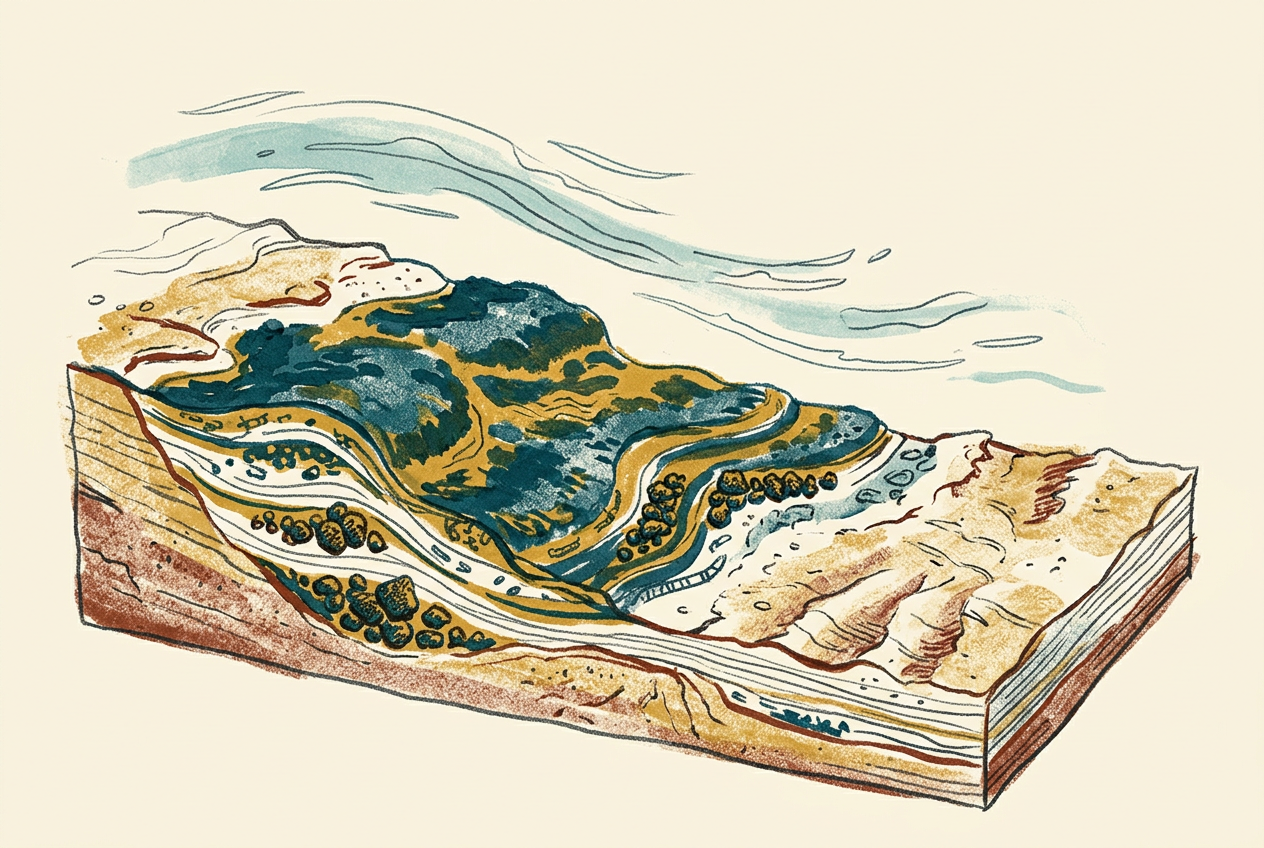
The Pine Creek Geosyncline was once a shallow marine basin fringing an Archaean continent. Rivers draining the granites and volcanic rocks of what is now the Top End carried uranium leached from those ancient crustal rocks into the quiet, sediment-starved basin. The uranium did not precipitate straight away. It stayed dissolved in the water column, invisible, until it met something that could trap it.
That something was a microbial mat. Across the floor of the basin, layered communities of cyanobacteria and other microbes grew as sticky, organic films. These mats acted like chemical sponges. Uranyl ions—the soluble form of uranium—bonded readily to the organic matter, pulled out of solution and concentrated into the sediment.
The Living Filter
The process was not fast. For millions of years, the mats grew, died, and were buried, each new generation adding another layer of organic-rich mud. The uranium accumulated slowly, grain by grain, bound to decaying cell walls and the sulphides that the microbes produced. By the time the basin was filled, the sediment held uranium at concentrations hundreds of times higher than average crustal rock.
A living reef of slime, no thicker than a coin, had done what volcanoes and hot springs could not.
Then the basin was buried. Heat and pressure transformed the organic-rich mud into shale. The uranium, now locked in the rock, began to migrate again as hot fluids circulated through the buried sediment. But the organic ghosts of the microbial mats remained as chemical traps. Where the uranium-rich fluids encountered zones of carbonaceous shale—the fossilised remains of those ancient mats—the metal precipitated out as uraninite, forming the high-grade ore bodies that would be mined decades later.
The Mine That Came From a Mat
Ranger Mine, which operated from 1981 to 2021, produced more than 100,000 tonnes of uranium oxide. The richest ore grades exceeded 0.3 percent uranium—extraordinary for a deposit that formed not from hydrothermal veins but from sedimentary concentration. The ore bodies were lens-shaped, following the original layers of the ancient basin floor, still tracing the geometry of those long-vanished microbial communities.
The deposit sits within the Alligator Rivers region, a name that hints at the wet tropics that now cover the Proterozoic rocks. The uranium is hosted in the Cahill Formation, a sequence of metamorphosed sediments that still preserves the carbonaceous bands that mark where the mats grew. Even after 1.6 billion years of burial, heating, and deformation, the chemical signature of microbial life remained the primary control on where the uranium settled.
The Invisible Architecture
What makes the Pine Creek deposits remarkable is not just their grade but their origin. Most of the world's uranium comes from sandstone-hosted deposits formed by groundwater flow, or from unconformity-related deposits where fluids moved along geological boundaries. The Ranger ore bodies are different. They are essentially fossilised chemical traps—the remains of a biological filtration system that operated on a continental scale.
The microbes that built the deposit left no obvious fossils. No stromatolite domes, no trace fossils, no preserved cells. Their only legacy is the metal they captured. The uranium that powered nuclear reactors and sparked decades of political debate in Australia began as dissolved ions drifting through a Proterozoic sea, caught by a film of slime that stretched across an ancient basin floor.
In the end, the richest uranium deposit on Earth was not forged in fire or squeezed from deep magma. It was secreted, slowly, by the quiet metabolism of living things.
More like this
- The 560-Million-Year-Old Garden That Never Saw a PredatorIn South Australia's Flinders Ranges, 560-million-year-old Ediacara surfaces preserve entire seafloor communities of fronds, discs, and quilts — a garden of soft-bodied life that flourished before pre
- The 1.75-Billion-Year-Old Reef That Outranks the BarrierA 1.75-billion-year-old microbial reef in the Kimberley is the largest biological structure ever built by a single species, preserving a world without predators.
- The 3.5-Billion-Year-Old Cones That Still Catch LightIn the Pilbara's Dresser Formation, 3.5-billion-year-old stromatolites preserve the oldest direct evidence of life on Earth—microbial mats that built layered domes in a volcanic caldera.