8 July 2026 · 2 min read
The 545-Million-Year-Old Burst That Left a Cliff of Glass
In South Australia's Flinders Ranges, 545-million-year-old volcanic ash beds preserve the Cambrian explosion in exquisite detail—a sudden eruption that buried a shallow seafloor and its emergent anima
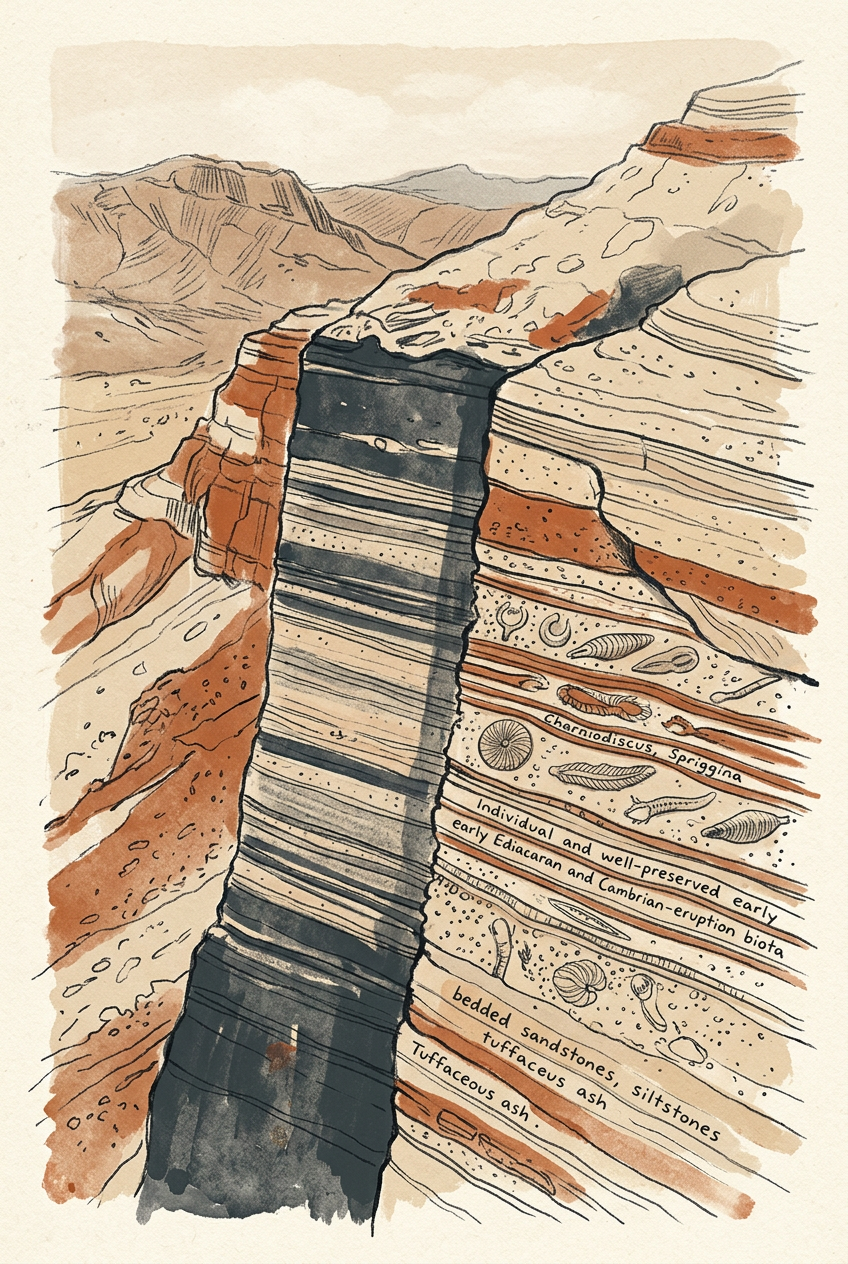
On a hillside in the Flinders Ranges, a layer of pale rock no thicker than a hand splits the red earth like a wound that will not heal. It is a 545-million-year-old volcanic ashfall, and beneath it lies one of the most abrupt transitions in the history of life.
The Ash That Froze a Seafloor
The Ediacaran Period ended with a shallow sea covering much of what is now South Australia. Microbial mats coated the seabed in leathery sheets. Strange, quilted organisms — fronds, discs, and tubes — lay pinned to the sediment, feeding on organic films. Then a volcano erupted somewhere to the east.
The ash fell in a single event, perhaps days or weeks long. It blanketed hundreds of square kilometres of seafloor in fine-grained volcanic glass, smothering the Ediacaran community where it lived. What makes the deposit precious is what came next: the ash hardened into a tuff, sealing the underlying surface like a lid. Above it, a radically different world appears.
In the Pound Subgroup of the Flinders Ranges, the boundary between the Ediacaran and Cambrian periods is marked by this ash bed — the Uratanna Formation. Below it, the last of the soft-bodied Ediacaran biota. Above it, the first burrows, shells, and skeletons of the Cambrian explosion.
A Moment Caught in Mineral
The ash itself is a time capsule. Its zircon crystals have been dated to 545 million years, giving one of the most precise constraints on the Ediacaran–Cambrian boundary anywhere on Earth. But the ash did more than provide a date: it preserved the seafloor in three dimensions.
Below the tuff, Ediacaran fossils lie flat on bedding planes, as they always do. Above it, the trace fossil Treptichnus pedum appears — the first complex burrowing trace, a zigzag of tunnels that marks the beginning of the Cambrian. The contrast is stark. In a geological instant, life went from passive to penetrative. The ashfall is the curtain between two acts.
Nearby, at the base of the Cambrian, the first biomineralising animals appear: tiny tubes and cones of calcium carbonate, the forerunners of shells. They occur in sediments laid down just after the ash. The volcanic glass that killed one world preserved the birth of the next.
The ashfall buried a seafloor that still belonged to the Precambrian, and the rock above it already belonged to the Phanerozoic — the age of visible life.
The Glass That Still Speaks
The Uratanna ash is not the only volcanic marker in the Flinders Ranges, but it is the most consequential. Similar ash beds appear at other Ediacaran–Cambrian boundaries around the world — in Namibia, Siberia, and Newfoundland — but the South Australian exposure is among the best preserved.
The ash itself has altered over half a billion years. The original glass shards have recrystallised into clay minerals, but their shapes remain. Under a microscope, the outlines of bubble-wall fragments and shard splinters are still visible — the ghost of an eruption that ended an era.
The Flinders Ranges today are arid, folded, and weathered. But the Uratanna ash bed cuts across the landscape as a pale stripe, tracing the moment a volcano reset the rules of life.
More like this
- The 5,000-Year-Old Volcanoes That Still Smoke in the SouthIn Victoria's Newer Volcanics Province, 400 volcanic vents erupted as recently as 5,000 years ago—the youngest volcanic field in mainland Australia, where craters still hold blue lakes and scoria cone
- The 560-Million-Year-Old Garden That Never Saw a PredatorIn South Australia's Flinders Ranges, 560-million-year-old Ediacara surfaces preserve entire seafloor communities of fronds, discs, and quilts — a garden of soft-bodied life that flourished before pre
- The 300-Million-Year-Old Forest That Died Standing UpIn New South Wales, a 300-million-year-old fossil forest preserves dozens of trees buried upright by a Permian volcanic eruption—an entire ecosystem frozen in ash.