25 June 2026 · 3 min read
The 1.7-Billion-Year-Old Lava That Froze a Lake of Gold
How 1.7-billion-year-old volcanic eruptions in Western Australia's Duketon greenstone belt created a gold deposit where metal concentrated in a caldera lake, preserved by ancient weathering
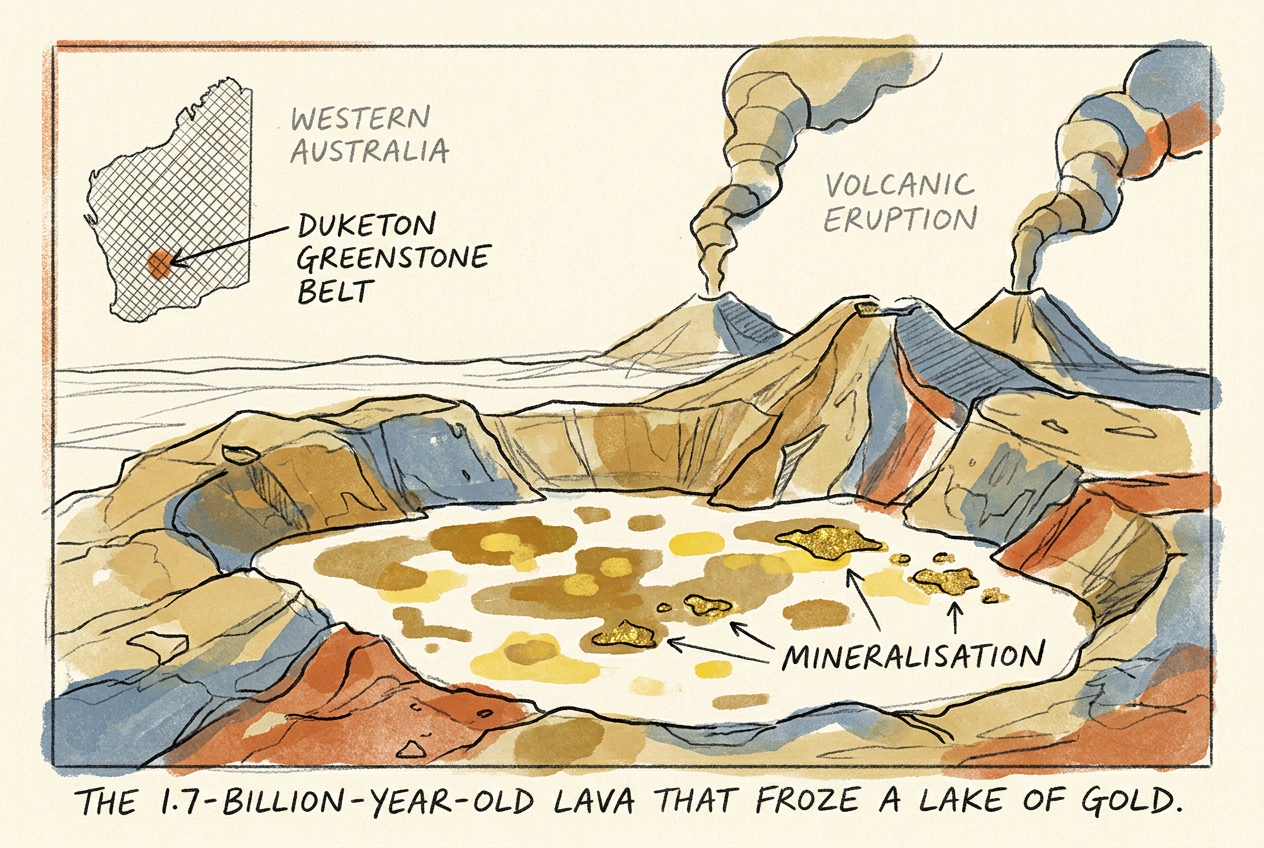
Ten kilometres above Western Australia's Duketon greenstone belt, the landscape is flat—red dirt, spinifex, a horizon that barely trembles. But two kilometres below, a 1.7-billion-year-old volcanic lake holds one of the richest gold deposits on Earth, its metal concentrated not by rivers or magma but by the slow chemistry of an ancient crater lake.
The Caldera That Became a Chemical Trap
Somewhere between 1.72 and 1.68 billion years ago, a series of volcanic eruptions in the eastern Yilgarn Craton collapsed inward, forming a caldera roughly 15 kilometres across. The crater filled with water, creating a lake that sat above still-hot volcanic rock. Hydrothermal fluids—hot, acidic, metal-rich—rose through fractures in the caldera floor and hit the lake water. The sudden change in temperature and chemistry forced the dissolved gold to precipitate out, settling into the porous volcanic sediments at the bottom.
This is unusual. Most gold deposits form in quartz veins or along fault zones, where hot fluids cool and deposit metal in cracks in the rock. The Duketon deposit—known as the Rosemont deposit—formed in a lake. The gold is not in veins but disseminated through layers of volcaniclastic sandstone and conglomerate, the cemented debris of the ancient caldera walls. It is a fossilised chemical reaction.
The gold did not arrive in a rush of molten rock. It fell from solution, grain by grain, into the still water of a dying volcano.
Weathering That Made the Deposit Minable
The story did not end when the lake dried. For the next 1.6 billion years, the Duketon greenstone belt was buried, compressed, and gently metamorphosed. Then, in the past 100 million years, the Australian continent began to erode. The overlying rock was stripped away, and the ancient caldera sediments were exposed to weathering.
Modern weathering in Western Australia's arid climate is not gentle. Groundwater percolates through the rock, oxidising sulphides and mobilising metals. At Duketon, this process did something useful: it dissolved the fine-grained gold from the weathered zone and redeposited it lower down, in the transition between oxidised and fresh rock. This created a supergene enrichment blanket—a layer where the gold grade is two to three times higher than in the unweathered rock below.
The effect is practical. The deposit can be mined from the surface, without tunnels or shafts. The gold is free-milling, meaning it does not need complex processing to separate it from the surrounding minerals. All of this—the ancient caldera, the lake chemistry, the billion-year wait, the recent weathering—conspired to make a deposit that is both rich and cheap to extract.
What the Lake Sediments Reveal
The volcaniclastic rocks at Duketon preserve more than gold. They record a specific kind of volcanic environment—a subaqueous caldera—that is rare in the Archaean and Proterozoic rock record. The bedding structures show that the lake was deep enough to prevent wave action, and the chemistry of the sediments indicates that the water was acidic, likely from volcanic gases bubbling through the lake floor.
This has implications beyond mining. The Duketon caldera is one of the best-preserved ancient volcanic lake systems on Earth. It offers a window into how Proterozoic volcanoes behaved, how their craters filled, and how metal-rich fluids circulated through the crust 1.7 billion years ago. The gold is just the marker; the real story is the plumbing.
The Scale of What Remains
The Rosemont deposit holds an estimated 3.6 million ounces of gold. That is modest by global standards—a fraction of what lies in the Witwatersrand Basin or the Carlin Trend—but it is remarkable for its geology. Most gold deposits of this age have been recycled by plate tectonics, metamorphosed beyond recognition, or eroded away entirely. The Duketon caldera survived because it sat in a stable part of the Yilgarn Craton, a chunk of continental crust that has not moved much in two billion years.
Australia is full of these survivors: ancient landscapes that have sat quietly while other continents were crushed, folded, and reborn. The gold at Duketon is not the richest or the deepest or the oldest. But it is a reminder that sometimes the most valuable deposits are the ones that simply waited.
More like this
- The 5,000-Year-Old Volcanoes That Still Smoke in the SouthIn Victoria's Newer Volcanics Province, 400 volcanic vents erupted as recently as 5,000 years ago—the youngest volcanic field in mainland Australia, where craters still hold blue lakes and scoria cone
- The 300-Million-Year-Old Forest That Died Standing UpIn New South Wales, a 300-million-year-old fossil forest preserves dozens of trees buried upright by a Permian volcanic eruption—an entire ecosystem frozen in ash.
- The 1.85-Billion-Year-Old Caldera That Still Feeds the FurnaceIn South Australia's Middleback Ranges, a 1.85-billion-year-old volcanic caldera collapsed and later became one of the world's richest iron ore deposits.