12 May 2026 · 3 min read
The Lava That Became a Reef: The Undara Volcano's 164-Kilometre Flow
In Queensland's outback, a 190,000-year-old volcano produced one of Earth's longest lava tubes, where molten rock flowed 164 kilometres through insulated tunnels now collapsed into a chain of vine-fil
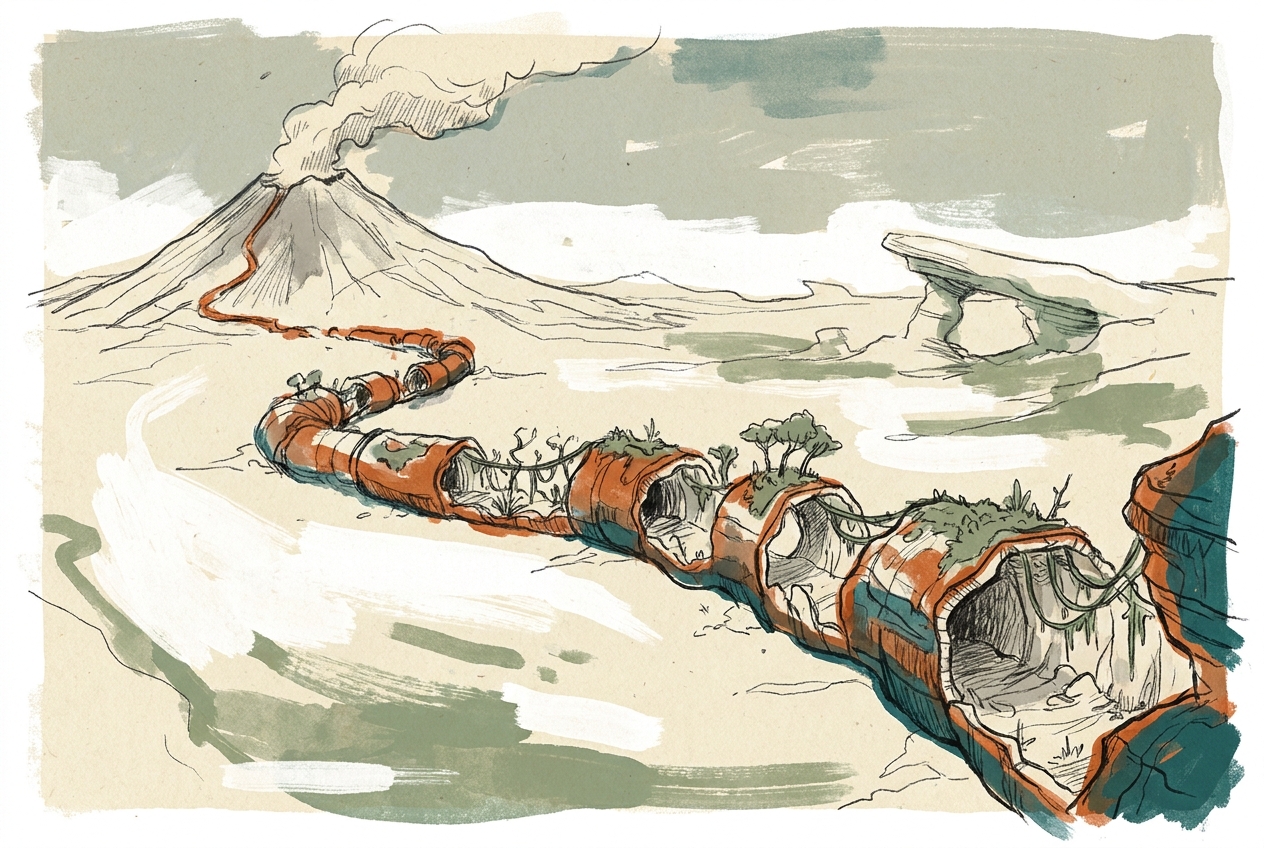
The Undara Volcano did not explode. It opened a wound in the earth and bled for months, releasing a flood of basalt so fluid that it travelled 164 kilometres across northern Queensland before finally cooling. That lava flow — one of the longest ever recorded on Earth — left behind a landscape that still looks like a wound.
The Eruption That Ran
Around 190,000 years ago, a vent near what is now Undara Volcanic National Park erupted tholeiitic basalt at temperatures exceeding 1,100 °C. The lava was unusually low in silica, which made it runny — far runnier than the sticky rhyolite that builds steep stratovolcanoes. It poured across the McBride Volcanic Province at speeds that probably reached several kilometres per hour, following ancient drainage channels toward the Gulf of Carpentaria.
As the flow surface cooled and crusted over, the molten interior stayed hot and mobile. This is the crucial trick of lava tubes: the solid crust acts as a pipe, insulating the liquid rock so it can travel vast distances without freezing. Undara's tube system became one of the most extensive on the planet, a subterranean river of basalt that ran for weeks or months.
When the eruption ceased, the tubes drained. What remained were hollow tunnels, some more than ten metres in diameter, snaking beneath the black soil plains.
The Collapsed Roof
Over thousands of years, sections of the tube roofs caved in. The result is a chain of depressions — known as "kīpuka" in Hawaiian terminology — that punctuate the landscape like a string of beads. Walking the Undara trail, you step from open savannah into sudden, lush amphitheatres where fig trees and palms grow from the rubble of collapsed basalt. The contrast is jarring: dry eucalypt woodland above, a pocket of rainforest below.
The longest intact section of the tube, known as the Barker's Cave complex, runs for more than a kilometre without a break in its roof. Inside, the walls show flow marks — striations left by the last pulses of lava, frozen in place. The floor is littered with breakdown blocks: slabs of roof that fell after the tube emptied.
The tube is not a cave in the usual sense. It is a vein. The volcano's heart stopped, but the shape of its pulse remains.
A Different Kind of Volcano
Undara belongs to a class of eruptions that geologists call "Hawaiian-style" — not because of any tectonic link to the Pacific, but because the behaviour mirrors the shield volcanoes of Hawaii. The same low-silica basalt, the same fluid flows, the same tube-fed transport. Yet Undara sits in a continental setting, far from any hot spot, on the stable interior of the Australian plate.
The McBride Volcanic Province contains more than 160 volcanic vents, most much younger than Undara. The youngest eruptions here may be only 7,000 years old — a blink in geological time. The region is still considered potentially active, though no eruption has occurred in recorded history.
What makes Undara remarkable is not its size — the volcano itself is barely a bump on the horizon — but the efficiency of its plumbing. The lava tube network allowed a modest volume of magma to travel an extraordinary distance, covering an area of more than 1,500 square kilometres with a thin sheet of basalt.
The Living Tubes
Today the collapsed tubes host a peculiar ecosystem. The sunken craters trap moisture and shade, creating microclimates that support species normally found hundreds of kilometres to the east, in the wet tropics. The tubes themselves shelter bats — including the rare ghost bat — and invertebrates adapted to permanent darkness.
The basalt weathers slowly in the dry climate. The flow surface is still rough, still black, still littered with the clinkery fragments geologists call 'āā. In places, the original flow features — pressure ridges, tumuli, and squeeze-ups — survive almost intact, as if the eruption ended last season rather than 190 millennia ago.
Undara is a reminder that volcanoes do not need to be violent to be dramatic. The quiet ones, the ones that simply open and pour, can leave marks just as permanent — and far more elegant.
More like this
- The 110-Million-Year-Old River That Runs Backwards UndergroundWestern Australia's 110-million-year-old dune system has been slowly dissolving into a labyrinth of caves where an ancient river still flows, carrying the taste of a Cretaceous desert.
- The 5,000-Year-Old Volcanoes That Still Smoke in the SouthIn Victoria's Newer Volcanics Province, 400 volcanic vents erupted as recently as 5,000 years ago—the youngest volcanic field in mainland Australia, where craters still hold blue lakes and scoria cone
- The 300-Million-Year-Old Forest That Died Standing UpIn New South Wales, a 300-million-year-old fossil forest preserves dozens of trees buried upright by a Permian volcanic eruption—an entire ecosystem frozen in ash.