15 May 2026 · 3 min read
The Nickel That Grew in a Meteorite: Western Australia's Burek Deposit
At Burek in Western Australia's Yilgarn Craton, a 2.7-billion-year-old meteorite impact created a unique nickel deposit where extraterrestrial metal mingled with ancient crust beneath a vanished lake.
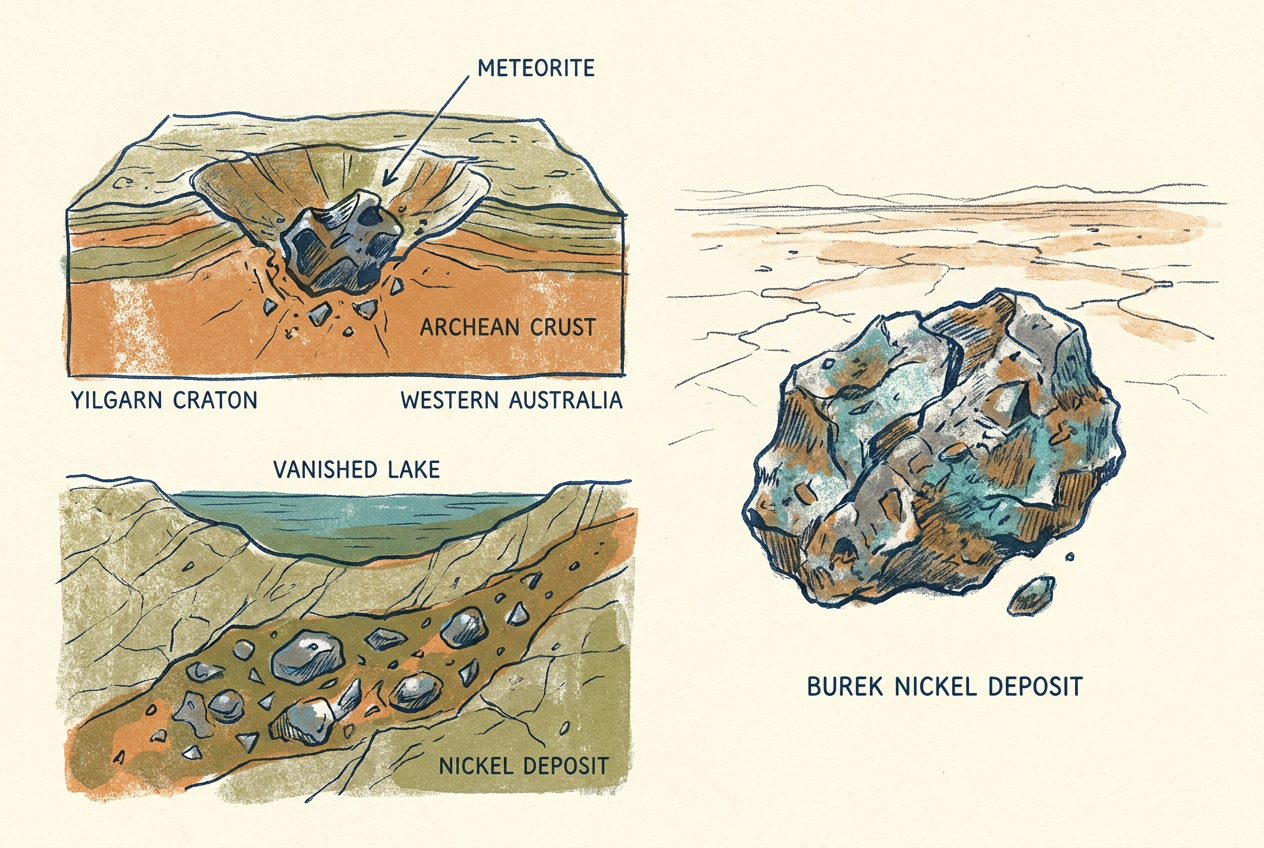
At Burek, in the red heart of Western Australia's Yilgarn Craton, nickel ore did not rise from the mantle through volcanic plumbing. It fell from the sky, and then it grew.
The Burek nickel deposit, 80 kilometres north-west of Leonora, is one of the strangest mineral bodies on Earth. Unlike most nickel sulphide deposits, which form when magma cools and separates into layers deep underground, Burek's nickel came from a meteorite. Not a small one—a stony-iron body perhaps a kilometre across that struck the ancient Australian crust 2.7 billion years ago, when the continent was still assembling from volcanic arcs and microcontinents.
The Impact That Melted the Crust
The impact did not leave a visible crater. Too much time has passed, too much erosion, too many tectonic shuffles. But the evidence survives in the rock itself. At Burek, drill cores reveal a breccia—a jumbled chaos of shattered fragments, some the size of houses, fused together by heat and pressure. Within this breccia, geologists have found grains of nickel-iron alloy that match the composition of certain meteorite groups. The impact vaporised part of the incoming body, and the vapour condensed into droplets that settled into the fractured crust below.
What makes Burek remarkable is what happened next. The impact created a depression that became a lake. For millions of years, the lake acted as a chemical reactor. Nickel leached from the surrounding impact breccia, concentrated by weathering and groundwater, and precipitated as a secondary ore body richer than the original meteorite itself.
The ore at Burek is not just meteoritic. It is meteoritic metal that was refined by the slow alchemy of a lake that no longer exists.
A Billion-Year Weathering Cycle
The Yilgarn Craton, which makes up the ancient core of Western Australia, is one of the most stable pieces of continental crust on Earth. It has not been deformed or buried for over a billion years. That stability allowed the Burek impact structure to weather slowly, its nickel migrating downward through the rock column over hundreds of millions of years.
Today, the deposit contains an estimated 190,000 tonnes of nickel metal, much of it in the form of garnierite—a bright green nickel-magnesium silicate that forms in weathered ultramafic rocks. The green veins run through the impact breccia like moss through rubble. Miners have worked the deposit intermittently since the 1970s, but its small size and remote location have kept it from becoming a major operation.
What the Nickel Tells Us
The Burek deposit is a reminder that not all ore bodies form through the slow churning of plate tectonics. Some arrive ready-made from elsewhere in the solar system. The meteorite that struck the Yilgarn Craton was probably a piece of a differentiated asteroid—one that had already separated into a metallic core and a stony mantle, much like Earth itself. When it hit, it delivered a sample of that core directly into the Australian crust.
Similar impact-related deposits exist elsewhere—the Sudbury Basin in Canada is the most famous—but Burek is older, smaller, and stranger. It formed in a single event, not a series of volcanic pulses. It sat undisturbed while the rest of the continent drifted, rifted, and collided around it.
The nickel mined at Burek today was forged in the heart of a planetesimal that formed before Earth's own core had fully solidified. It crossed the void, struck a young continent, and then spent billions of years being slowly concentrated by rainwater and time. In the green veins of that ancient impact breccia, we touch something that began its journey beyond the orbit of Mars.
More like this
- The 790,000-Year-Old Scar That Still Holds ShrapnelOn the Nullarbor Plain, a 790,000-year-old meteorite left a 24-metre-wide crater that preserves fragments of the iron projectile itself—a rare survival among Earth's impact structures.
- The 580-Million-Year-Old Scar That Reset EvolutionA 580-million-year-old impact crater in South Australia's Gawler Ranges may have reset the course of Ediacaran evolution, its ejecta layer preserved in Flinders Ranges sediments.
- The 550-Million-Year-Old Seafloor That Turned to DiamondHow a 550-million-year-old meteorite impact in South Australia created Australia's only known diamond-bearing impact rock—shocked graphite from the Ediacaran seafloor