15 May 2026 · 3 min read
The Sand That Became a Mountain: Tasmania's Quartzite Peak
On Tasmania's Cradle Mountain, 500-million-year-old quartzite—once beach sand—records a vanished ocean and the tectonic forces that raised it a kilometre high.
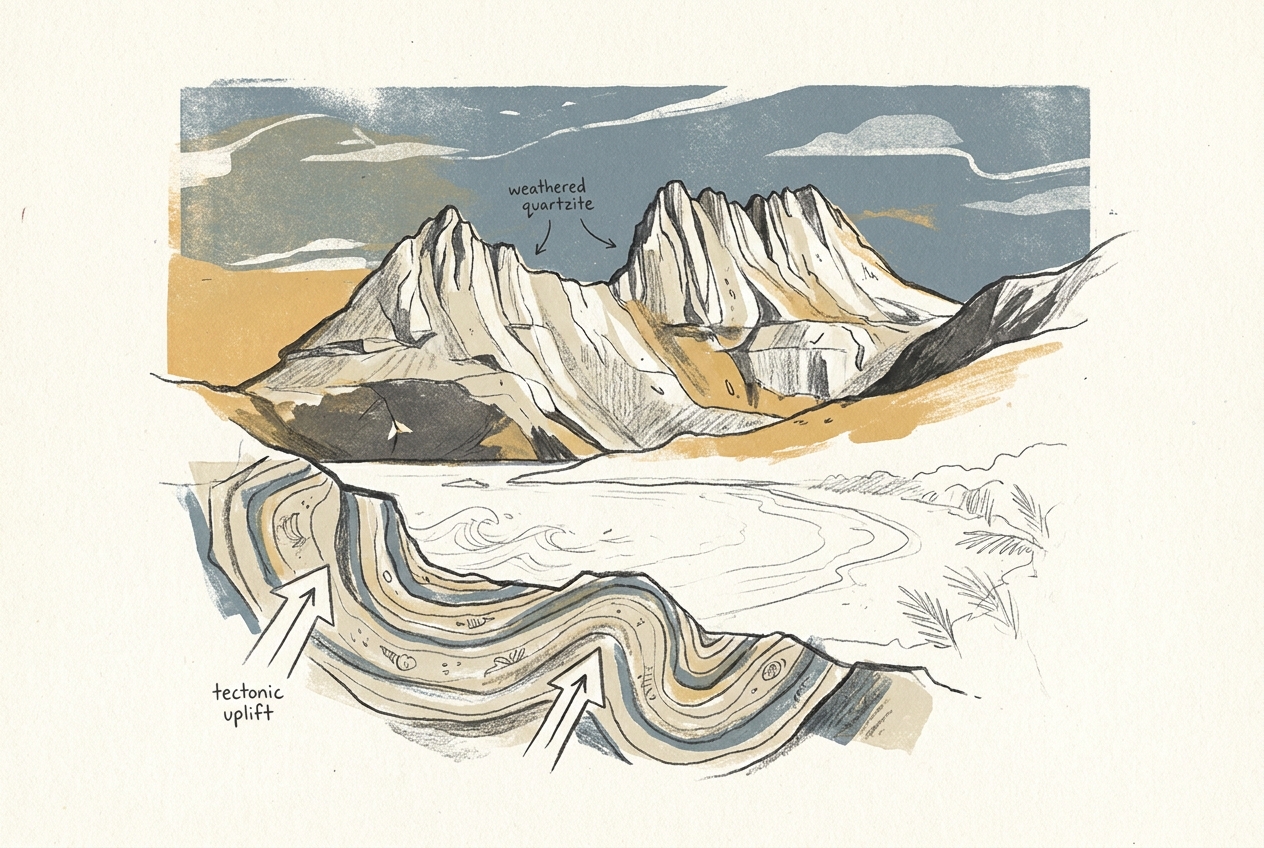
The summit of Cradle Mountain is made of sand—sand that fell through seawater half a billion years ago, was buried, crushed, welded into quartzite, then lifted a kilometre into the Tasmanian sky. The rock feels like glass underfoot.
The Sand That Waited
In the early Cambrian period, around 510 million years ago, the landmass that would become eastern Tasmania was a passive continental margin—a long, shallow shelf where rivers dumped sediment into a quiet sea. For millions of years, layer after layer of quartz sand accumulated on that seafloor, sometimes interrupted by volcanic ash from distant eruptions. The sand was almost pure silica, weathered from granite terrain and carried by ancient rivers whose names are lost.
Geologists call this formation the Tyndall Group. It is part of the Mount Read Volcanics, a belt of Cambrian volcanic and sedimentary rock that runs through western Tasmania. But the quartzite at Cradle Mountain is not volcanic. It is the sedimentary record of a long, uneventful period when the only thing happening was sand settling.
Then the tectonics began.
The Squeeze That Turned Sand to Stone
During the late Cambrian to early Ordovician, the margin of Gondwana began to close. The seafloor that held the sand was compressed, folded, and thrust upward. The quartz grains, rounded by their long journey from some vanished mountain range, were pressed together so tightly that the pore spaces vanished. Silica precipitated between the grains, fusing them into a rock so hard that a hammer rings when struck.
This is quartzite—metamorphic in the strict sense, but barely changed. No new minerals grew. The original sedimentary texture remains visible: cross-bedding from ancient currents, ripple marks from Cambrian tides. The rock is more a memory than a transformation.
The folding was intense. At Cradle Mountain, the quartzite layers were tilted nearly vertical, then eroded into the sharp ridgelines that give the mountain its distinctive profile. The dolerite that caps nearby peaks—the Jurassic magma sheets that dominate Tasmanian geology—is absent here. Cradle Mountain is pure quartzite, a sliver of ancient seafloor standing on edge.
The Ice That Finished the Job
The mountain's jagged form is not the work of tectonics alone. During the Pleistocene glaciations, ice sheets covered much of Tasmania, and Cradle Mountain lay under a small alpine glacier. The ice plucked blocks of quartzite from the ridgeline, widening fractures and steepening the slopes. The result is a classic arête: a knife-edge ridge carved by ice on both sides.
Below the summit, glacial cirques hold tarns—small lakes that fill bedrock basins scoured by ice. The water is startlingly clear, filtered through quartz sand that continues to erode from the mountain today. Walking on the summit, you stand on a surface that has been abraded by ice, weathered by rain, and broken by frost for the past two million years. But the sand grains themselves are half a billion years old.
To hold a piece of Cradle Mountain quartzite is to hold a moment from a world before animals walked on land.
What the Sand Remembers
The quartzite of Cradle Mountain tells a story that is common in geology but startling in its intimacy. The sand was not special. It was ordinary beach sand on an ordinary continental shelf. But it was buried deeply enough, squeezed tightly enough, and lifted high enough to survive as a mountain while the surrounding rock eroded away.
The same formation appears elsewhere in western Tasmania—at Frenchmans Cap, at Mount Murchison, at the Tyndall Range—but nowhere is it more exposed, more readable, than at Cradle Mountain. The rock preserves a Cambrian shoreline that stretched across a vanished ocean, between continents that no longer exist. The sand grains are the only witnesses.
Today, the mountain is a national park, visited by thousands of walkers each year. Most come for the view of Dove Lake and the jagged skyline. Few notice that they are walking on a seabed. But the rock does not mind. It has been waiting a long time to be seen.
More like this
- The 110-Million-Year-Old River That Runs Backwards UndergroundWestern Australia's 110-million-year-old dune system has been slowly dissolving into a labyrinth of caves where an ancient river still flows, carrying the taste of a Cretaceous desert.
- The 5,000-Year-Old Volcanoes That Still Smoke in the SouthIn Victoria's Newer Volcanics Province, 400 volcanic vents erupted as recently as 5,000 years ago—the youngest volcanic field in mainland Australia, where craters still hold blue lakes and scoria cone
- The 560-Million-Year-Old Garden That Never Saw a PredatorIn South Australia's Flinders Ranges, 560-million-year-old Ediacara surfaces preserve entire seafloor communities of fronds, discs, and quilts — a garden of soft-bodied life that flourished before pre