13 May 2026 · 3 min read
The Glass That Fell From the Sky: Darwin Crater's Impactite
In Tasmania's remote rainforest, a 800,000-year-old meteorite impact melted local rock into dark glass, preserving a rare impactite formation.
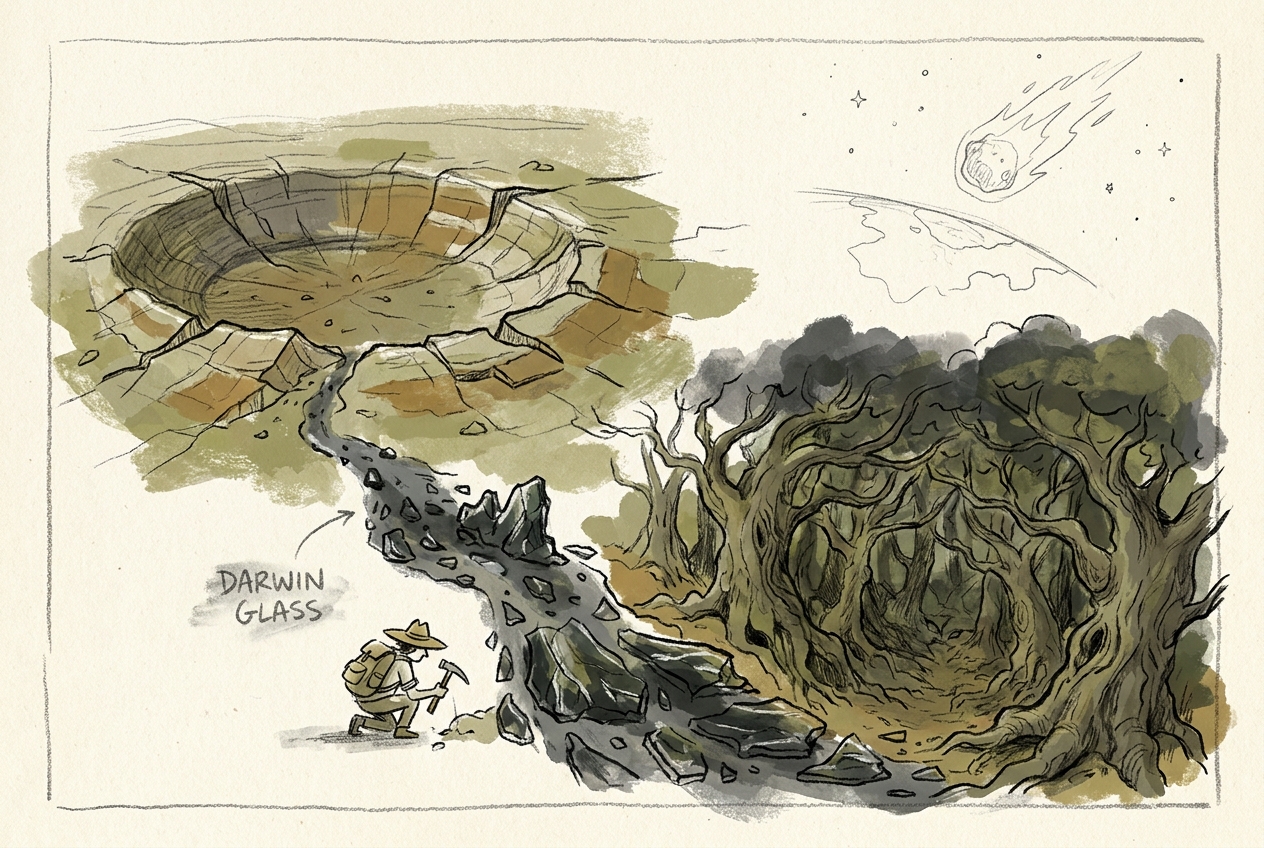
Deep in Tasmania's temperate rainforest, a circular depression 1.2 kilometres wide lies hidden beneath button grass and myrtle beech. It was not made by a volcano, a glacier, or a river. Darwin Crater—named for a nearby mountain, not the naturalist—formed 800,000 years ago when a meteorite slammed into the quartzite bedrock of western Tasmania at hypersonic speed.
The Impact That Made Glass
The crater is young by geological standards, but its surface expression is subtle. Erosion has softened the rim. What gives the site away is not the shape of the ground but what lies scattered across it: thousands of fragments of dark, vesicular glass called Darwin glass.
When the meteorite struck, the kinetic energy released was equivalent to several nuclear warheads. The impact melted a small volume of the local quartzite and ejected the molten material as droplets that cooled and solidified mid-air. These glass fragments—ranging from a few millimetres to fist-sized lumps—landed across an area of roughly 400 square kilometres.
Darwin glass belongs to a rare class of rock called impactite. Unlike volcanic glass, which forms from lava cooling at the surface, impactite is forged by pressures exceeding 10 gigapascals and temperatures hot enough to vaporise rock. The glass is dark green to black, sometimes frothy with bubbles from volatiles that boiled off during the impact.
A single gram of Darwin glass holds the memory of a collision that moved at more than 15 kilometres per second.
The Search for the Crater
The glass was first described in the 1960s, but the source crater took decades to confirm. Early researchers found the glass scattered across the rainforest but no obvious depression. The landscape is thick with vegetation and peat, masking the subtle topography.
It was not until the 1980s that airborne geophysical surveys revealed a circular magnetic anomaly beneath the peat. Drilling confirmed the presence of shocked quartz—mineral grains with microscopic deformation features that can only be produced by impact. The crater had been hiding in plain sight, filled with 70 metres of sediment and swamp.
At 1.2 kilometres in diameter, Darwin Crater is modest compared to Wolfe Creek or Meteor Crater in Arizona. But its value lies in preservation. The wet, acidic environment has kept erosion slow, and the glass remains remarkably fresh.
What the Glass Records
Darwin glass is not uniform. Chemical analysis shows that different fragments have subtly different compositions, reflecting the heterogeneity of the target rock. Some contain traces of the meteorite itself—iron and nickel isotopes that fingerprint the impactor as a chondrite, a primitive stony meteorite.
The glass also preserves a moment in Tasmania's climatic history. The impact occurred during the Pleistocene, when the island was cooler and drier than today. Pollen grains trapped in sediments just above the impact layer show that the surrounding forest was dominated by eucalypts and grasses, not the dense rainforest that now covers the crater.
The glass has another use. Aboriginal people in Tasmania collected Darwin glass and fashioned it into sharp cutting tools. Archaeological sites across western Tasmania contain flakes and cores of the material, carried sometimes hundreds of kilometres from the impact site. The glass was prized for its hardness and conchoidal fracture—properties inherited from its violent origin.
A Landscape Written in Glass
Darwin Crater is one of only a handful of confirmed impact craters in Australia, a continent whose ancient surface has been repeatedly reshaped by erosion. Most craters older than a few hundred thousand years have been erased.
The glass that remains is a durable archive. Unlike the crater itself, which is slowly filling with peat and becoming indistinguishable from the surrounding valley, the glass fragments will persist for millions of years. They are scattered across the forest floor, weathering slowly, waiting for another geologist—or another civilisation—to read their story.
In the quiet of the Tasmanian wilderness, the ground beneath your feet holds the scattered shrapnel of a collision from a time when humans were just beginning to spread across the Earth.
More like this
- The 110-Million-Year-Old River That Runs Backwards UndergroundWestern Australia's 110-million-year-old dune system has been slowly dissolving into a labyrinth of caves where an ancient river still flows, carrying the taste of a Cretaceous desert.
- The 5,000-Year-Old Volcanoes That Still Smoke in the SouthIn Victoria's Newer Volcanics Province, 400 volcanic vents erupted as recently as 5,000 years ago—the youngest volcanic field in mainland Australia, where craters still hold blue lakes and scoria cone
- The 1.75-Billion-Year-Old Reef That Outranks the BarrierA 1.75-billion-year-old microbial reef in the Kimberley is the largest biological structure ever built by a single species, preserving a world without predators.