11 May 2026 · 3 min read
The Nickel That Sank: The Kambalda Komatiite Flows
In Western Australia's Kambalda Dome, 2.7-billion-year-old lava flows—komatiites—carried nickel from the mantle and deposited it in channels that still define the world's richest nickel province.
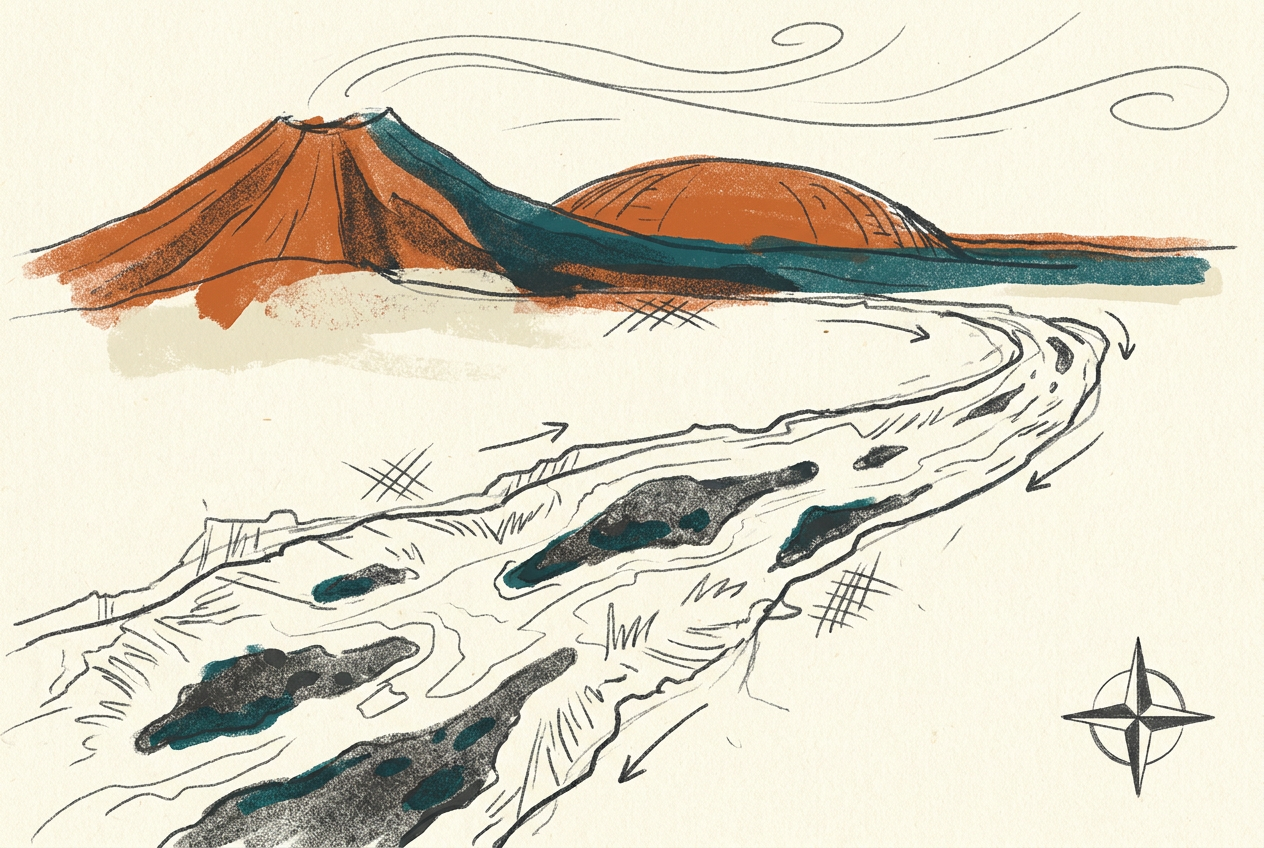
At 1,600 degrees Celsius, the lava that erupted from Archaean fissures near what is now Kambalda, Western Australia, was hotter than any molten rock on Earth today. It flowed like water—thin, fast, incandescent—across a seafloor that did not yet know life beyond microbes. Those flows, called komatiites, carried something precious from deep in the mantle. They carried nickel.
The Hottest Lava
Komatiites are rare. They require a mantle temperature at least 200 degrees hotter than today's, conditions that existed almost exclusively during the Archaean eon, between 3.8 and 2.5 billion years ago. The komatiites of the Kambalda Dome erupted around 2.7 billion years ago, when the Yilgarn Craton was still assembling from volcanic arcs and island chains.
The name comes from the Komati River in South Africa, where these rocks were first described. But the finest exposures are in Western Australia, where the greenish-black lavas—altered now to serpentine and chlorite—outcrop in low ridges among the saltbush and eucalypts.
The extreme temperature meant the lava could dissolve large quantities of sulphur and metal. As it flowed, it incorporated seafloor sediments. The sulphur in those sediments triggered a chemical reaction: the molten rock could no longer hold its load of nickel, and droplets of nickel sulphide began to separate, like oil droplets in water.
The Sinking Drops
Nickel sulphide is dense. The droplets sank through the flowing lava and pooled in topographic lows—ruts, channels, depressions in the Archaean seafloor. Some of these channels were carved by the komatiite itself, the lava eroding the underlying basalt as it surged across the landscape.
The result was a series of concentrated nickel deposits, each one shaped by the local geometry of the flow. A channel might hold a lens of massive sulphide ore, metres thick and hundreds of metres long, flanked by disseminated sulphides in the surrounding komatiite.
Today, the Kambalda Dome hosts more than 50 nickel deposits. Since mining began in 1966, the district has produced over 1.5 million tonnes of nickel metal. The deposits are among the highest-grade nickel sulphide ores in the world.
The lava that built these deposits flowed for only hours, perhaps days. The ore they left has been mined for decades.
The Dome That Preserved Them
The Kambalda Dome is not a volcanic structure but a tectonic one. Compression during the later stages of the Yilgarn Craton's assembly folded the Archaean volcanic sequence into a dome-and-basin pattern. The komatiite flows, originally horizontal, were tilted and folded, then exhumed by erosion over hundreds of millions of years.
The dome's eastern and western limbs both contain komatiite flows, but the richest deposits occur where the flows were thickest and the channels deepest. These zones are now traced by geophysics and drilling, the ore bodies mapped as sinuous ribbons plunging into the crust.
The surrounding greenstone belts—metamorphosed volcanic and sedimentary rocks—have been altered by low-grade metamorphism, but the nickel sulphides survived largely unchanged. The ore is still the same dark, metallic mass that settled from lava two and a half billion years ago.
A Province Built on Heat
The Kambalda deposits are part of a larger nickel province that stretches across the Yilgarn Craton, from Kalgoorlie to Norseman and beyond. Every deposit traces back to those Archaean komatiite flows, each one a snapshot of a planet that ran hotter than it does now.
Nickel is essential for stainless steel, batteries, and superalloys. The Kambalda ore, refined in Kalgoorlie and Kwinana, ends up in everything from kitchen sinks to electric vehicles. But the geology behind it is ancient and singular: a few million years of extreme volcanism, preserved through billions of years of tectonic change, exposed by erosion at just the right moment for human industry.
The flows themselves are gone—eroded, metamorphosed, buried. But the nickel they carried still lies in the channels where it settled, a record of the hottest lava this planet has ever known.
More like this
- The 5,000-Year-Old Volcanoes That Still Smoke in the SouthIn Victoria's Newer Volcanics Province, 400 volcanic vents erupted as recently as 5,000 years ago—the youngest volcanic field in mainland Australia, where craters still hold blue lakes and scoria cone
- The 1.85-Billion-Year-Old Caldera That Still Feeds the FurnaceIn South Australia's Middleback Ranges, a 1.85-billion-year-old volcanic caldera collapsed and later became one of the world's richest iron ore deposits.
- The 190,000-Year-Old Lava Tube That Still Holds a River of StoneIn Queensland's Undara volcano, 190,000-year-old lava tubes preserve the longest known flow on Earth—a frozen river of basalt that still shelters bats, ferns, and the memory of Pleistocene fire.