14 May 2026 · 3 min read
The Lava That Wrote a Letter: Tasmania's Cenozoic Basalts
Tasmania's 55-million-year-old Cenozoic basalt flows preserved a rainforest leaf bed under lava, capturing a precise Polar-Eocene greenhouse climate snapshot.
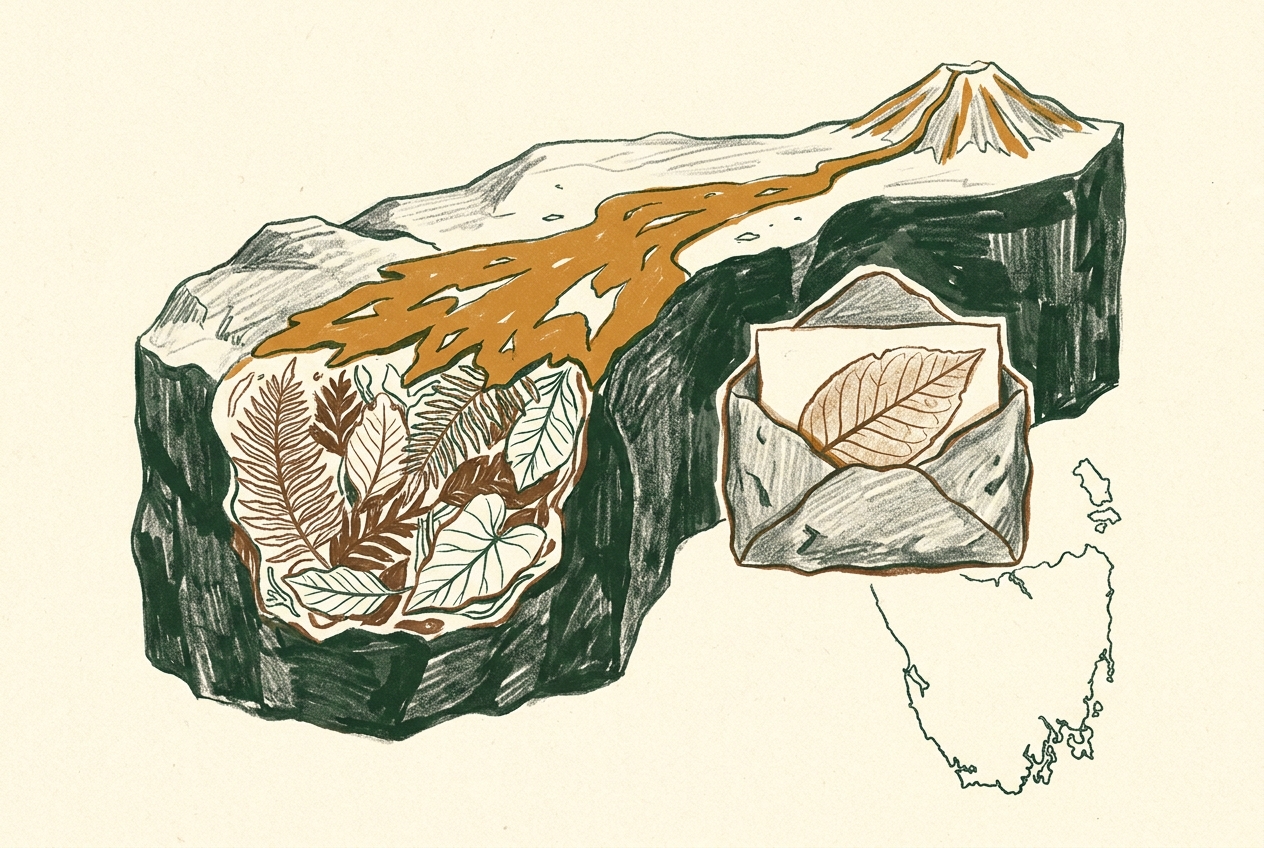
In northern Tasmania, near the town of Bishopsbourne, a 55-million-year-old lava flow did something unusual. It buried a rainforest floor so gently that leaves, flowers, and seeds were pressed into fine clay beneath the basalt—preserved in the dark stone as if a book had been shut mid-sentence.
That fossil leaf bed, known as the Bishopsbourne Flora, is one of the most detailed windows into Australia's climate during the Early Eocene, when the continent was still connected to Antarctica and the world was much warmer than today.
The Lava That Preserved, Not Destroyed
The Cenozoic basalts of northern Tasmania are the remnants of widespread volcanic activity that began around 55 million years ago and continued intermittently until roughly 20 million years ago. These were not violent explosive eruptions but slow, effusive flows—pāhoehoe and ʻaʻā—that spread across the landscape like dark syrup.
At Bishopsbourne, a flow moved across a damp forest floor without incinerating it. The heat was sufficient to bake the clay beneath into a hardpan, but not so intense that the organic matter burned away. Instead, the leaves were compressed into thin carbon films, preserving the outlines of entire trees, ferns, and shrubs.
Similar deposits occur at other Tasmanian sites—Regatta Point, Macquarie Harbour, and the Lea River—but Bishopsbourne is exceptional for the sheer density of fossil foliage. Individual rock slabs can hold dozens of overlapping leaves, stacked like pages.
A Greenhouse World, Preserved in Basalt
The Bishopsbourne Flora dates to the Early Eocene Climatic Optimum, a period roughly 53 to 49 million years ago when global temperatures were 5–8°C warmer than today. Tasmania, then at about 65°S latitude, supported a rainforest dominated by southern beech, conifers, and proteaceous plants—a flora that today thrives only in much warmer, wetter climates.
The fossils show no frost damage. The leaves are large, thin, and entire-margined—characteristics of a forest that never experienced winter freezing.
This is significant because Tasmania was then still connected to Antarctica via the Tasman Rise. The continent was not yet glaciated. The fossils confirm that even at polar latitudes, the Early Eocene supported lush, temperate rainforest—a finding that climate models have struggled to replicate.
The basalt flows themselves also carry information. Geochemical analysis shows they are alkali basalts, typical of intraplate volcanism associated with continental extension. As Australia rifted away from Antarctica during the Cretaceous and Palaeogene, the stretching crust allowed magma to rise along fractures in northern Tasmania. The flows that buried the forest were part of a larger volcanic province that extended across Bass Strait into Victoria.
Reading the Leaves, Reading the Rock
The Bishopsbourne leaf bed was first described in the 1870s, but its full significance emerged only in the last two decades. Palynology—pollen analysis—reveals that the understorey included ferns, cycads, and primitive flowering plants now extinct in Australia. The tree canopy included Nothofagus (southern beech), Araucaria, and Podocarpus, genera that persist today in South America and New Zealand—relics of the Gondwanan flora.
The basalt itself has been dated using potassium-argon methods to 54.7 ± 0.8 million years, giving a precise age for the fossil assemblage. This makes the Bishopsbourne Flora one of the best-dated polar Eocene floras in the world.
The preservation also reveals something about the eruption. The lava must have been relatively cool and slow-moving—perhaps 1,000–1,100°C rather than the 1,200°C of hotter flows—and it likely advanced over the forest during a period of wet weather. The clay beneath the flow was damp enough to prevent combustion but firm enough to record the leaves' fine venation.
What the Basalt Still Holds
The Bishopsbourne quarries are now largely filled or overgrown. But the material collected in the 20th century, housed at the Tasmanian Museum and Art Gallery and the University of Tasmania, continues to yield new species. In 2021, researchers described a new genus of fossil flower from the site—a small, five-petalled bloom that had never been seen before.
The flows themselves remain exposed in roadside cuttings and riverbanks across northern Tasmania, dark ledges of basalt that once ran with molten rock. Most people drive past them without looking. But beneath those flows, in thin seams of baked clay, the leaves of a lost greenhouse world wait to be read.
More like this
- The 5,000-Year-Old Volcanoes That Still Smoke in the SouthIn Victoria's Newer Volcanics Province, 400 volcanic vents erupted as recently as 5,000 years ago—the youngest volcanic field in mainland Australia, where craters still hold blue lakes and scoria cone
- The 560-Million-Year-Old Garden That Never Saw a PredatorIn South Australia's Flinders Ranges, 560-million-year-old Ediacara surfaces preserve entire seafloor communities of fronds, discs, and quilts — a garden of soft-bodied life that flourished before pre
- The 300-Million-Year-Old Forest That Died Standing UpIn New South Wales, a 300-million-year-old fossil forest preserves dozens of trees buried upright by a Permian volcanic eruption—an entire ecosystem frozen in ash.