14 May 2026 · 3 min read
The Ice That Carved a Continent: Tasmania's Glacial Lakes
Tasmania's Central Plateau preserves 4,000 glacial lakes carved by Pleistocene ice sheets, revealing how glaciers shaped Australia's southernmost landscape during the last ice age.
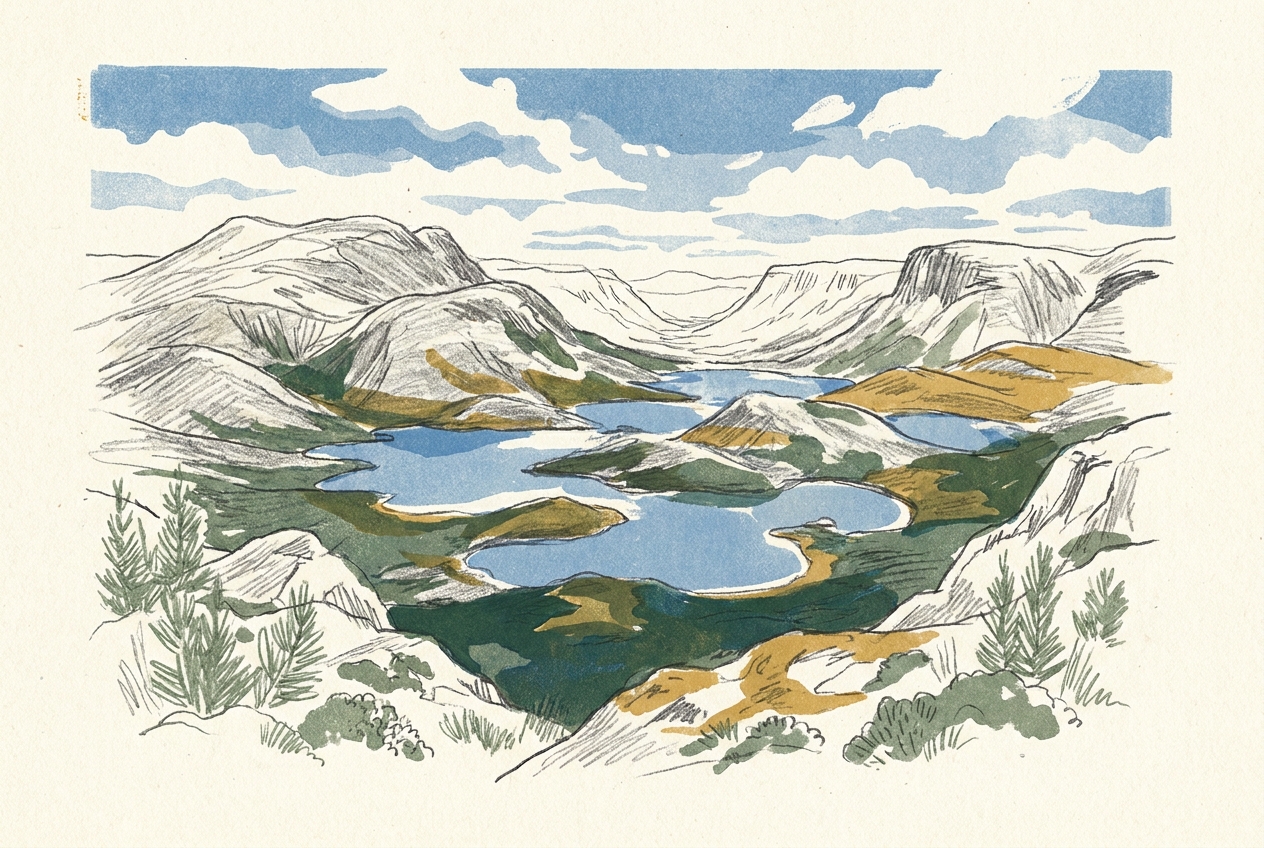
Tasmania's Central Plateau holds more than 4,000 lakes. Most are not named. From the air, they appear as a scatter of blue shards across a low, treeless plain—the densest concentration of glacial lakes anywhere in Australia, and a quiet record of the ice that once covered a fifth of the island.
The Ice That Came South
Between 20,000 and 18,000 years ago, at the peak of the last glacial period, Tasmania's average temperature was about 5°C colder than today. Snowfall accumulated year after year on the Central Highlands, compacting into ice that began to flow outward under its own weight. The ice cap that formed was modest by global standards—perhaps 700 metres thick at its deepest—but it was enough to reshape the landscape.
Unlike the continental ice sheets that scoured Canada and Scandinavia, Tasmania's glaciers were localised. They formed in the high country and moved downhill along existing valleys, grinding, plucking, and polishing the underlying dolerite bedrock. When the climate warmed and the ice retreated around 14,000 years ago, it left behind a landscape studded with depressions—some scoured out, others dammed by piles of rock debris—that filled with meltwater and rain.
These are the lakes you see today on the Central Plateau: shallow, irregular, and oriented along the direction the ice flowed.
A Landscape of Scrape and Pile
The most visible glacial features are the tarns—small lakes that sit in bowl-shaped hollows called cirques, carved into the steep flanks of mountains like Cradle Mountain and Mount Field. At Cradle Mountain, the cirque holding Dove Lake was excavated by ice that plucked blocks of Jurassic dolerite from the headwall and carried them downhill. The lake's eastern shore is a terminal moraine, a ridge of dumped rubble that marks where the glacier's snout once sat.
On the plateau itself, the ice moved more broadly. It scraped away soil and weathered rock, exposing fresh dolerite in long, smoothed surfaces called roches moutonnées—asymmetrical bumps with a gentle upstream slope and a steep, quarried downstream face. The direction of the striations scratched into these surfaces tells geologists that the ice flowed generally north and east from a divide near Lake St Clair.
The lakes are not deep—most are less than 10 metres—but they are extraordinarily numerous. On the Central Plateau alone, roughly 2,000 lakes occupy an area of 900 square kilometres, giving it a lake density comparable to parts of the Canadian Shield.
The ice did not carve the Central Plateau into a new shape. It simply took an old one and erased the soft parts.
What the Water Hides
The lakes are oligotrophic—low in nutrients, clear, and cold. Their beds are bare dolerite or glacial till, not the thick organic sediment found in lowland lakes. This makes them sensitive recorders of environmental change. Cores taken from the bottom of Lake Selina, on the western edge of the plateau, contain pollen layers that show how Tasmania's vegetation shifted as the ice retreated: from alpine heath to eucalypt woodland to the temperate rainforest that now surrounds the lake.
But the lakes also preserve something older. In a few basins, the sediment contains volcanic ash layers from eruptions in New Zealand—tephra from the Taupō Volcanic Zone, carried 2,000 kilometres across the Tasman Sea. These ash bands provide precise dates for the sediments around them, turning the lakes into natural chronometers.
One such layer, the Kawakawa tephra from New Zealand's Oruanui eruption 25,000 years ago, has been found in lake sediments on the Central Plateau. It fell on ice. When that ice melted, the ash settled into the lake mud, where it remains—a pinpoint marker in the slow, patient record of a landscape that was, for a few thousand years, buried beneath ice. Today, the lakes sit silent. But they remember.
More like this
- The 110-Million-Year-Old River That Runs Backwards UndergroundWestern Australia's 110-million-year-old dune system has been slowly dissolving into a labyrinth of caves where an ancient river still flows, carrying the taste of a Cretaceous desert.
- The 5,000-Year-Old Volcanoes That Still Smoke in the SouthIn Victoria's Newer Volcanics Province, 400 volcanic vents erupted as recently as 5,000 years ago—the youngest volcanic field in mainland Australia, where craters still hold blue lakes and scoria cone
- The 1.75-Billion-Year-Old Reef That Outranks the BarrierA 1.75-billion-year-old microbial reef in the Kimberley is the largest biological structure ever built by a single species, preserving a world without predators.