13 May 2026 · 3 min read
The Bone That Rewrote Prehistory: The Mungo Lady and the Willandra Lakes
In the dry lakebeds of western New South Wales, 42,000-year-old human remains reveal the world's oldest known cremation and a landscape transformed by Pleistocene climate shifts.
In 1969, geologist Jim Bowler was mapping the ancient shorelines of a dried-out lake system in western New South Wales when he noticed a fragment of bone protruding from a sand dune. It was a human skull fragment, stained red by the iron-rich soil, and it would push the story of human occupation in Australia back by 20,000 years. The Willandra Lakes, now a chain of salt-crusted basins, had surrendered the remains of Mungo Lady—and later Mungo Man—proving that people had lived on this continent for at least 42,000 years.
The Lake That Vanished
The Willandra Lakes system, part of the Murray-Darling Basin in far western New South Wales, once held a series of freshwater lakes fed by the ancient Lachlan River. Between 50,000 and 40,000 years ago, the lakes were full. Aboriginal people camped along their shores, hunting wallabies and gathering shellfish from the shallows.
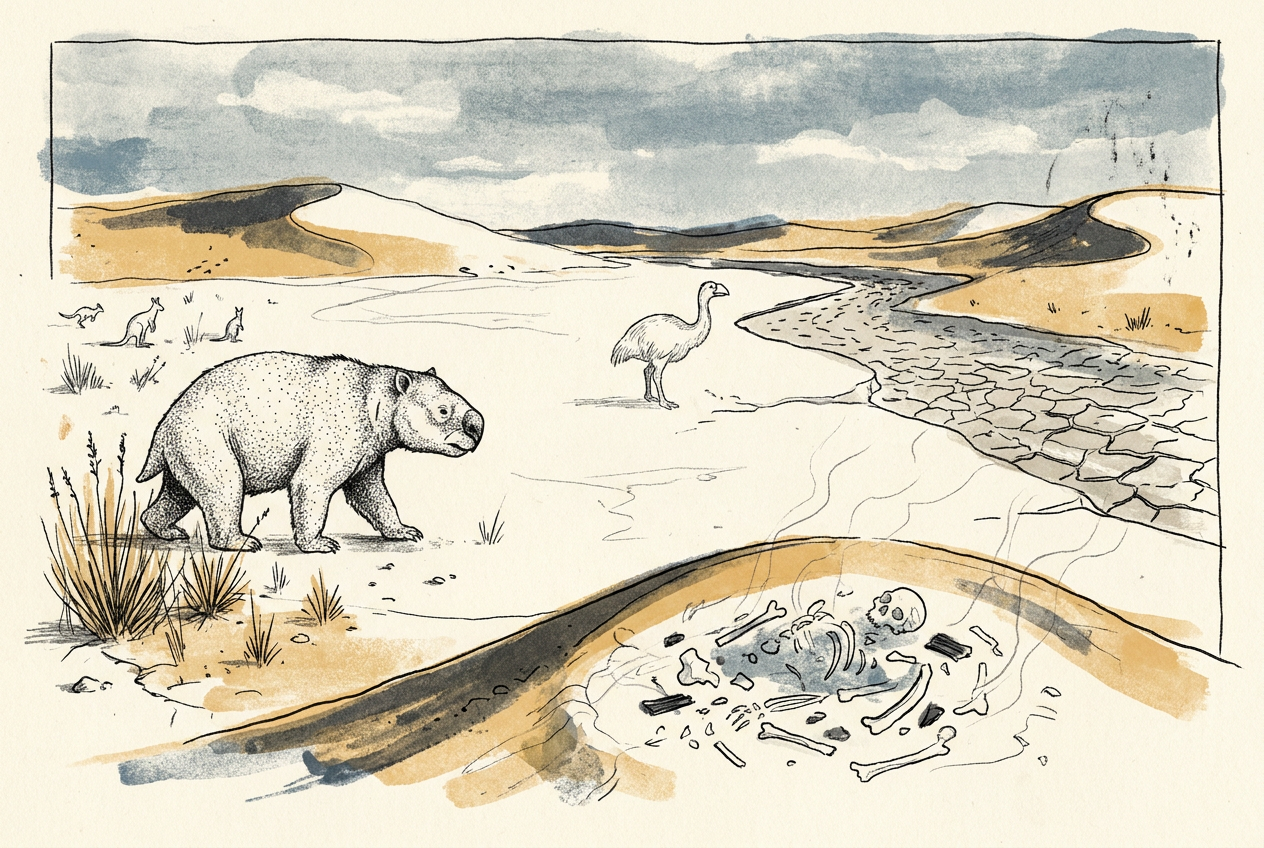
Then the climate shifted. The last glacial period intensified, and by 18,000 years ago the lakes had dried completely. Wind stripped the exposed lakebeds, piling silt and sand into crescent-shaped dunes—called lunettes—on the eastern shores. These lunettes, some rising 40 metres high, preserved everything buried in them: hearths, tools, and the bones of the people who had lived beside the water.
The Mungo Lady remains were found eroding from one such lunette at Lake Mungo. When Bowler and his colleagues radiocarbon-dated charcoal fragments from the same sediment layer, the result was astonishing. The bones were 42,000 years old. Even more striking, the skeleton showed clear evidence of cremation—the bones had been broken and burned at high temperature, then crushed and buried in a small pit. It remains the oldest known cremation in the world.
The Giant Neighbours
The Willandra lunettes preserved more than human remains. They also held the bones of megafauna that shared the landscape with those first Australians. Giant wombats called Diprotodon, weighing up to 2,500 kilograms, grazed the lake margins. Procoptodon, a short-faced kangaroo standing two metres tall, browsed on shrubs. Genyornis, a flightless bird nearly as tall as an ostrich, laid eggs the size of cantaloupes along the sandy shores.
At Lake Mungo, fragments of Genyornis eggshell have been found in the same sediment layers as stone tools and fireplaces. The shells show scorch marks consistent with cooking. The evidence suggests that people ate these giant birds, and that human hunting may have contributed to their extinction.
The Willandra lunettes are not just geological features—they are libraries of a lost world, stacked in layers of silt and sand.
Diprotodon fossils from the same region date to roughly 46,000 years ago, overlapping with the earliest human occupation. The debate over what killed Australia's megafauna—climate change, human hunting, or both—finds its sharpest focus here, where the bones of people and giants lie in the same ancient shoreline.
A Landscape That Reads Like a Book
The lunettes of the Willandra Lakes are among the most complete Pleistocene sedimentary records in Australia. Each layer of sand and clay corresponds to a phase of lake-full or lake-dry, a wet period or a drought. The sequence spans the last 50,000 years without major gaps.
Bowler's original discovery came from understanding this stratigraphy. He was mapping the lunette at Lake Mungo when he noticed a patch of disturbed sediment—ancient human digging—and, nearby, the bone fragment. The geology led him to the archaeology, not the other way around.
Today the Willandra Lakes World Heritage Area covers 2,400 square kilometres. The lakebeds are dry, the lunettes are eroding, and each rainstorm reveals new material. The remains of Mungo Lady and Mungo Man were repatriated to Aboriginal custodians in 2017 and now rest in a secure keeping place, no longer exposed to the wind that first uncovered them.
The lakes themselves are gone. But the dunes that replaced them still hold the story of the people who walked those shores, who cremated their dead, who hunted giant kangaroos, and who watched the water retreat for the last time.
More like this
- The 110-Million-Year-Old River That Runs Backwards UndergroundWestern Australia's 110-million-year-old dune system has been slowly dissolving into a labyrinth of caves where an ancient river still flows, carrying the taste of a Cretaceous desert.
- The 5,000-Year-Old Volcanoes That Still Smoke in the SouthIn Victoria's Newer Volcanics Province, 400 volcanic vents erupted as recently as 5,000 years ago—the youngest volcanic field in mainland Australia, where craters still hold blue lakes and scoria cone
- The 560-Million-Year-Old Garden That Never Saw a PredatorIn South Australia's Flinders Ranges, 560-million-year-old Ediacara surfaces preserve entire seafloor communities of fronds, discs, and quilts — a garden of soft-bodied life that flourished before pre