17 May 2026 · 3 min read
The Lava That Turned to Sapphire: Queensland's Anakie Gemfields
How 300-million-year-old volcanic eruptions and tropical weathering created Australia's richest sapphire deposits in central Queensland's Anakie region.
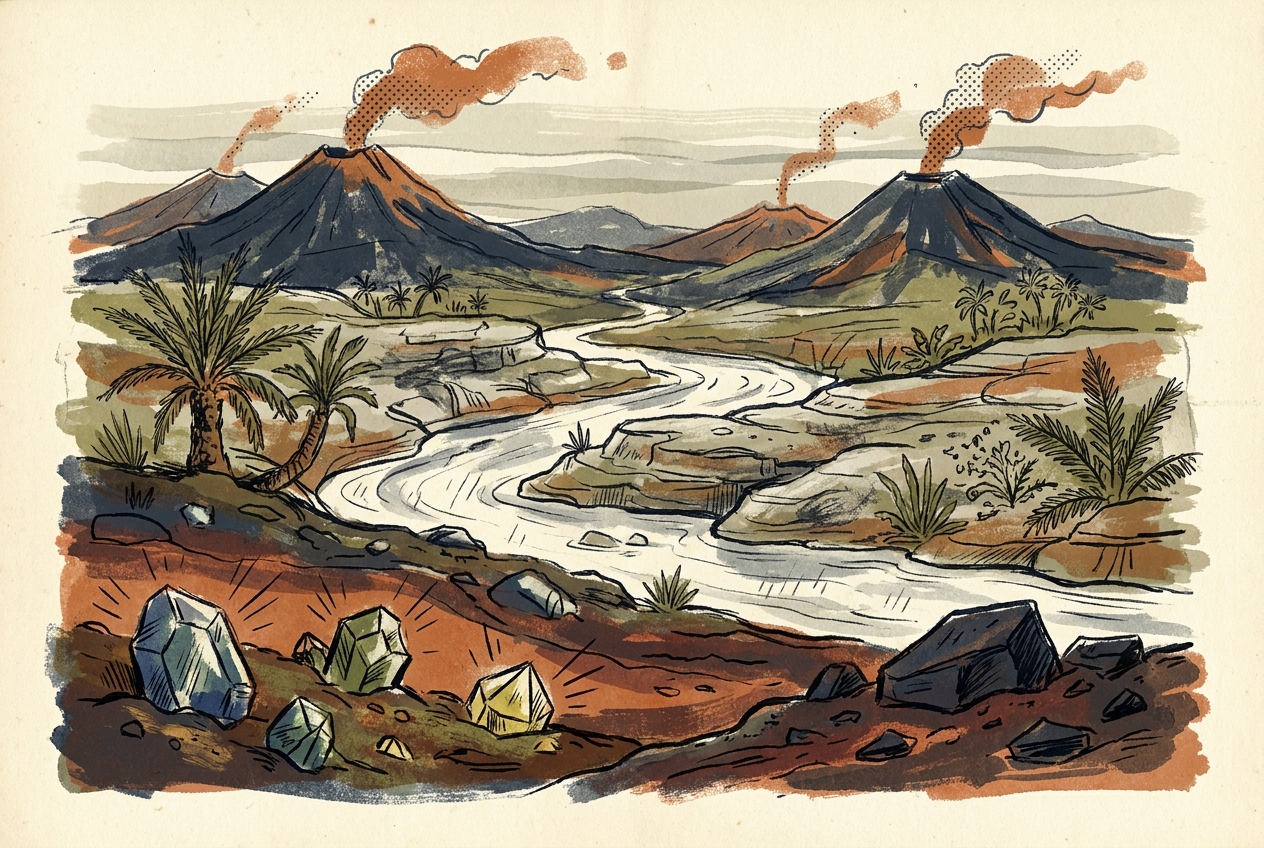
Deep beneath central Queensland's scrubby ironbark country, a 300-million-year-old volcanic eruption left behind something unexpected: not lava, not ash, but sapphire. The Anakie Gemfields have produced more than 70 million carats of the blue gemstone since the 1870s, making them one of the world's great sapphire provinces. But the stones did not come from the usual places. They arrived by accident, riding a rare kind of magma that rose from deep within the continent.
The Alkaline Exception
Most volcanic eruptions in eastern Australia tapped basalt — runny, iron-rich lava that spread across the landscape in flat sheets. The Anakie eruptions were different. Around 300 million years ago, during the Carboniferous, small pockets of alkaline magma punched through the crust near what is now the town of Rubyvale. Alkaline magma is unusual: it originates in the mantle, deep below the continent, and carries elements that do not normally reach the surface.
This magma contained aluminium, oxygen, and traces of iron and titanium. As it cooled slowly in underground chambers, those elements crystallised into corundum — the mineral that becomes ruby when red and sapphire in any other colour. The crystals grew large, some reaching the size of a thumb. But they remained trapped in the rock for hundreds of millions of years.
The Weathering Engine
What freed the sapphires was not another eruption but the slow work of weather. Over tens of millions of years, the tropical climate of central Queensland dissolved the softer volcanic rock around the corundum crystals. The hard sapphires did not dissolve. They washed into ancient creek beds and accumulated in gravel layers, concentrated by the same processes that sort gold nuggets from sand.
The richest deposits lie in a belt about 60 kilometres long and 20 kilometres wide, centred on the towns of Sapphire, Rubyvale, and Anakie. Miners follow the "wash" — a layer of weathered pebbles and clay that sits between the topsoil and the unweathered bedrock. The sapphires are heavy. They sink to the bottom of the wash, where a shovel can find them a metre or two below the surface.
The same weathering that freed the sapphires also coloured them. Iron turned some crystals green or yellow; traces of chromium made others pink.
The Colour of Deep Time
Anakie sapphires are famous for their variety. They come in blue, green, yellow, pink, and the rare "parti-coloured" stones that show two or three colours in a single crystal. This diversity reflects the chemistry of the original magma and the conditions under which the crystals grew. Slow cooling produced large, clear stones. Fluctuations in temperature and pressure created the zoning that gives parti-coloured sapphires their stripes.
The gemfields have never been fully mapped by modern exploration. Small-scale miners still work claims with excavators and wash plants, processing gravel by hand and eye. A single storm can shift the creeks and reveal fresh pockets of gemstones. The deposits are patchy, unpredictable, and thoroughly Australian in their refusal to follow neat geological rules.
A Different Kind of Riches
Unlike the gold rushes that reshaped Victoria and Western Australia, the Anakie fields produced a quieter kind of wealth. The stones were not melted down or used for industry. They were cut, polished, and sold as gems — luxury goods that depended on fashion as much as geology. The market has always been volatile. A single large sapphire can fund a year of mining; a season of poor colour can shut a claim.
Yet the geology endures. The alkaline magma that rose through Queensland's crust 300 million years ago was part of a larger pattern: small, deep-sourced eruptions that occurred across eastern Australia during the Carboniferous and Permian. Most of those eruptions left nothing but weathered basalt. At Anakie, the conditions aligned perfectly — the right magma, the right cooling rate, the right climate, the right length of time.
The result is a gemstone that carries the history of Australia's deep mantle in its crystal lattice. Every sapphire from Anakie records a moment when the continent's interior reached toward the surface, then waited millions of years for rain and time to set it free.
More like this
- The 110-Million-Year-Old River That Runs Backwards UndergroundWestern Australia's 110-million-year-old dune system has been slowly dissolving into a labyrinth of caves where an ancient river still flows, carrying the taste of a Cretaceous desert.
- The 5,000-Year-Old Volcanoes That Still Smoke in the SouthIn Victoria's Newer Volcanics Province, 400 volcanic vents erupted as recently as 5,000 years ago—the youngest volcanic field in mainland Australia, where craters still hold blue lakes and scoria cone
- The 300-Million-Year-Old Forest That Died Standing UpIn New South Wales, a 300-million-year-old fossil forest preserves dozens of trees buried upright by a Permian volcanic eruption—an entire ecosystem frozen in ash.