17 May 2026 · 3 min read
The Ediacaran Garden That Turned to Uranium: South Australia's Beverley Deposit
How a 700-million-year-old Ediacaran marine basin in South Australia's Lake Frome region concentrated uranium into one of the continent's richest in-situ recovery mines.
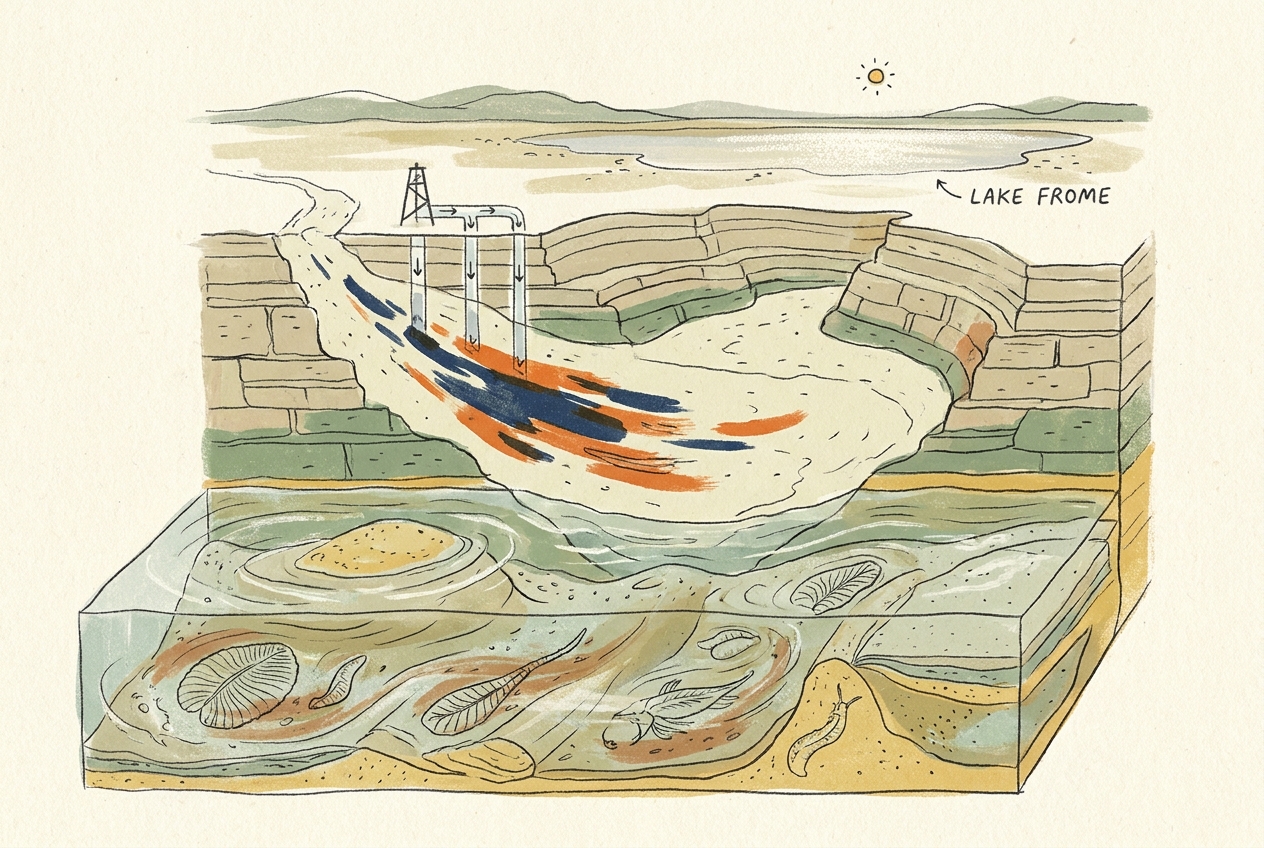
In the arid plains north of the Flinders Ranges, a 700-million-year-old seabed holds enough uranium to power a city for decades. The Beverley uranium deposit sits not in a vein or a volcanic pipe, but inside a buried Ediacaran marine basin—a fossilised sea floor that concentrated radioactive metal the way a reef concentrates lime.
The Sea That Became a Sponge
During the Sturtian glaciation, around 700 million years ago, ice sheets scraped the ancient Gawler Craton bare. When the glaciers retreated, the sea flooded the scoured landscape, depositing sands and silts in a basin now called the Frome Embayment. These sedimentary layers—the Nuccaleena Formation and the underlying Brachina Formation—are the same rocks that, in the Flinders Ranges, preserve the first impressions of Ediacaran soft-bodied life.
At Beverley, no fossils are mined. The rock itself is the resource. The sands and conglomerates of the 700-million-year-old sequence are porous, permeable, and rich in organic carbon—remnants of microbial mats that once carpeted the Ediacaran sea floor. That carbon would later become the chemical trap for uranium.
The Beverley deposit is not a mountain of ore. It is a chemical ghost—uranium dissolved, transported, and precipitated inside the skeleton of an ancient seabed.
The Fluid That Carried the Metal
Uranium is soluble in oxidised groundwater. For tens of millions of years, oxygenated water percolated through the Mount Painter region to the east, leaching trace uranium from the Proterozoic granites of the Olary Province. This uranium-laced groundwater then moved westward through the buried Ediacaran sandstones.
Where the groundwater encountered the organic-rich layers—the fossilised microbial mats of the ancient sea floor—the chemistry shifted. The organic carbon reduced the uranium, causing it to precipitate as uraninite, a black uranium oxide. Over millions of years, this process concentrated uranium along a redox front—a chemical boundary where oxidised water met reducing rock.
The result is not a single ore body but a series of tabular rolls, stacked like coins in the sandstone, each one a fossilised chemical reaction.
The Mine That Drinks Nothing
Beverley is an in-situ recovery mine. No open pit gapes in the red plain; no headframe marks the site. Instead, a grid of wells injects a weak acid solution into the Ediacaran sandstone, dissolving the uranium, and pumps the pregnant solution to a processing plant on the surface. The rock itself stays in place.
This method works only because the Beverley sandstone is confined between impermeable clay layers—the same layers that sealed the Ediacaran basin 700 million years ago. The geology that preserved the chemical trap now contains the mining fluid, preventing contamination of the Great Artesian Basin that lies above.
Operations began in 2000 and have produced more than 10,000 tonnes of uranium oxide, making Beverley one of Australia's most productive uranium mines. The deposit is far from exhausted; the same Ediacaran sequence continues beneath the lake beds to the north and south.
The Garden That Became Fuel
There is a quiet strangeness to this. The Ediacaran period marks the first appearance of complex multicellular life on Earth—frond-like organisms, disc-shaped holdfasts, quilted mats that spread across the sea floor. At Beverley, those microbial mats did not fossilise into visible forms. They turned into a chemical sponge, one that later generations would drill for nuclear fuel.
The same rocks that preserve the dawn of animal life, exposed in the Flinders Ranges to the west, continue underground as the host for one of Australia's largest uranium deposits. The Ediacaran sea floor is not only a window into deep time. It is also a resource, buried beneath the desert, waiting for groundwater to wake it.
More like this
- The 560-Million-Year-Old Garden That Never Saw a PredatorIn South Australia's Flinders Ranges, 560-million-year-old Ediacara surfaces preserve entire seafloor communities of fronds, discs, and quilts — a garden of soft-bodied life that flourished before pre
- The 1.75-Billion-Year-Old Reef That Outranks the BarrierA 1.75-billion-year-old microbial reef in the Kimberley is the largest biological structure ever built by a single species, preserving a world without predators.
- The 3.5-Billion-Year-Old Cones That Still Catch LightIn the Pilbara's Dresser Formation, 3.5-billion-year-old stromatolites preserve the oldest direct evidence of life on Earth—microbial mats that built layered domes in a volcanic caldera.