17 May 2026 · 3 min read
The Lava That Became a Coal Seam: Queensland's Bowen Basin
How 300-million-year-old volcanic ash fell into Permian swamps and became the coal that powers Australia's east coast, preserved in the Bowen Basin.
A single cubic metre of coal from Queensland's Bowen Basin contains the compressed remains of four hundred thousand years of plant growth, crushed into a black seam less than two metres thick. That seam runs for hundreds of kilometres beneath the dry plains north of Rockhampton, and it began not with fire but with ash.
The Ash That Fell on Swamps
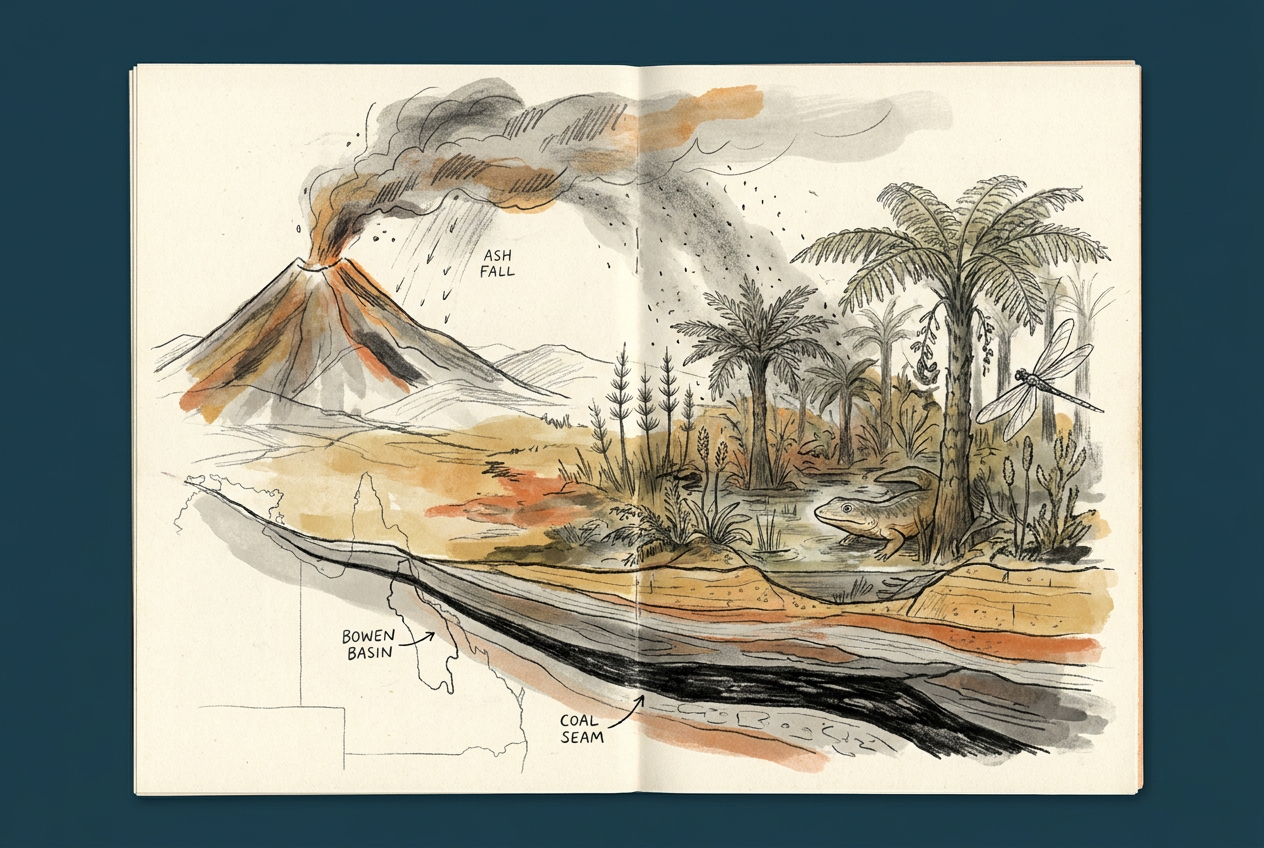
Three hundred million years ago, during the Permian period, the east coast of Australia sat at a much higher latitude, close to the Antarctic Circle. The climate was cold and wet, and vast peat swamps stretched across a subsiding basin that geologists now call the Bowen Basin. These were not tropical mangrove swamps. They were cool-temperate mires, dominated by glossopterid trees—a now-extinct group of seed ferns whose leaves fell in thick mats into stagnant, oxygen-poor water.
To the east, a chain of volcanoes erupted along the edge of the Gondwanan continent. These were not shield volcanoes or gentle lava flows. They were explosive, rhyolitic eruptions that threw fine ash high into the Permian atmosphere. Prevailing winds carried that ash westwards, where it settled onto the peat swamps in layers millimetres thick.
Each ash fall did two things. It added silica and minerals to the swamp chemistry. And it smothered the surface, sealing the peat from oxygen and slowing the decay that would otherwise have returned the carbon to the air.
The Bowen Basin holds more than 40 billion tonnes of coal. Most of it would not exist without those volcanic ash falls.
The Compression of a Forest
Over millions of years, the peat accumulated in cycles. A swamp would grow for thousands of years, building a layer of compressed plant matter several metres thick. Then an eruption would coat it in ash. The swamp would regrow on top of the ash, only to be buried again. Geologists recognise these cycles in the coal seams today as bright and dull bands—the bright bands are pure coal, the dull bands are rich in clay minerals from the volcanic ash.
The basin continued to subside, pulled downward by the weight of sediment washing in from the rising New England Orogen to the east. Each kilometre of burial added heat and pressure. The peat cooked slowly, at temperatures between 100 and 150 degrees Celsius, driving off water and volatile gases. What remained was carbon, concentrated and ordered into the black rock we call coal.
The Bowen Basin's coal is mostly bituminous—mid-rank, high-energy, ideal for steelmaking. The best seams, like the Goonyella and Moranbah seams in the northern part of the basin, are up to eight metres thick and run continuously for tens of kilometres.
The Basin That Built an Economy
The Bowen Basin covers about 60,000 square kilometres, roughly the size of Tasmania. It contains more than 40 operating coal mines. The coal travels by rail to the ports of Hay Point, Dalrymple Bay, and Gladstone, where it is loaded onto ships bound for steel mills in Japan, South Korea, and India.
This is metallurgical coal, not the thermal coal burned for electricity. When heated in the absence of oxygen, it turns into coke—a porous, carbon-rich material that burns hot enough to smelt iron ore in a blast furnace. Without the Bowen Basin's coal, Australia's iron ore exports from Western Australia would have nowhere to go. The two resources are partners in the same industrial chain, separated by three thousand kilometres of continent.
Yet the Bowen Basin is also a geological archive. The ash bands between the coal seams contain zircons—tiny crystals of zirconium silicate that preserve the age of each eruption. By dating these zircons, geologists have reconstructed the volcanic timeline of the Permian east coast with remarkable precision. They know, for example, that the major volcanic phase lasted from about 275 to 265 million years ago, and that individual ash falls occurred every 100,000 to 200,000 years.
The Fire That Didn't Burn
There is an irony in the Bowen Basin's coal. The same volcanic eruptions that delivered the ash to preserve the peat also posed a constant threat. Hot ash falling onto a dry swamp could have ignited it. But the Permian swamps were waterlogged, and the ash was cool by the time it settled through the damp air. The fire never came.
Instead, the ash did the opposite of burning. It sealed the carbon away, locking it in the ground for three hundred million years, until humans arrived with draglines and longwall miners to release it in a single, brief flash of industrial flame.
More like this
- The 5,000-Year-Old Volcanoes That Still Smoke in the SouthIn Victoria's Newer Volcanics Province, 400 volcanic vents erupted as recently as 5,000 years ago—the youngest volcanic field in mainland Australia, where craters still hold blue lakes and scoria cone
- The 560-Million-Year-Old Garden That Never Saw a PredatorIn South Australia's Flinders Ranges, 560-million-year-old Ediacara surfaces preserve entire seafloor communities of fronds, discs, and quilts — a garden of soft-bodied life that flourished before pre
- The 300-Million-Year-Old Forest That Died Standing UpIn New South Wales, a 300-million-year-old fossil forest preserves dozens of trees buried upright by a Permian volcanic eruption—an entire ecosystem frozen in ash.