16 May 2026 · 3 min read
The Ediacaran Spires That Went Extinct: South Australia's Strange Reef
In the Flinders Ranges, 550-million-year-old fossil reefs built by mysterious cone-shaped organisms reveal a failed experiment in reef-building that predates corals by 200 million years.
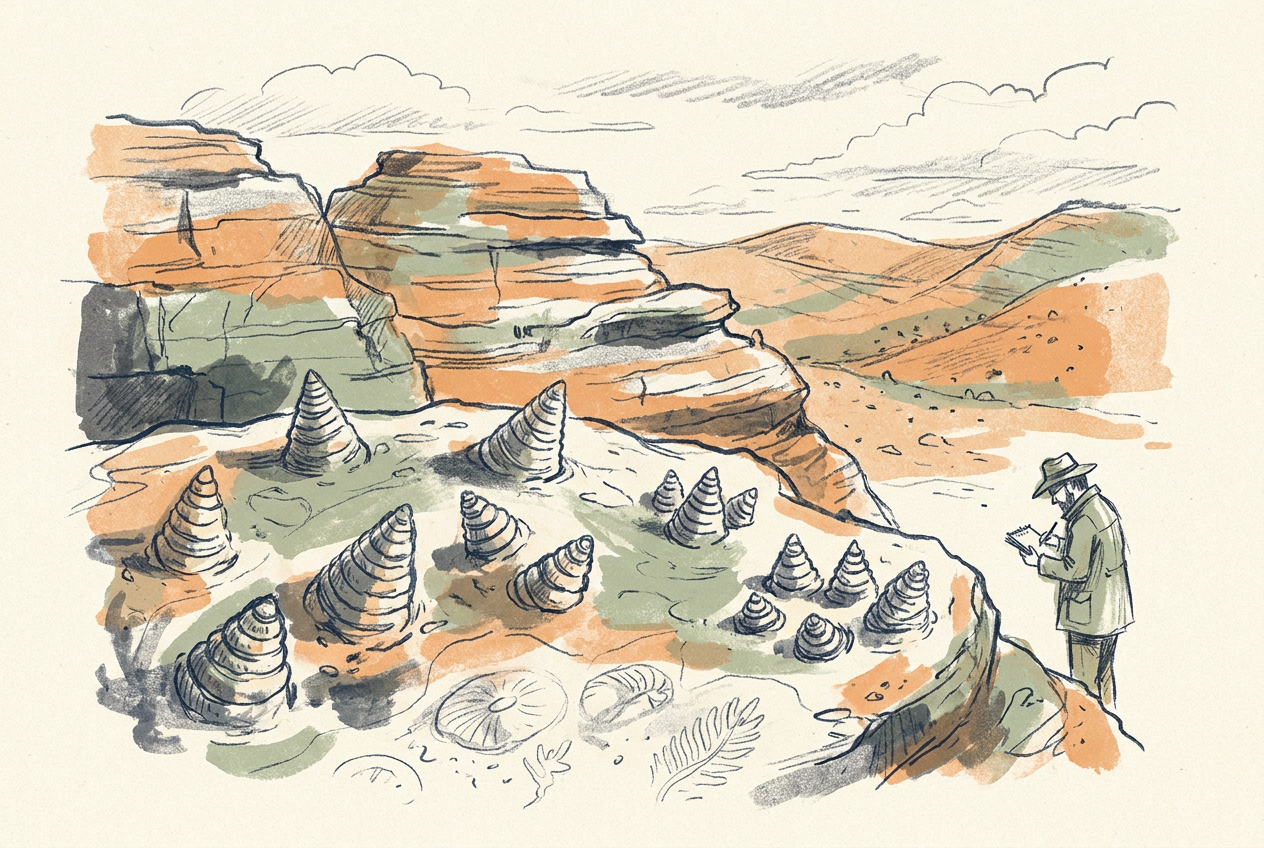
In the northern Flinders Ranges of South Australia, a hillside of grey limestone contains the remains of a reef built by creatures that no longer exist. The rock is 550 million years old. The reef builders were not corals, not sponges, not any animal alive today. They were Cloudina — tiny, cone-shaped organisms that stacked their calcium carbonate shells in tiers, like a tower of paper cups. And they built the first skeletal reefs on Earth.
A Reef Before Corals
The site is called the Rawnsley Quartzite, part of the Ediacaran succession in the Flinders Ranges. Here, within the Nilpena Ediacara National Park, Cloudina fossils appear in dense clusters, packed together in life position. These organisms grew their shells by adding one cone inside another, creating a tube that could reach a few centimetres long. The tubes were then cemented together by microbial mats — biofilms that acted as living glue.
What makes this remarkable is timing. The first coral reefs appear in the Ordovician, around 480 million years ago. The Cloudina reefs of the Flinders Ranges predate them by 70 million years. For a brief geological moment, these cone-builders were the world's most advanced reef architects. Then they vanished.
Cloudina is the first organism in the fossil record to build a mineralised skeleton — a hard shell that could survive burial, compaction, and 550 million years of time.
The Experiment That Failed
The Flinders Ranges preserve not just the reef, but the moment of its disappearance. Above the Cloudina-bearing layers, the rock changes. The limestone gives way to shale, then to sandstone. The reef builders are gone.
The most likely explanation is predation. At the same time that Cloudina was building reefs, another Ediacaran organism — Kimberella — was grazing the sea floor with a rasp-like feeding structure. Trace fossils preserved in the same beds show scratch marks on microbial mats. If Kimberella could scrape microbial films, it could also drill into a Cloudina shell. And indeed, many Cloudina fossils from the Flinders Ranges show small, round holes — the first unambiguous evidence of predation in the fossil record.
The reef builders had no defence. They had evolved hard skeletons to stand upright and filter food from the water. But those same skeletons made them vulnerable to a new kind of threat: a creature that could eat them from the outside. Within a few million years, Cloudina was extinct. The reef-building niche would remain empty for 70 million years, until corals evolved to fill it.
A Landscape Frozen in Time
The Flinders Ranges today are arid, folded, eroded. The hills that contain the Cloudina reefs were once the floor of a shallow sea, part of the same basin that preserved the famous Ediacaran soft-bodied fossils at Nilpena. The tectonic forces that built the ranges — the Delamerian Orogeny, around 500 million years ago — tilted and fractured these rocks, but did not destroy them.
Walk the outcrops today, and you can see the reef in cross-section. The Cloudina tubes appear as white rings in the grey limestone, packed so densely that the rock is nearly half skeleton. Each ring is a single organism's shell, stacked inside the next like a set of nesting cups. Between the tubes, the microbial mats are preserved as wavy laminations — the glue that held the reef together.
The reef is small by modern standards — perhaps a metre thick, a few metres across. But it represents a turning point. Before Cloudina, life was soft, gelatinous, defenceless. After Cloudina, skeletons existed. Predation existed. The arms race had begun.
Why It Matters
The Cloudina reefs of the Flinders Ranges are not just a curiosity. They are the first example of a fundamental ecological pattern: a group of organisms that builds a new structure, dominates a habitat, and then disappears when the world changes around them. This pattern — the rise and fall of reef-building communities — would repeat many times in Earth's history, from the stromatolite reefs of the Precambrian to the coral reefs of today.
But Cloudina was different. It was the first organism to build a hard skeleton, the first to form a reef, and the first to be driven to extinction by a predator. In the grey limestone of the Flinders Ranges, the entire story is written in stone: the innovation, the success, the failure. A brief experiment in reef-building, 550 million years old, that never got a second chance.
More like this
- The 560-Million-Year-Old Garden That Never Saw a PredatorIn South Australia's Flinders Ranges, 560-million-year-old Ediacara surfaces preserve entire seafloor communities of fronds, discs, and quilts — a garden of soft-bodied life that flourished before pre
- The 300-Million-Year-Old Forest That Died Standing UpIn New South Wales, a 300-million-year-old fossil forest preserves dozens of trees buried upright by a Permian volcanic eruption—an entire ecosystem frozen in ash.
- The 1.75-Billion-Year-Old Reef That Outranks the BarrierA 1.75-billion-year-old microbial reef in the Kimberley is the largest biological structure ever built by a single species, preserving a world without predators.