17 May 2026 · 3 min read
The Volcano That Gave Birth to Opal: Lightning Ridge's Cretaceous Secret
How 100-million-year-old volcanic eruptions and ancient inland seas created the conditions for Australia's precious black opal at Lightning Ridge.
The most valuable opal on Earth comes from a fossilised seashell.
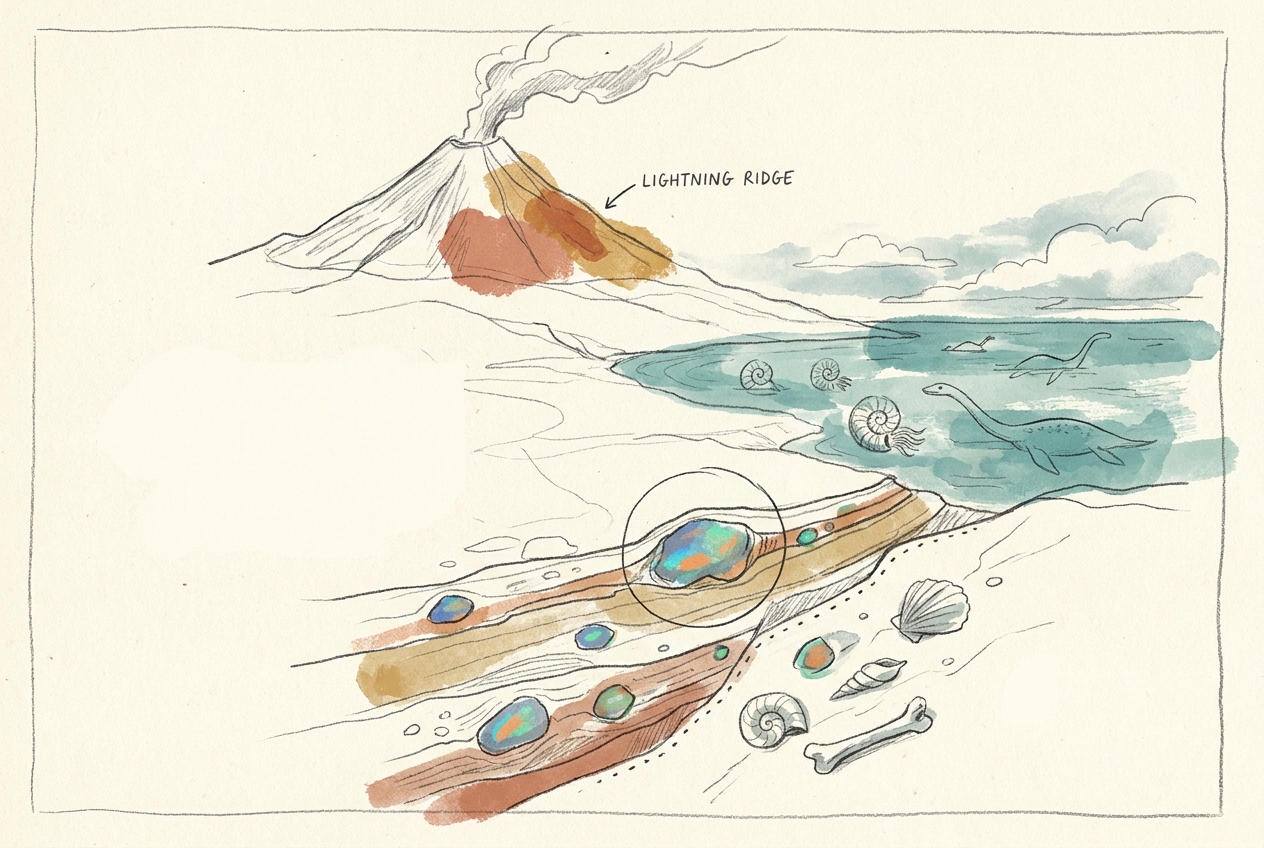
At Lightning Ridge in northern New South Wales, miners pull black opal from 100-million-year-old sedimentary rock. The opal fills the hollows of ancient clam shells, belemnites, and the bones of long-necked plesiosaurs. But the opal itself—that play of colour trapped in silica—owes its existence to a chain of events that began with volcanoes.
The Inland Sea That Dried to Clay
In the early Cretaceous, eastern Australia sat under a shallow inland sea. The continent was still attached to Antarctica and South America. The sea teemed with ammonites, marine reptiles, and giant clams. Rivers carried sediment from volcanic highlands to the west, dumping silt and sand into the basin.
As the sea retreated around 100 million years ago, the sediments remained. Over millions of years, they compressed into sandstone and claystone. The region that would become Lightning Ridge was a floodplain, laced with the remains of the sea's creatures. Their shells and bones left cavities in the rock—moulds waiting to be filled.
The Ash That Turned to Gemstone
The volcanic highlands were not passive. Across what is now Queensland and northern New South Wales, volcanoes erupted throughout the Cretaceous. They showered the landscape with ash rich in silica.
Rainwater percolated through the ash, dissolving the silica into a gel. The silica-rich groundwater seeped downward through the sandstone until it reached the clay layer beneath, where it pooled. In the cavities left by the fossilised sea creatures, the silica gel dried and hardened over millions of years.
As it solidified, the silica formed microscopic spheres arranged in a regular grid. When those spheres are uniform and tightly packed, they diffract light into the rainbow flashes that make opal precious. The black background of Lightning Ridge opal comes from iron oxide and carbon in the surrounding clay, which darkens the stone and makes the colours blaze.
A single cubic centimetre of precious opal can contain 10 million silica spheres, each arranged with the precision of a crystal lattice.
The Plesiosaur That Became a Gem
Lightning Ridge is the only place on Earth where opal fills the bones of large vertebrates. Miners have found opalised plesiosaur vertebrae, opalised dinosaur claws, and the jaw of a monotreme—a platypus relative—preserved in gemstone.
The process required three conditions that rarely converge. First, a silica source: the Cretaceous volcanoes. Second, a porous host rock: the ancient seafloor sediments. Third, a water table that fluctuated slowly enough for the silica gel to set without cracking. Lightning Ridge had all three.
The opal fields stretch across about 1,000 square kilometres of semi-arid scrub. Miners work shallow shafts, following the "opal dirt"—a layer of weathered claystone that sits about 10 to 20 metres below the surface. The fossils are accidental treasure, pulled from the ground alongside the gem.
The Chemistry of Colour
Not all opal from Lightning Ridge is black. The range includes crystal opal, semi-black opal, and the rare "jelly" opal with translucent body tone. The colour depends on the size of the silica spheres. Small spheres produce blue and violet. Larger spheres yield red and orange. The most valuable stones flash red on a black background.
The volcanic connection is often overlooked. Most accounts of Australian opal emphasise the sedimentary setting—the ancient seabed, the slow percolation of water. But without the Cretaceous volcanic ash that blanketed the landscape, there would be no silica to fill the fossils. The opal is a marriage of fire and water: volcanic glass dissolved by rain, then reborn as gemstone inside the shells of creatures that died when dinosaurs still walked the earth.
The volcanoes themselves are long gone. Erosion has stripped away the cones and flows, leaving only the ash beds in the geological record. But the opal remains, each stone a fragment of a Cretaceous moment: a sea, a volcano, a shell, and a slow crystallisation that took 100 million years to complete. Human history has only been mining them for about 130 years. The formation is still happening, somewhere underground, as groundwater continues its patient work.
More like this
- The 5,000-Year-Old Volcanoes That Still Smoke in the SouthIn Victoria's Newer Volcanics Province, 400 volcanic vents erupted as recently as 5,000 years ago—the youngest volcanic field in mainland Australia, where craters still hold blue lakes and scoria cone
- The 560-Million-Year-Old Garden That Never Saw a PredatorIn South Australia's Flinders Ranges, 560-million-year-old Ediacara surfaces preserve entire seafloor communities of fronds, discs, and quilts — a garden of soft-bodied life that flourished before pre
- The 300-Million-Year-Old Forest That Died Standing UpIn New South Wales, a 300-million-year-old fossil forest preserves dozens of trees buried upright by a Permian volcanic eruption—an entire ecosystem frozen in ash.