12 May 2026 · 3 min read
The Lava That Buried a Forest: The Triassic Petrified Trees of Chinchilla
In Queensland's Darling Downs, a 230-million-year-old fossil forest preserves upright trees entombed by volcanic ash, revealing a Triassic landscape before dinosaurs dominated.
Near the town of Chinchilla, on Queensland's Darling Downs, a bulldozer blade struck stone in 1971. The stone was wood — a tree trunk nearly two metres in diameter, still standing upright, turned to agate by 230 million years of silica replacement. It was not alone.
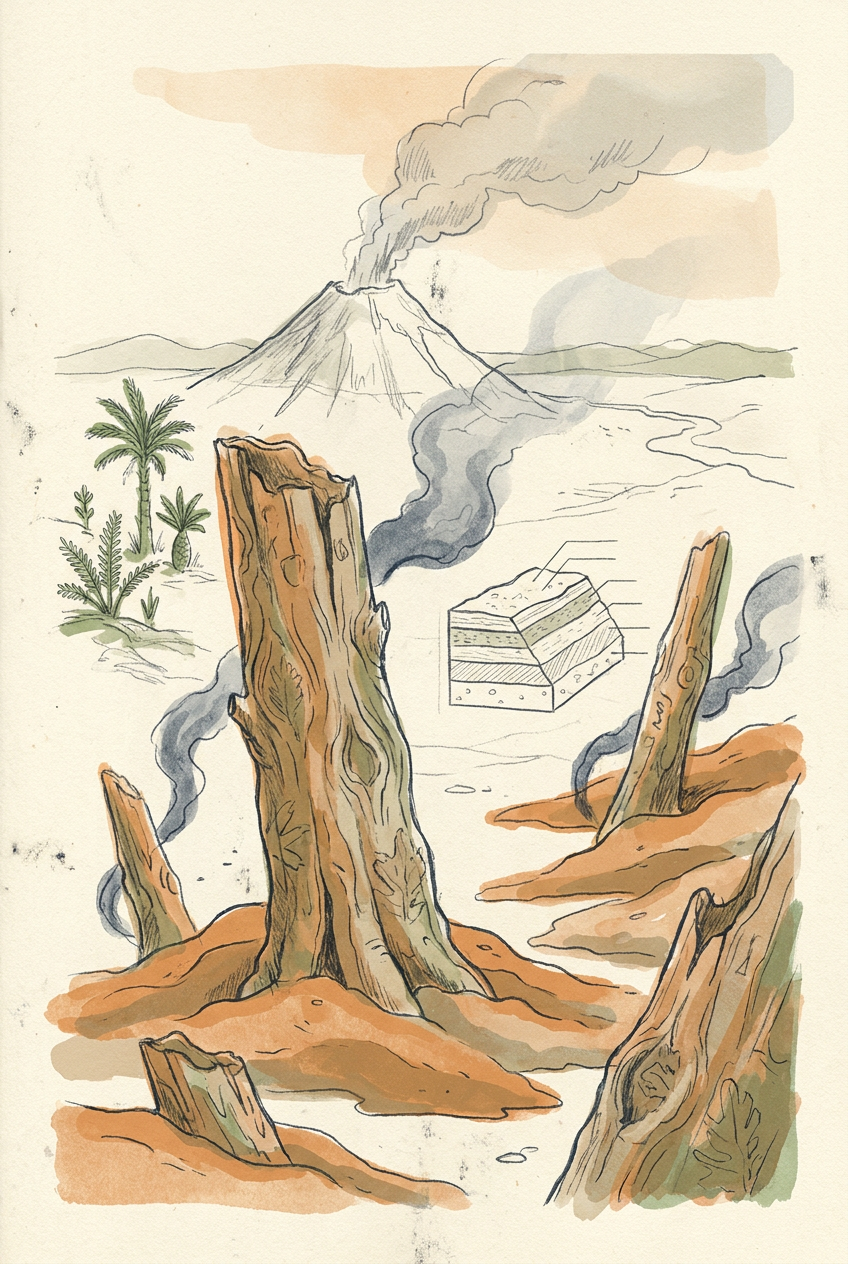
The Chinchilla Petrified Forest preserves an entire Triassic woodland, buried by volcanic ash and later exhumed by erosion. The trees stand as they grew: trunks upright, root systems intact, bark textures preserved in chalcedony and quartz. They are a snapshot of Gondwana before the dinosaurs became large.
The Ash That Fell
Around 230 million years ago, during the Middle to Late Triassic, the landscape of what is now southeastern Queensland was a forested floodplain. Conifers dominated — ancient relatives of today's araucarias and pines, with tall straight trunks and scaly foliage. The climate was seasonal, with wet summers and dry winters.
Then a volcano erupted somewhere to the east. The eruption was explosive, probably rhyolitic, throwing vast columns of ash into the atmosphere. The ash fell over the floodplain in thick layers, burying the forest where it stood. The trees did not burn. They were smothered, sealed from oxygen, their cellular structure preserved.
Groundwater rich in dissolved silica seeped through the ash and into the buried wood. Over millions of years, the silica crystallised as microcrystalline quartz — agate, jasper, chalcedony — replacing the original cell walls molecule by molecule. The result is petrified wood that retains the tree's external shape and internal growth rings, but is now solid stone.
A tree that grew in Triassic sunlight now rings like a bell when struck with a hammer.
The Forest That Emerged
The Chinchilla deposit is not a single layer but a series of fossil soils, or palaeosols, stacked one above another. Each soil horizon contains upright stumps, fallen logs, and root systems that spread through the ancient ground. The trees are not pressed flat, as in coal measures, but stand in three dimensions — a forest caught in the act of dying.
Some trunks exceed 30 metres in length. The largest upright stump stands about two metres tall, but its roots extend another three metres into the underlying sediment. The wood is preserved in exquisite detail: growth rings visible to the naked eye, bark texture still rough, branch scars where limbs once emerged.
The petrified wood is colourful. Iron oxides stain the quartz in shades of red, brown, yellow, and orange. Manganese adds black and grey. The agate fills cracks and hollows, creating banded patterns that cut across the grain of the original wood. Each log is a geode in disguise.
What the Rings Reveal
The growth rings in Chinchilla's petrified wood are not annual. Triassic conifers in this part of Gondwana grew in response to rainfall, not temperature. Wide bands of large cells indicate wet seasons; narrow bands of small cells record dry spells. The rings are irregular, suggesting a climate that fluctuated from year to year.
This matters because the Triassic was a time of planetary upheaval. The supercontinent Pangaea was breaking apart. The climate was generally hot and dry, but punctuated by wetter intervals. The Chinchilla forest grew during one of those wetter phases, when the interior of Gondwana was not yet the desert it would later become.
The fossils also show evidence of fire. Some logs contain charcoal layers within their growth rings — evidence of surface fires that swept through the forest but did not kill the trees. The same fires that burn Australian bushland today burned Triassic woodlands 230 million years ago.
The Edge of a Lost World
Chinchilla's petrified forest is not a single moment of catastrophe but a recurring event. The stacked fossil soils show that forests grew, were buried by ash, and grew again — a cycle repeated over thousands of years. Each eruption reset the landscape, and each time the conifers returned.
The deposit is one of the few places on Earth where Triassic forests are preserved in growth position. Most fossil wood is transported — logs washed into rivers, buried in deltas, compressed into coal. Chinchilla's trees died where they stood. They are a Triassic Pompeii, without the bodies.
Today the petrified logs lie scattered across private farmland, exposed in gullies and creek beds. Some have been collected; others remain half-buried, waiting for the next heavy rain to reveal another trunk. The forest is still emerging from the ground, 230 million years after it was buried alive.
More like this
- The 5,000-Year-Old Volcanoes That Still Smoke in the SouthIn Victoria's Newer Volcanics Province, 400 volcanic vents erupted as recently as 5,000 years ago—the youngest volcanic field in mainland Australia, where craters still hold blue lakes and scoria cone
- The 560-Million-Year-Old Garden That Never Saw a PredatorIn South Australia's Flinders Ranges, 560-million-year-old Ediacara surfaces preserve entire seafloor communities of fronds, discs, and quilts — a garden of soft-bodied life that flourished before pre
- The 300-Million-Year-Old Forest That Died Standing UpIn New South Wales, a 300-million-year-old fossil forest preserves dozens of trees buried upright by a Permian volcanic eruption—an entire ecosystem frozen in ash.