12 May 2026 · 3 min read
The Kimberley's Fossilised Barrier Reef: The Devonian Reefs of Windjana Gorge
In Western Australia's Kimberley region, 350-million-year-old Devonian reef complexes—among Earth's best-preserved ancient barrier reefs—rise as limestone walls through Windjana Gorge and Napier Range
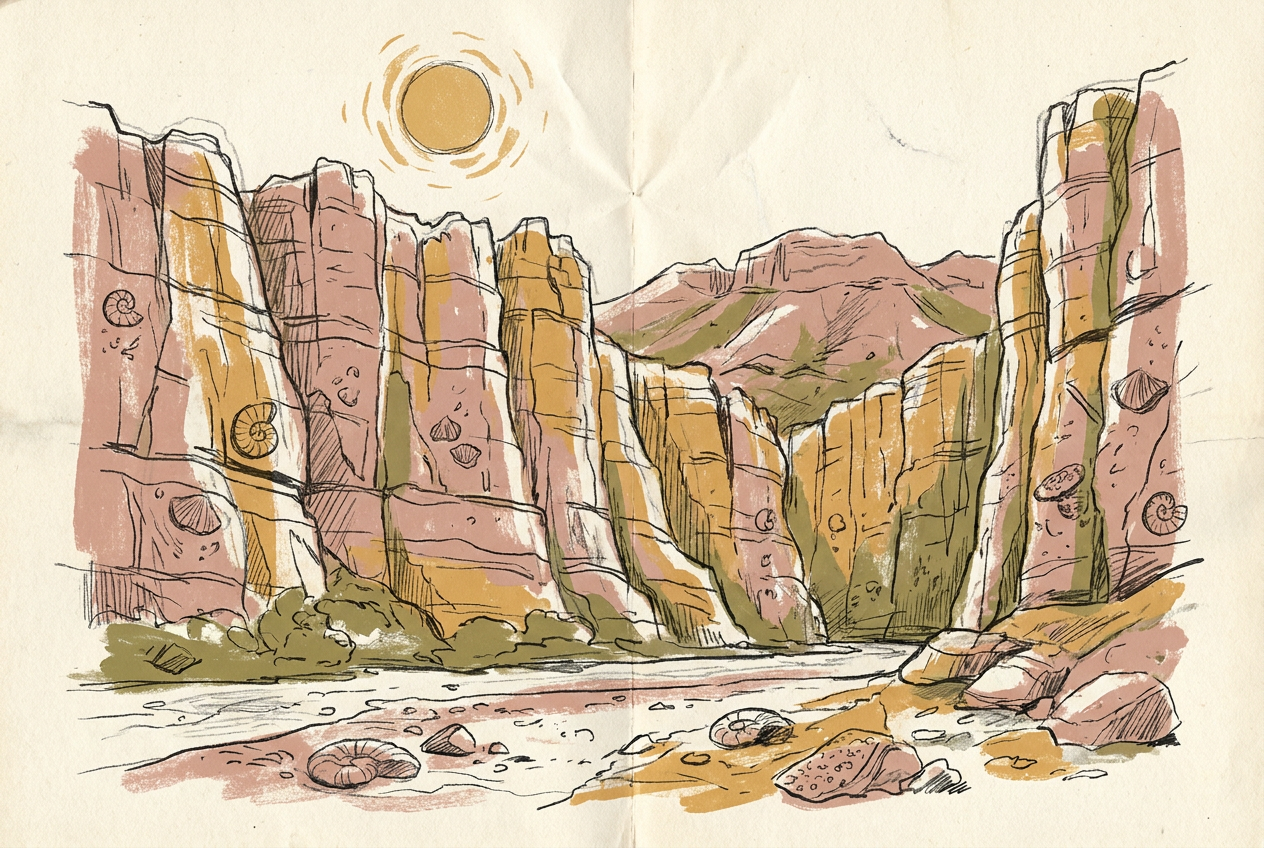
The walls of Windjana Gorge rise forty metres above the Lennard River, and they are not walls at all. They are a reef—a barrier reef built by corals, sponges, and algae that lived and died 350 million years ago, when the Kimberley lay beneath a warm Devonian sea and the fish that swam through these waters wore armour.
The Reef That Became a Range
The Devonian reef complexes of the Kimberley stretch for 350 kilometres along what is now the Napier, Oscar, and Geikie Ranges. They were part of a barrier system that ringed an ancient continent called Kimberley Land, a low landmass that sat roughly where the Kimberley sits today but in the southern hemisphere's tropical belt.
What makes these reefs exceptional is their preservation. Most Devonian reefs—including the famous ones at Canning Basin—were buried, compressed, and altered beyond recognition. Here, the limestone kept its original structure. The reef core, the fore-reef slope, the back-reef lagoon—each zone is still recognisable, still exposed in cross-section along the gorge walls.
You can walk through a gap cut by the Lennard River and see, in a single glance, the anatomy of an entire ecosystem.
What Lived and What Died
The reef builders were not the corals we know today. Tabulate and rugose corals built the framework, but they shared the reef with stromatoporoids—massive, layered sponges that secreted calcium carbonate skeletons. Together they created a structure dense enough to withstand Devonian storms.
In the limestone, fossils are everywhere. Brachiopods, crinoids, and trilobites lie packed in the rock. Above the reef, in the Gogo Formation of the same region, a different kind of preservation occurred: fish with bony armour, their soft tissues replaced by phosphate, preserved in three dimensions inside limestone nodules.
These placoderms—armoured fish up to four metres long—were the apex predators of the Devonian seas. One species, Eastmanosteus, had jaws lined with sharp bony plates that could crush ammonite shells. The Gogo fish are among the best-preserved Devonian vertebrates on Earth.
A barrier reef the length of the Great Barrier Reef once ringed the Kimberley. All that remains is the limestone skeleton, exposed in a river gorge.
How a Reef Becomes a Gorge
The Devonian sea withdrew when the Kimberley Land collided with the rest of Western Australia during the Carboniferous, about 320 million years ago. The reef limestone was buried under younger sediments for 250 million years, then lifted again when the continent rifted from Gondwana and drifted north.
Erosion did the rest. The Lennard River cut through the softer sediments, then met the limestone. Limestone dissolves slowly in slightly acidic rainwater, so the river carved a narrow gorge through the reef, leaving the harder reef rock standing as cliffs.
The result is a geological section that geologists travel from around the world to study. You can stand on the riverbed and touch the reef core, walk downstream and cross the fore-reef slope, then climb out onto the back-reef flat. The entire reef complex is readable, like a book with the pages still open.
A Vanished World
The Devonian reefs of the Kimberley were built during a time of extremes. Atmospheric carbon dioxide was four to six times higher than today. Sea levels fluctuated wildly. And at the end of the Devonian, a mass extinction wiped out most of the reef builders—the stromatoporoids, the tabulate corals, the trilobites.
The Kimberley reefs died with them. But the limestone skeleton survived, buried, then lifted, then carved by a river that still flows through the gorge each wet season.
Today, freshwater crocodiles bask on sandbanks where armoured fish once hunted. The reef that took 10 million years to build now holds water for cattle, shelters fig trees, and draws tourists who walk through a gap in the rock and do not realise they are walking through a wall of ancient sea.
More like this
- The 110-Million-Year-Old River That Runs Backwards UndergroundWestern Australia's 110-million-year-old dune system has been slowly dissolving into a labyrinth of caves where an ancient river still flows, carrying the taste of a Cretaceous desert.
- The 5,000-Year-Old Volcanoes That Still Smoke in the SouthIn Victoria's Newer Volcanics Province, 400 volcanic vents erupted as recently as 5,000 years ago—the youngest volcanic field in mainland Australia, where craters still hold blue lakes and scoria cone
- The 560-Million-Year-Old Garden That Never Saw a PredatorIn South Australia's Flinders Ranges, 560-million-year-old Ediacara surfaces preserve entire seafloor communities of fronds, discs, and quilts — a garden of soft-bodied life that flourished before pre