14 May 2026 · 3 min read
The Crystal That Remembers the Snowball: South Australia's Sturtian Tillite
In the Flinders Ranges, 660-million-year-old glacial deposits preserve evidence of a planet frozen from pole to pole, when Australia sat at the equator.
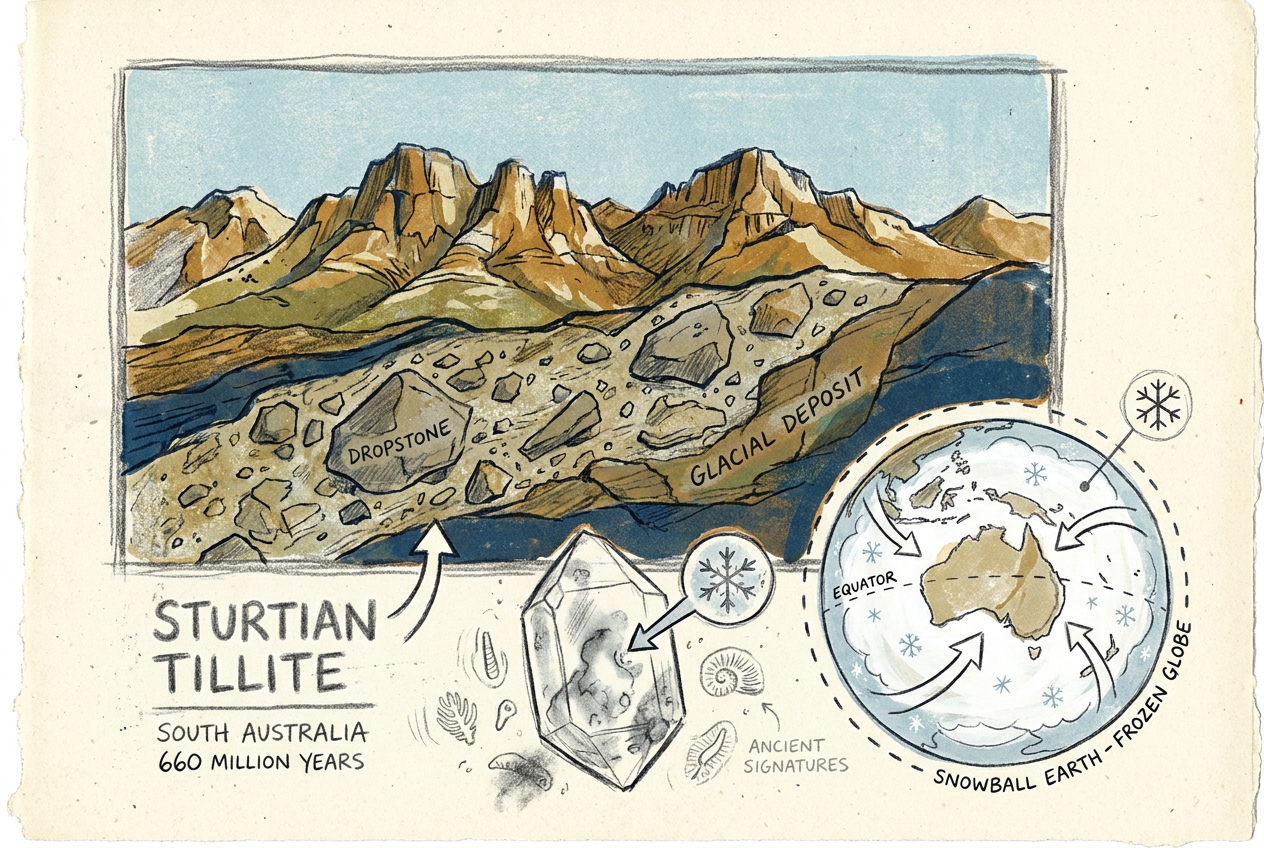
In the Flinders Ranges of South Australia, a band of grey-green rock sits atop red quartzite like a bruise on ancient skin. It contains boulders the size of cars, dropped into fine silt that settled in still, cold water. This is the Sturtian tillite—a deposit laid down 660 million years ago, when Australia sat near the equator and the entire planet was encased in ice.
The Evidence of a Frozen World
The Sturtian tillite is not subtle. It is a diamictite—a jumbled mess of pebbles, cobbles, and massive boulders suspended in a fine-grained matrix. Geologists call such rocks "glacial marine diamictites" because they form when icebergs calve into a quiet sea and melt, dropping their cargo of debris onto the seafloor below.
The boulders themselves tell the story. Many are striated—scratched and grooved by the grinding of ice against bedrock before they were plucked up and carried. Some are faceted, their surfaces planed flat by the weight of overlying ice. These are not river rocks. They are the calling cards of glaciers.
The best exposures lie along the Heysen Range, north of Wilpena Pound, where road cuttings slice through the tillite like a knife through layered cake. At Brachina Gorge, the formation is nearly 2,000 metres thick—an astonishing volume of glacial sediment that accumulated over millions of years as ice sheets advanced and retreated across a shallow sea.
The Sturtian glaciation lasted roughly 55 million years—one of the longest and most severe ice ages in Earth's history.
Australia at the Equator
Palaeomagnetic data places the Adelaide Rift Complex—now the Flinders Ranges—within 10 degrees of the equator during the Sturtian glaciation. This is the key fact that makes the tillite so strange. How does ice exist at the equator?
The answer is a "Snowball Earth"—a hypothesis that the entire planet, from pole to pole, froze over. Albedo feedback drove the freeze: ice reflected sunlight, which cooled the planet, which created more ice. The oceans froze kilometres thick. Only volcanic outgassing of carbon dioxide, building up over millions of years, eventually warmed the planet enough to melt the ice.
The Sturtian tillite is one of the best-exposed Snowball Earth deposits on the planet. South Africa, Namibia, and Canada have similar formations, but none are as continuous or as accessible as those in the Flinders Ranges.
The Great Unconformity
Above the tillite lies a sharp boundary—a surface geologists call the Great Unconformity. It separates the glacial sediments from overlying layers of dolomite and limestone that formed in warm, shallow seas after the ice retreated. This transition records one of the most dramatic climate shifts in Earth history: from a frozen planet to a greenhouse world in perhaps a few thousand years.
Above that unconformity, the fossils begin. The Trezona Formation, deposited shortly after the ice melted, contains the first signs of Ediacaran biota—soft-bodied, frond-like organisms that represent Earth's earliest complex life. The Sturtian glaciation may have acted as a bottleneck: it wiped out most existing life, and the warm interglacial that followed allowed new forms to diversify.
A Rock That Speaks
The Sturtian tillite is not beautiful. It is not gemstone or ore. It is a grey-green mess of angular rock fragments that looks, to the untrained eye, like nothing more than badly mixed concrete.
But it holds the memory of a frozen ocean, of a time when the continents were silent and the only sound was the groan of ice against stone. It records the moment the planet nearly died, and the improbable recovery that followed. And it sits, exposed and unremarkable, in a dry Australian gorge where tourists stop to photograph the red cliffs and never notice the grey-green rock at their feet.
More like this
- The 450-Million-Year-Old Volcano That Holds the Great Barrier ReefThe Great Barrier Reef grows on the eroded stumps of a 450-million-year-old volcanic arc that forms its hidden foundation.
- The 110-Million-Year-Old River That Runs Backwards UndergroundWestern Australia's 110-million-year-old dune system has been slowly dissolving into a labyrinth of caves where an ancient river still flows, carrying the taste of a Cretaceous desert.
- The 5,000-Year-Old Volcanoes That Still Smoke in the SouthIn Victoria's Newer Volcanics Province, 400 volcanic vents erupted as recently as 5,000 years ago—the youngest volcanic field in mainland Australia, where craters still hold blue lakes and scoria cone