14 May 2026 · 4 min read
The Reef That Rose From the Dead: The Nullarbor's Limestone Plain
Beneath the world's largest limestone karst, a 15-million-year-old seabed preserves the remains of a collapsed coral reef system that once stretched across southern Australia.
The world's largest limestone karst is not a mountain range or a canyon system. It is a flat, treeless plain the size of Great Britain, where the only interruptions are sinkholes that drop thirty metres straight down into the dark.
The Nullarbor Plain covers 270,000 square kilometres of southern Australia. Its name comes from the Latin nullus arbor — no trees — and it keeps that promise for hundreds of kilometres at a stretch. But beneath this featureless surface lies a buried history that is anything but flat.
The Sea That Left Its Bones
Fifteen million years ago, during the Middle Miocene, a shallow tropical sea covered what is now southern Australia. The continent had drifted north after breaking from Antarctica, and warm currents bathed its southern margin. In that clear, sunlit water, coral reefs grew.
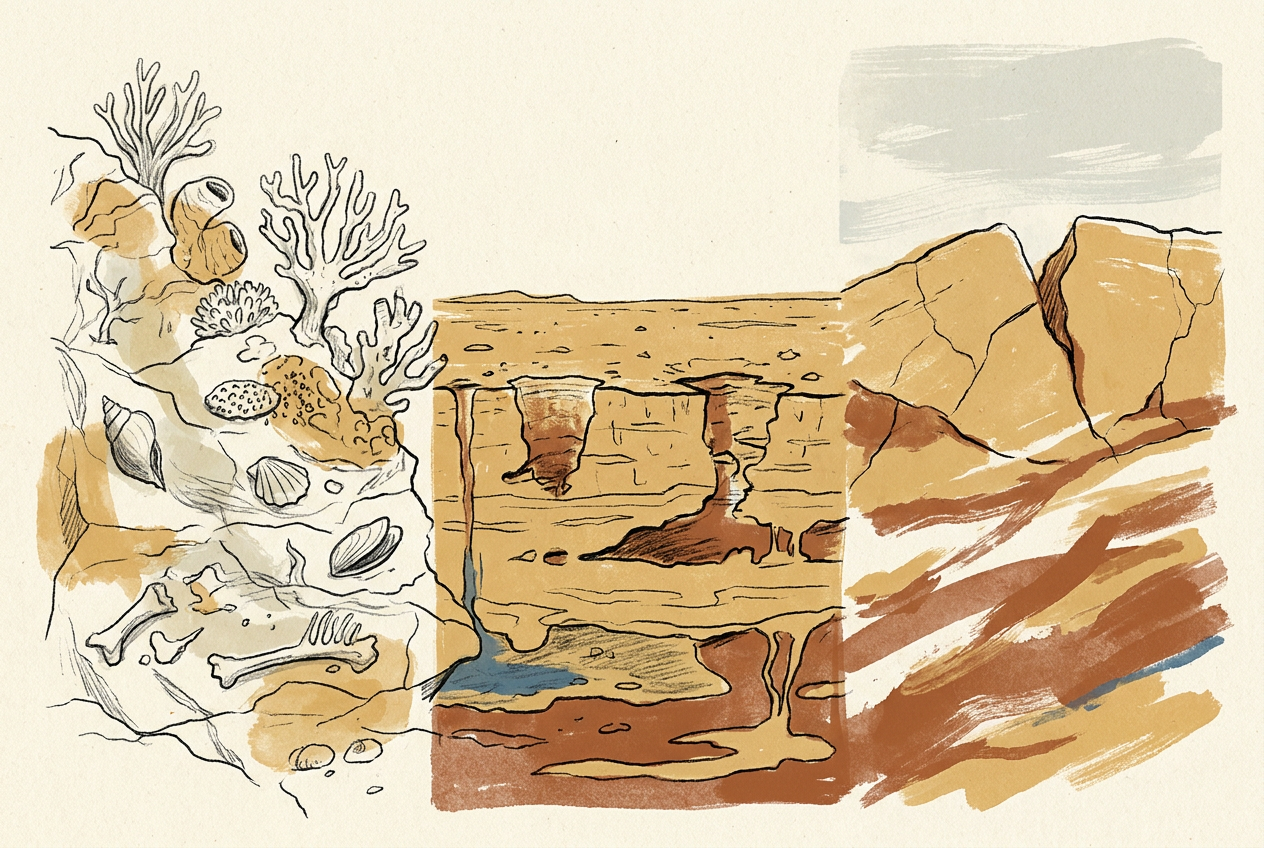
The Nullarbor limestone is almost entirely made of the calcium carbonate skeletons of marine organisms. Bryozoans, foraminifera, molluscs, and corals built a platform of reef and lagoon deposits that reached several hundred metres thick. When the sea retreated — partly due to global cooling, partly due to continental uplift — it left behind a flat, porous limestone plateau.
What makes the Nullarbor unusual is how little it has changed since. Unlike the Great Barrier Reef, which has been repeatedly buried, eroded, and reworked, the Nullarbor's Miocene reef system was simply lifted out of the water and parked in the desert. The original reef topography is still preserved beneath the plain, visible only in drill cores and cave passages.
The Caves That Drew the Reef
Rain falling on the Nullarbor does not run off. It sinks. Over millions of years, slightly acidic groundwater dissolved the limestone along joints and fractures, creating one of the most extensive cave systems on Earth.
More than 1,500 caves have been mapped beneath the Nullarbor. Some are single vertical shafts — "blowholes" that exhale cool, damp air onto the plain. Others are horizontal passages that extend for kilometres. The longest, Cocklebiddy Cave, runs 6.7 kilometres underground.
These caves are not random. They follow the buried contours of the Miocene reef. Where the reef had higher ridges of coral growth, the limestone was thicker and more fractured; water concentrated there and dissolved the rock fastest. The cave passages trace the shape of a reef that has not seen sunlight for 14 million years.
The Nullarbor's caves are fossil watercourses, following the ghost of a coral reef that died when Australia left Antarctica behind.
The Bones That Fell In
The sinkholes and caves acted as natural traps. For the past 5 million years, animals that wandered across the plain — and fell through its hidden openings — were preserved in the cave floors in extraordinary detail.
The most famous of these deposits is Koala Cave, discovered in the 1960s. The cave's floor contained the remains of giant marsupials that lived during the Pleistocene, when the Nullarbor was woodland rather than desert. A three-metre-tall wombat relative, Diprotodon. A marsupial lion, Thylacoleo. A short-faced kangaroo that stood two metres tall.
These animals did not live in the cave. They fell into it. The entrance was a vertical shaft hidden by vegetation; once an animal slipped in, the limestone walls offered no grip. The cave floor accumulated bones over hundreds of thousands of years, layering the remains of predators and prey together.
The same process continues today. Sheep occasionally fall into Nullarbor blowholes, and their skeletons join the fossil record.
The Plain That Won't Stay Flat
For all its apparent emptiness, the Nullarbor is still changing. The southern edge of the plain ends in the Bunda Cliffs, a 200-kilometre line of vertical escarpments that drop straight into the Great Australian Bight. Wave erosion cuts the cliffs back by several centimetres each year, exposing fresh sections of the Miocene limestone.
The cliff face is a cross-section through the ancient reef. You can walk along the base at low tide and see the same structures that divers see on modern reefs: branching coral forms, shelly lag deposits, the horizontal bedding of lagoon sediments. The cliff is a cutaway diagram of a world that existed when Australia was still attached to Antarctica.
On the plain itself, new sinkholes form every few decades. The limestone is so porous that a single heavy rain event can destabilise a cavity roof, opening a fresh hole in the desert floor. Each new sinkhole is a potential fossil trap, waiting for an animal to wander too close to the edge.
The Nullarbor looks dead. It is not. It is a reef that rose out of the sea and is still dissolving, collapsing, and collecting bones at its own slow pace.
More like this
- The 110-Million-Year-Old River That Runs Backwards UndergroundWestern Australia's 110-million-year-old dune system has been slowly dissolving into a labyrinth of caves where an ancient river still flows, carrying the taste of a Cretaceous desert.
- The 5,000-Year-Old Volcanoes That Still Smoke in the SouthIn Victoria's Newer Volcanics Province, 400 volcanic vents erupted as recently as 5,000 years ago—the youngest volcanic field in mainland Australia, where craters still hold blue lakes and scoria cone
- The 560-Million-Year-Old Garden That Never Saw a PredatorIn South Australia's Flinders Ranges, 560-million-year-old Ediacara surfaces preserve entire seafloor communities of fronds, discs, and quilts — a garden of soft-bodied life that flourished before pre