14 May 2026 · 3 min read
The Ash That Preserved a Garden: Victoria's Alcoa Fossil Forest
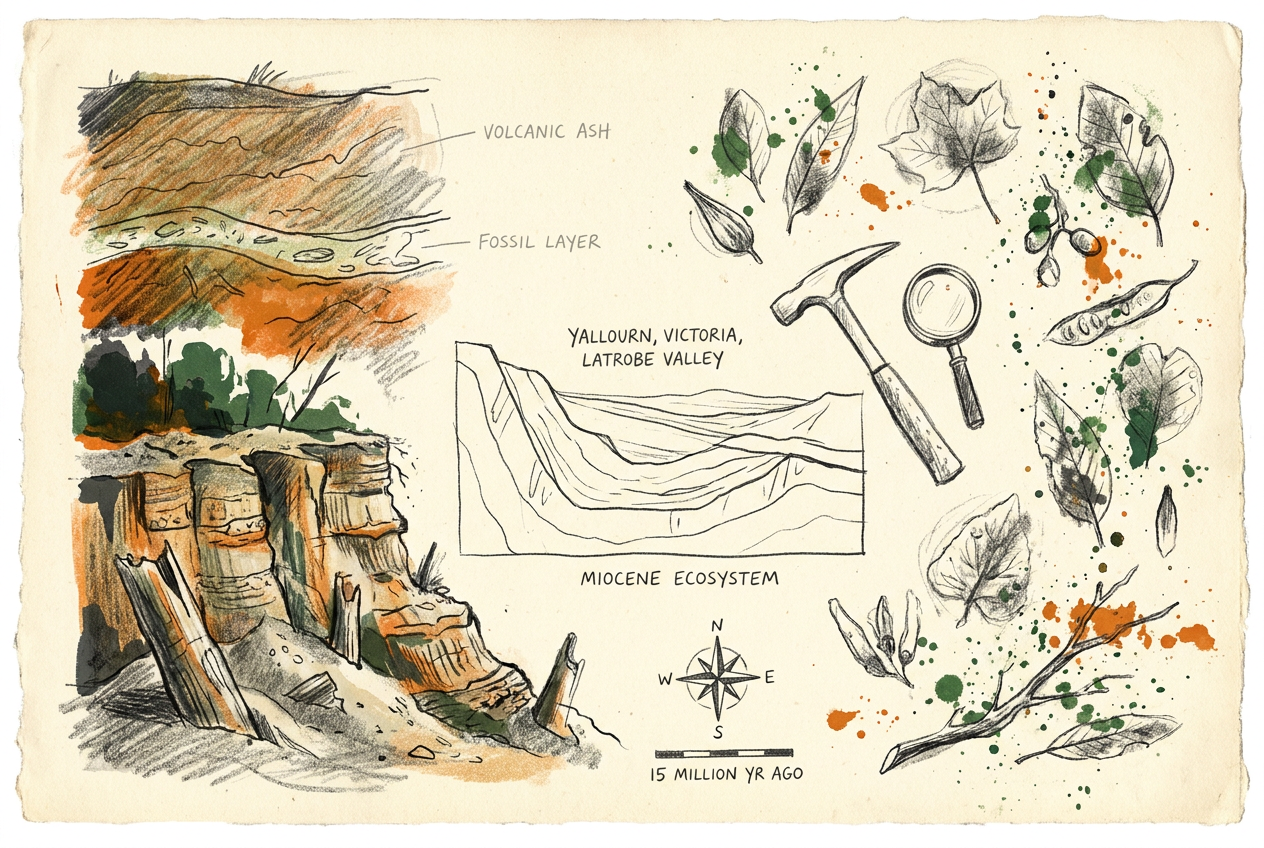
At Yallourn in Victoria's Latrobe Valley, a 15-million-year-old fossil forest buried by volcanic ash preserves an entire Miocene ecosystem in growth position.
In the Latrobe Valley, 150 kilometres east of Melbourne, coal miners working the Yallourn open-cut have exposed something extraordinary: a 15-million-year-old forest, still standing where it grew. The trees were buried so suddenly that their trunks remain upright, their roots still penetrating the soil they once drew from. A whole Miocene woodland, flash-frozen in ash.
The Eruption That Stopped Time
The Yallourn fossil forest sits within the brown coal seams of the Latrobe Valley, one of Australia's thickest coal deposits. Around 15 million years ago, this landscape was a warm temperate rainforest—podocarps, southern beeches, and eucalypts growing along peat-forming swamps. Then a volcano in the nearby Strzelecki Ranges erupted.
Ashfall buried the forest in hours. The trees did not fall or rot. They were entombed upright, their cellular structure preserved by silica-rich volcanic glass that permineralised the wood before decay could take hold. Today, mining operations expose these fossil trunks as they strip away the overburden. Some stand more than a metre tall, their bark impressions still visible.
More than 100 individual trees have been documented in growth position at Yallourn. The site is among the best-preserved Miocene fossil forests on Earth.
"The trees were buried so quickly that they never had time to fall. They are still standing exactly where they grew, 15 million years later."
What the Forest Tells Us
The Yallourn fossils capture a precise ecological moment. Pollen grains preserved in the surrounding sediment reveal a forest dominated by Nothofagus (southern beech) and podocarps, with a diverse understorey of ferns, cycads, and palms. This was not the dry eucalypt woodland that covers much of Victoria today. It was a cool temperate rainforest, sustained by high rainfall and mild temperatures.
The site also preserves leaves, fruits, and seeds pressed into the ash layers. These delicate remains allow palaeobotanists to reconstruct the forest's structure with remarkable detail—which species grew in the canopy, which formed the understorey, and how the ecosystem changed as the peat accumulated over thousands of years.
The Latrobe Valley's brown coal itself is the compressed remains of earlier peat swamps. The fossil forest sits within this coal, a ghost of the vegetation that preceded it. Together, the coal and the forest record millions of years of environmental change across southeastern Australia.
A Landscape That Repeated the Trick
The Yallourn burial was not a one-off event. Geologists have identified at least six separate fossil forest horizons within the Latrobe Valley coal sequence, each representing a different eruption that buried a different woodland. The same volcanic system in the Strzelecki Ranges erupted repeatedly over several million years, each time preserving a snapshot of the forest that happened to be growing downwind.
The Strzelecki volcanoes were part of a broader volcanic province that stretched across what is now Bass Strait. These eruptions were not explosive in the style of Mount St Helens. They produced large volumes of ash that drifted hundreds of kilometres, settling like a slow blanket over the landscape. Animals had little time to flee. The fossil record includes the remains of marsupials and birds that were caught in the ashfall, their bones preserved alongside the upright trees.
The Coal That Cannot Be Mined
The Yallourn open-cut mine is still active, feeding the nearby Hazelwood and Yallourn power stations. As the mine expands, new fossil trees are regularly uncovered. Some are destroyed by the mining process. Others are salvaged by museum teams who work alongside the excavators.
The fossil forest is not protected as a national park or heritage site. It exists because the coal is being removed. Once the mine closes and the pit is rehabilitated, the remaining fossils will be buried again—this time by design rather than by eruption. The forest that ash preserved for 15 million years will return to the ground, waiting for another unlikely exposure.
More like this
- The 5,000-Year-Old Volcanoes That Still Smoke in the SouthIn Victoria's Newer Volcanics Province, 400 volcanic vents erupted as recently as 5,000 years ago—the youngest volcanic field in mainland Australia, where craters still hold blue lakes and scoria cone
- The 560-Million-Year-Old Garden That Never Saw a PredatorIn South Australia's Flinders Ranges, 560-million-year-old Ediacara surfaces preserve entire seafloor communities of fronds, discs, and quilts — a garden of soft-bodied life that flourished before pre
- The 300-Million-Year-Old Forest That Died Standing UpIn New South Wales, a 300-million-year-old fossil forest preserves dozens of trees buried upright by a Permian volcanic eruption—an entire ecosystem frozen in ash.