16 May 2026 · 4 min read
The Ash That Gave Birth to Animals: Ediacara's Volcanic Moment
In South Australia's Flinders Ranges, a 555-million-year-old volcanic ash bed precisely dates the Ediacaran biota, revealing how a single volcanic event froze a snapshot of Earth's first complex life.
On a hillside in South Australia's Flinders Ranges, a bed of white ash no thicker than a finger marks the moment the first complex animals appeared on Earth. This is the Ediacara Member of the Rawnsley Quartzite, and the ash that fell here 555 million years ago buried a community of soft-bodied organisms so strange that scientists debated for decades whether they were animals at all.
The Ediacaran biota—frond-like Charnia, quilted Dickinsonia, and the mysterious Tribrachidium—represent life's first experiment with multicellular complexity. Before them, the world belonged to microbes and single-celled organisms. After them, the Cambrian explosion would fill the seas with skeletons and shells. The Ediacarans were the bridge, and volcanic ash is what preserved their story.
The Ash That Stopped Time
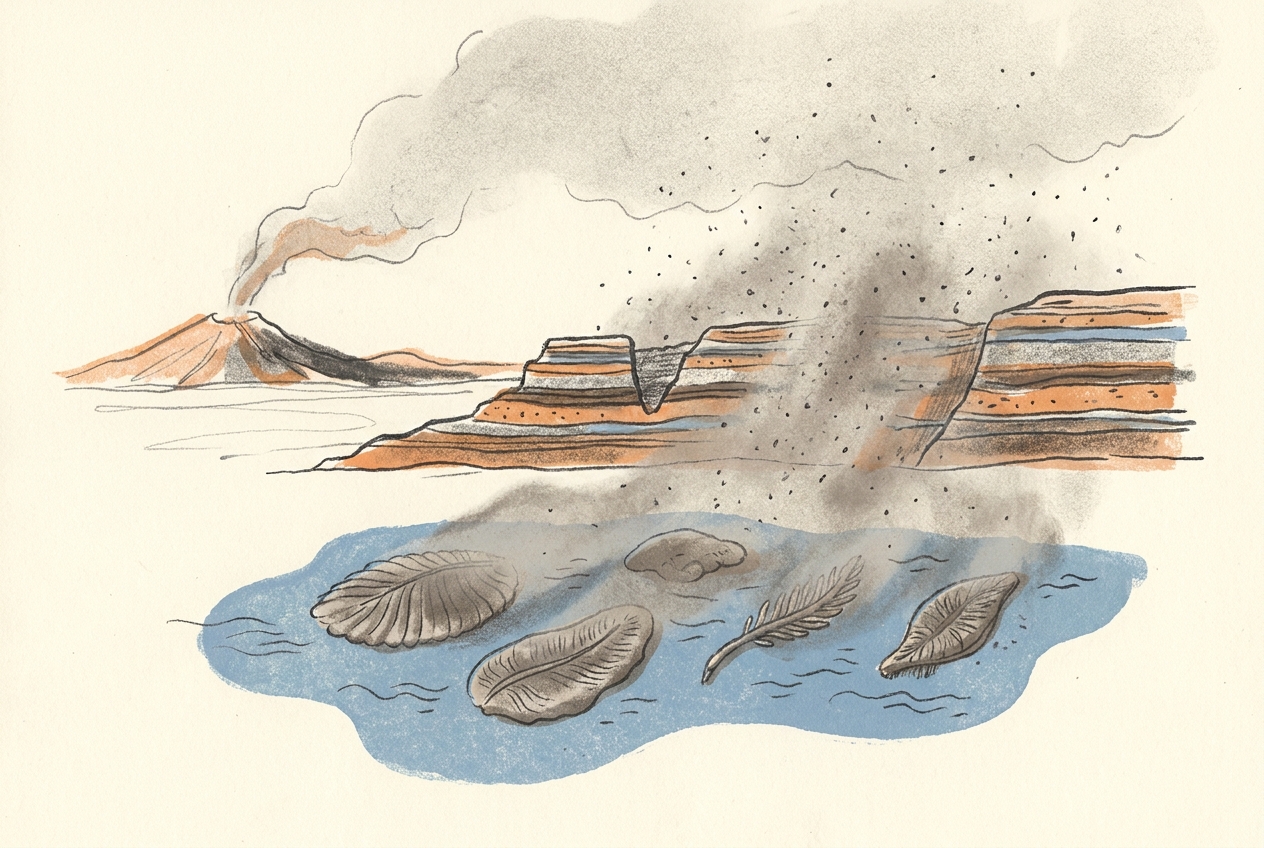
The bed of volcanic ash that entombs the Ediacaran fossils is called the "Bunyeroo Gorge ash." It fell into a shallow marine basin that stretched across what is now the Flinders Ranges, settling onto a seafloor carpeted with microbial mats. These mats—thin biofilms of cyanobacteria—stabilised the sediment and created a firm substrate where the Ediacaran organisms lived.
When the ash fell, it smothered the mat and everything on it, preserving the organisms in three dimensions. Unlike most fossils, which form when hard parts are replaced by minerals, the Ediacarans were soft-bodied. The ash cast them in fine-grained volcanic sediment before bacteria could decompose them, capturing the precise shape of their bodies.
The ash bed is not just a preservative. It is a clock.
The volcanic glass in the ash contains zircons—tiny crystals that lock in uranium and lead. By measuring the ratio of these elements, geochemists have dated the Ediacara Member to 555 million years, plus or minus about 300,000 years. This is one of the most precise dates in Precambrian palaeontology, and it pins the Ediacaran biota to a specific moment in Earth history.
A Continent Adrift
To understand why the ash was there, you have to look at the broader tectonic picture. Five hundred and fifty-five million years ago, the continent that would become Australia was part of the supercontinent Gondwana, which was then assembling near the South Pole. The Flinders Ranges region was a rift basin—a place where the crust was stretching and thinning as Gondwana pulled apart.
Volcanic eruptions accompanied this rifting. Magma rose through fractures in the crust, erupting onto the seafloor and into the atmosphere. The Bunyeroo Gorge ash came from one such eruption, likely from a volcanic arc to the east, where oceanic crust was subducting beneath the edge of Gondwana. The ash drifted west on prevailing winds and settled into the quiet waters of the rift basin.
This tectonic setting is what made the Ediacaran fossils possible. The rifting created the shallow, sediment-starved basin where microbial mats could flourish. The volcanism provided the ash that preserved the organisms. And the subsequent compression of the basin—during the Delamerian Orogeny, about 500 million years ago—lifted the sediments into the mountains we see today.
The Garden in the Rock
The Ediacara Member is not a single fossil bed. It is a series of bedding planes, each representing a different moment when ash fell and preserved a different community. Walking through the Flinders Ranges, you can trace these layers across kilometres, each one a snapshot of a vanished world.
Some beds preserve Dickinsonia—oval organisms with ribbed bodies that grew up to a metre long. Others preserve Spriggina, a segmented creature that may have been an early relative of the arthropods. Still others preserve trace fossils—the tracks and burrows of organisms moving across the microbial mat, evidence that some Ediacarans could crawl.
The diversity is remarkable. More than 50 species have been described from the Ediacara Member, representing a range of body plans unmatched in older rocks. Yet none of these organisms had skeletons, shells, or hard parts of any kind. They were experiments in multicellularity that mostly failed; by the Cambrian, almost all of them had vanished.
What the Ash Still Holds
The Bunyeroo Gorge ash is not the only volcanic bed in the Ediacara Member. Scattered through the sequence are other ash layers, each potentially holding a date and a fossil community. Many remain unstudied. The ash beds are also chemically distinct, containing trace elements that record the composition of the magma that produced them—and, by extension, the tectonic setting of the eruption.
Geochemists can use these trace elements to fingerprint individual eruptions and correlate ash beds across hundreds of kilometres. This allows them to reconstruct the volcanic landscape of Ediacaran Australia: where the volcanoes were, how often they erupted, and how the ash dispersed.
But the most important thing the ash holds is time. Without it, the Ediacaran biota would be a collection of strange shapes in the rock, their ages uncertain by millions of years. With it, the fossils are pinned to a precise interval, and the story of animal life has a date of birth.
More like this
- The 5,000-Year-Old Volcanoes That Still Smoke in the SouthIn Victoria's Newer Volcanics Province, 400 volcanic vents erupted as recently as 5,000 years ago—the youngest volcanic field in mainland Australia, where craters still hold blue lakes and scoria cone
- The 560-Million-Year-Old Garden That Never Saw a PredatorIn South Australia's Flinders Ranges, 560-million-year-old Ediacara surfaces preserve entire seafloor communities of fronds, discs, and quilts — a garden of soft-bodied life that flourished before pre
- The 300-Million-Year-Old Forest That Died Standing UpIn New South Wales, a 300-million-year-old fossil forest preserves dozens of trees buried upright by a Permian volcanic eruption—an entire ecosystem frozen in ash.