16 May 2026 · 2 min read
The Ash That Shaped the Nullarbor: Australia's Miocene Volcanoes
Beneath the Nullarbor Plain's limestone lie hundreds of 15-million-year-old volcanoes that erupted through a drying sea, leaving a landscape of scattered maars and volcanic vents.
The Nullarbor Plain looks like the most tectonically stable place on Earth — a flat, treeless limestone slab the size of New Zealand. But drill cores through its white surface reveal something unexpected: hundreds of buried volcanoes.
The Sea That Dried
Fifteen million years ago, during the Miocene, southern Australia looked nothing like the arid desert of today. A shallow, warm sea covered what is now the Nullarbor, rich with marine life whose carbonate skeletons would eventually become the plain's limestone cap. Australia was still drifting north from Antarctica, and the continent's southern margin was slowly rising.
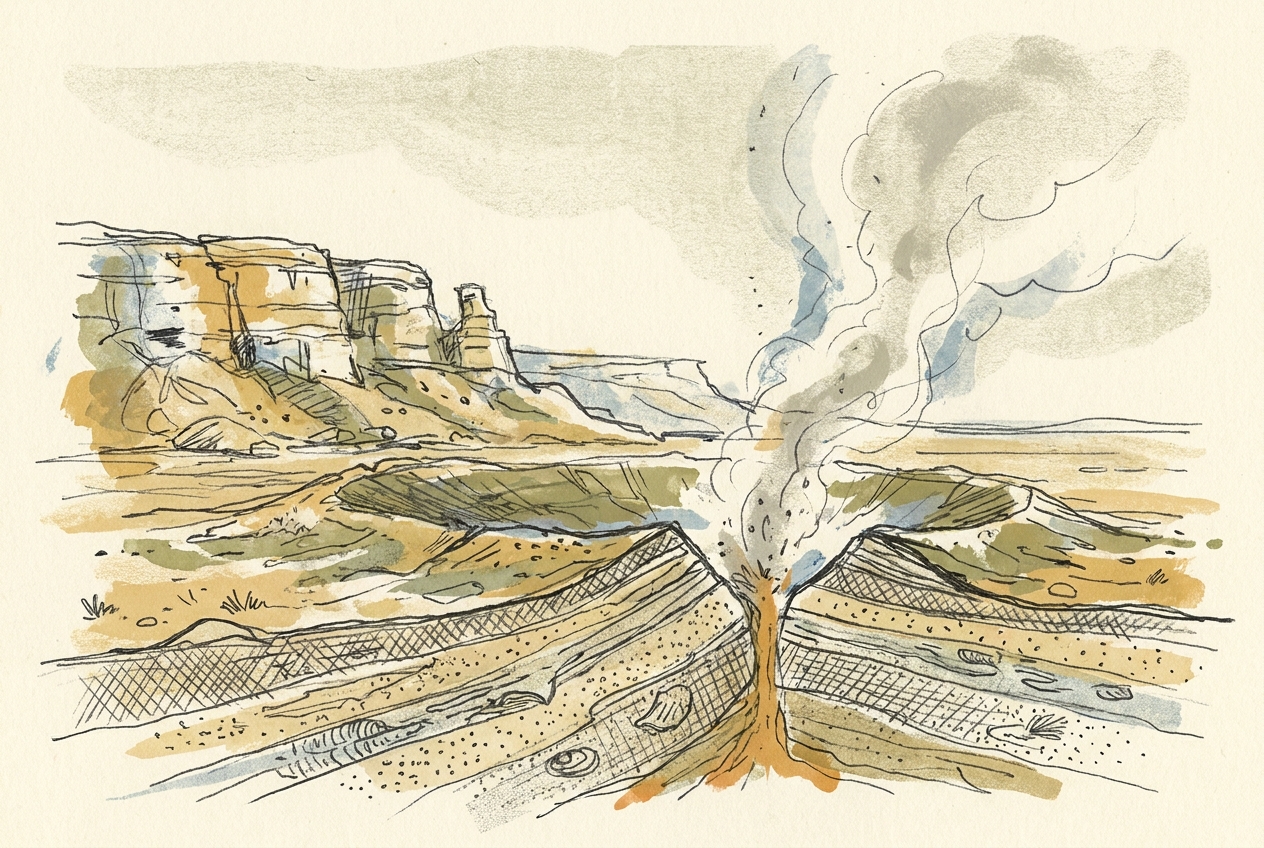
As the sea retreated, the crust stretched and cracked. Magma from the mantle found its way to the surface through these weaknesses, erupting not as towering shield volcanoes but as small, explosive vents. The eruptions met groundwater and limestone, producing phreatomagmatic explosions — steam-driven blasts that left shallow craters rather than mountains.
More than 350 volcanic centres have been identified beneath the Nullarbor's surface. Some are maars — broad, low craters formed when magma met water. Others are tuff rings and small scoria cones. None rose more than a few hundred metres above the plain.
The Craters That Stayed Hidden
The Nullarbor's volcanoes are almost invisible from the ground. Erosion has worn many flat. Others lie buried beneath younger limestone and sand. They were discovered largely through geophysical surveys and drilling, not by walking the surface.
"The Nullarbor volcanics are the most extensive Miocene volcanic province in Australia, yet you can drive across them and never know they exist."
The best-preserved example is the Mount Gambier volcanic complex, far to the southeast, but the Nullarbor's volcanoes are older and more weathered. At Toolinna Rockhole, near the coast, a weathered volcanic vent cuts through the limestone, exposing basalt that erupted when the sea was still nearby. The basalt contains olivine crystals and shows the chemical signature of mantle melting — a direct sample of the rock beneath the plain.
The eruptions were brief, probably lasting only a few thousand years. After the magma supply dwindled, the vents sat dormant. The sea continued to withdraw. The limestone continued to form. The volcanoes became buried.
The Legacy in the Rock
The Nullarbor's volcanic episode tells a story about Australia's tectonic journey. As the continent moved north, it passed over a region of mantle upwelling — a minor hot spot or a zone of extension related to the opening of the Southern Ocean. The magmatism was a symptom of that passage.
The erupted basalts also contain clues about the deep Earth. Xenoliths — fragments of the mantle carried up in the magma — have been found in some Nullarbor volcanic rocks. These small green crystals of peridotite and pyroxenite are samples of the lithosphere 50 kilometres down, delivered intact by rising magma.
Today, the Nullarbor's volcanoes are a quiet archive. The limestone that buried them also preserved them. Where erosion has cut through the cover, the old volcanic conduits stand as low, dark hills against the white plain — subtle reminders that even the flattest landscape once held fire.
More like this
- The 110-Million-Year-Old River That Runs Backwards UndergroundWestern Australia's 110-million-year-old dune system has been slowly dissolving into a labyrinth of caves where an ancient river still flows, carrying the taste of a Cretaceous desert.
- The 5,000-Year-Old Volcanoes That Still Smoke in the SouthIn Victoria's Newer Volcanics Province, 400 volcanic vents erupted as recently as 5,000 years ago—the youngest volcanic field in mainland Australia, where craters still hold blue lakes and scoria cone
- The 560-Million-Year-Old Garden That Never Saw a PredatorIn South Australia's Flinders Ranges, 560-million-year-old Ediacara surfaces preserve entire seafloor communities of fronds, discs, and quilts — a garden of soft-bodied life that flourished before pre