15 May 2026 · 3 min read
The Ash That Froze a Moment: Victoria's Miocene Lake Deposit
At Victoria's Bacchus Marsh, a 15-million-year-old diatomite deposit preserves a vanished lake ecosystem in microscopic silica, recording a Miocene climate when Australia was still connected to Antarc
Fifty kilometres west of Melbourne, a clay pit cuts into a hill that holds the ghost of a lake. The rock is light as pumice, white as chalk, and when you wet a fragment it smells of wet earth and ancient rain. This is diatomite—the compressed skeletons of a billion billion algae, laid down in still water fifteen million years ago, when Victoria was a different continent.
The Microscopic City
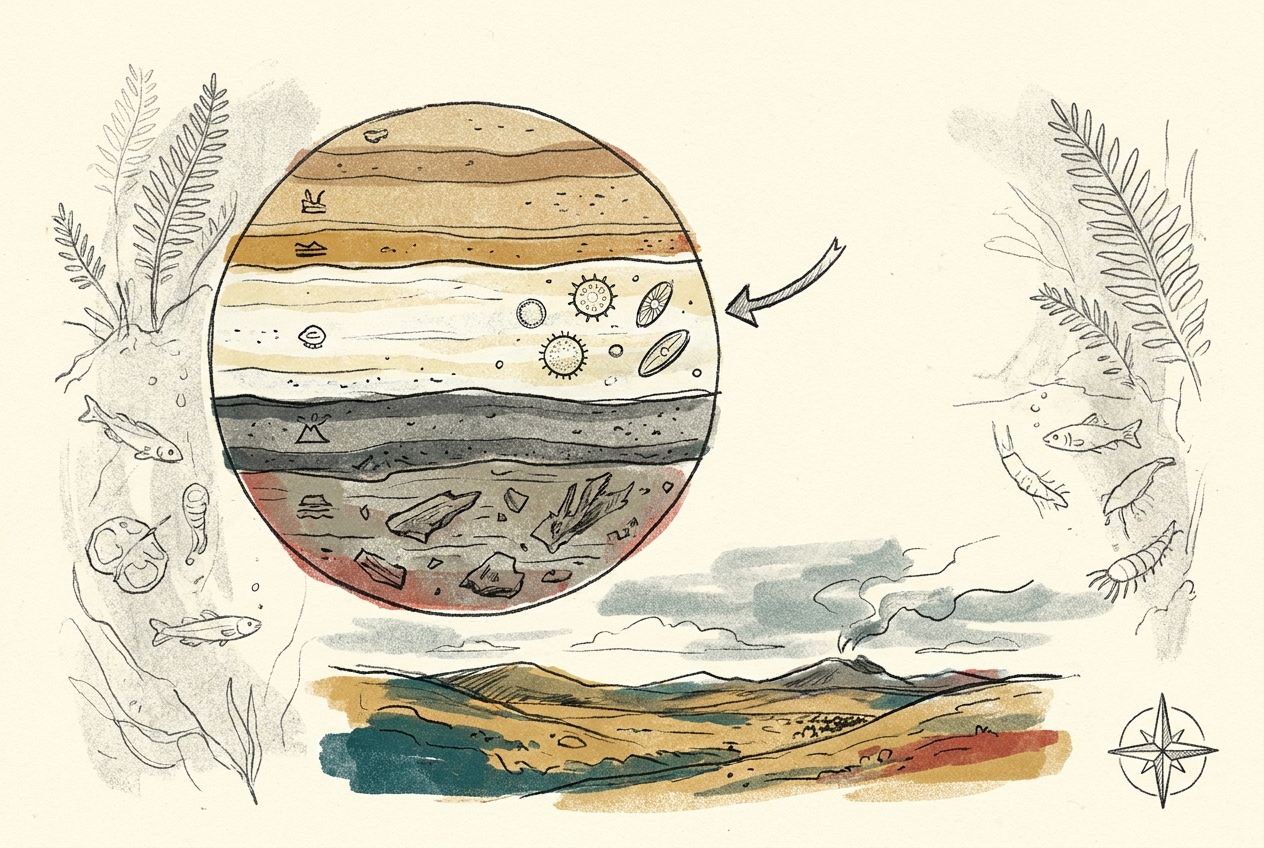
Diatoms are single-celled algae that build intricate glass shells around themselves. Each species constructs a unique architecture—circles, boats, stars, discs—perforated with pores finer than a human hair. When they die, their silica skeletons rain down through the water column and accumulate on the lakebed.
At Bacchus Marsh, that rain fell uninterrupted for thousands of years. The result is a deposit up to thirty metres thick, composed almost entirely of microscopic glass. A single cubic centimetre of diatomite contains millions of individual fossils, each one preserving the exact geometry of a cell that floated in sunlight when marsupials were still small and Antarctica was green.
The lake was deep, calm, and nutrient-rich. Seasonal blooms of diatoms turned the water green, then brown, then settled into the mud. Layer by layer, the lake recorded its own biology with a fidelity that coarser sediments cannot match.
The Ash That Stopped the Clock
What makes the Bacchus Marsh deposit remarkable is how it ended. A volcanic eruption—likely from one of the many vents that dotted Victoria during the Miocene—buried the lake in ash. The ash sealed the diatomite from oxygen and disturbance, preserving the delicate lamination of each season's growth.
The lake did not dry out gradually, nor was it scoured by a flood. It was simply covered, like a pressed flower between pages.
The ash itself contains crystals that can be dated. The deposit sits at roughly fifteen million years old—the Middle Miocene Climatic Optimum, the warmest period Earth has experienced since the dinosaurs. At that time, Australia was still connected to Antarctica, and the southern continent supported beech forests and marsupials that would later vanish under ice.
What the Layers Reveal
The diatomite is not uniform. Thin bands of darker sediment alternate with pure white layers, recording changes in water chemistry, temperature, and nutrient supply. Each band is a page in the lake's diary.
Scientists have used these layers to reconstruct Miocene seasons. The diatoms tell them that the lake was deep in winter, shallow in summer, and that the surrounding landscape was forested. Pollen grains trapped in the same sediment show traces of _Nothofagus_—southern beech—and conifers that no longer grow in Victoria.
The deposit also contains fish fossils. Complete skeletons of small freshwater fish, preserved in the same silica-rich mud, show no signs of scavenging or decay. They sank into anoxic water and were buried by the next season's diatom bloom, their bones replaced by the same glass that built the algae around them.
The Window That Remains
Diatomite is fragile. It crumbles easily, absorbs water, and erodes faster than most rocks. The Bacchus Marsh deposit survives only because it was buried under basalt and clay, protected from weathering for millions of years. Mining operations have exposed fresh faces of the rock, giving palaeontologists access to layers that would otherwise remain hidden.
The same volcanic activity that ended the lake also preserved it. Eruptions that must have seemed catastrophic to the animals living nearby—ash falls that smothered forests, buried streams, and turned day to twilight—created the conditions for a fossil deposit of extraordinary precision.
Today, the pit at Bacchus Marsh yields diatomite for industrial use: filtration, insulation, abrasives. But embedded in the pale rock is a record that no factory can use: a fifteen-million-year chronicle of a lake that bloomed, died, and was frozen in glass.
More like this
- The 560-Million-Year-Old Garden That Never Saw a PredatorIn South Australia's Flinders Ranges, 560-million-year-old Ediacara surfaces preserve entire seafloor communities of fronds, discs, and quilts — a garden of soft-bodied life that flourished before pre
- The 300-Million-Year-Old Forest That Died Standing UpIn New South Wales, a 300-million-year-old fossil forest preserves dozens of trees buried upright by a Permian volcanic eruption—an entire ecosystem frozen in ash.
- The 1.75-Billion-Year-Old Reef That Outranks the BarrierA 1.75-billion-year-old microbial reef in the Kimberley is the largest biological structure ever built by a single species, preserving a world without predators.