13 July 2026 · 3 min read
The 1.2-Billion-Year-Old Lake That Still Burns Underground
In the Stuart Shelf, 1.2-billion-year-old sedimentary rocks contain the world's oldest preserved groundwater, still chemically active and capable of generating hydrogen from radioactive decay.
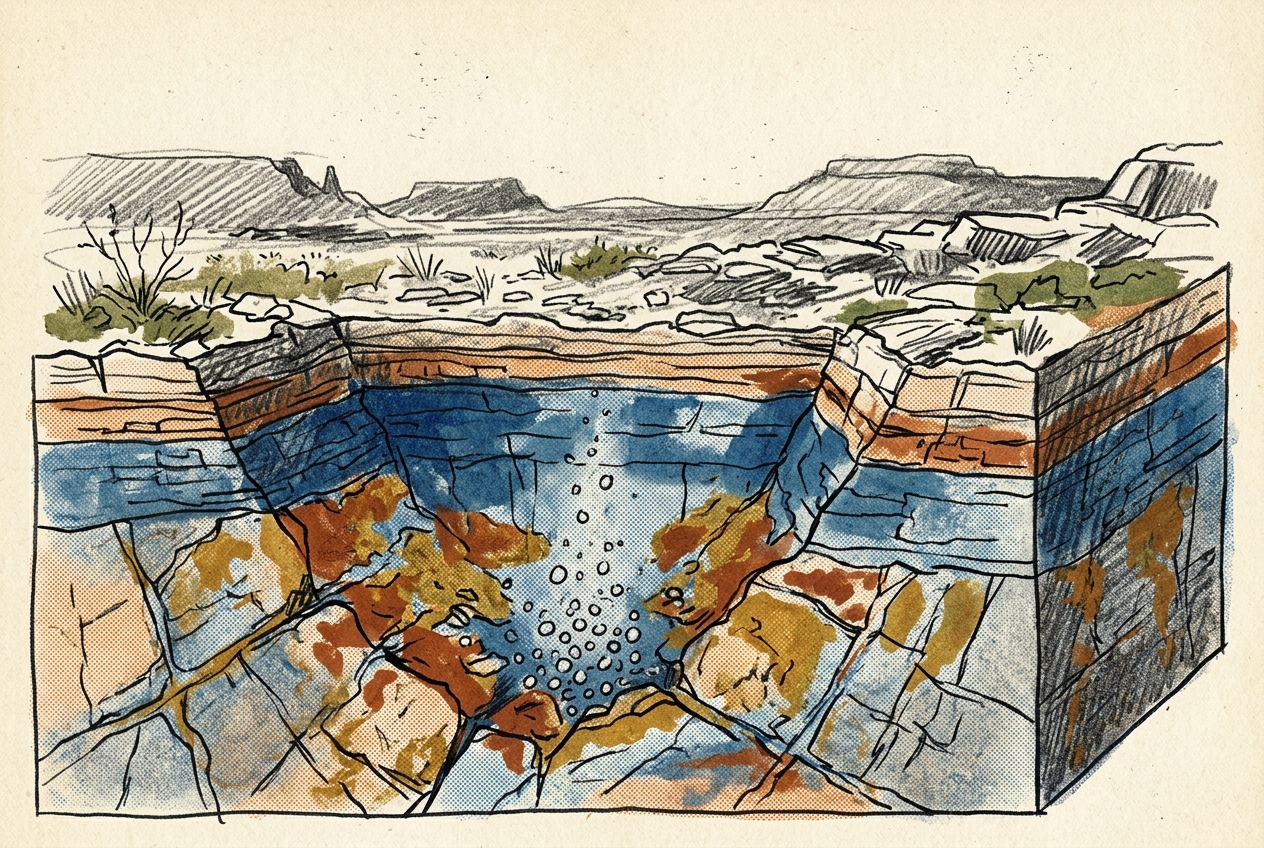
In the Stuart Shelf of South Australia, water has been trapped 1.5 kilometres underground for more than a billion years. It is not stagnant. It is still reacting with the rock around it, producing hydrogen, helium, and a faint chemical signature that tells us the Proterozoic was not as barren as we once thought.
The 1.2-Billion-Year-Old Rain
The water was first described in 2013 by a team drilling into the Olympic Dam copper-uranium deposit. They hit a pocket of brine that, when analysed, contained argon isotopes that could only have accumulated if the water had been sealed from the surface for over a billion years. Further dating pinned the age at 1.2 billion years — the oldest known groundwater on Earth.
This water did not seep down slowly. It was trapped when the basin closed. The sedimentary rocks of the Stuart Shelf — sandstones, shales, and evaporites deposited in a shallow Proterozoic sea — were buried and compressed until their pores sealed. Any water already inside became a closed system. No new water entered. Nothing left.
The brine is roughly four times saltier than seawater. It contains high concentrations of uranium, thorium, and potassium dissolved from the surrounding minerals. These radioactive elements decay steadily, and their energy splits water molecules, releasing hydrogen gas into the trapped fluid.
A Chemical Factory in the Dark
That hydrogen is the most interesting part. In the presence of the right catalysts — minerals such as pyrite and magnetite, which are abundant in the Stuart Shelf — hydrogen can react with carbon dioxide to form simple organic molecules like methane and formate. This is exactly what the researchers found: the ancient brine contains methane and other hydrocarbons that appear to have been generated abiotically, deep underground, with no help from living organisms.
The process mirrors what happens at hydrothermal vents on the seafloor, where hydrogen-rich fluids support entire ecosystems of microbes that never see sunlight. The difference is scale and duration. Here, the reaction has been running slowly for over a billion years, in a dark, pressurised reservoir the size of a small sea.
The water is not a fossil. It is a still-active chemical system, older than most rocks on the surface, and it is still making new molecules.
This raises a question that planetary scientists find compelling. If similar processes occurred on early Mars, when it had liquid water and a thicker atmosphere, then hydrogen-rich brines trapped in the Martian crust could have provided energy for microbial life long after the surface became uninhabitable.
What the Brine Tells Us About the Proterozoic
The Stuart Shelf brine also offers a rare window into the chemistry of the Proterozoic ocean. The water's isotopic composition — particularly its ratios of chlorine, bromine, and noble gases — matches what geochemists have modelled for ancient seawater before the rise of oxygen. It is a sample of the ocean as it existed 1.2 billion years ago, preserved in a geological time capsule.
That ocean was stratified. Deep waters were anoxic and rich in dissolved iron. Shallow waters had begun to accumulate oxygen from cyanobacteria, but not enough to oxygenate the entire water column. The brine from the Stuart Shelf retains this signature: it contains dissolved iron and manganese at concentrations that would be impossible in modern oxygenated groundwater.
The same formations that hold this ancient water also host some of the world's largest uranium and copper deposits. The connection is not coincidental. The brines acted as transport fluids, leaching metals from the surrounding rocks and depositing them in structural traps. Olympic Dam, the largest uranium deposit on Earth, was formed partly by the movement of these same Proterozoic fluids.
A Finite Archive
The Stuart Shelf brine is not infinite. As the radioactive elements decay and the chemical reactions proceed, the system is slowly exhausting its reactants. The hydrogen production will taper off over the next few hundred million years. The water itself will eventually become inert.
But for now, it remains what it has been since the Mesoproterozoic: a sealed chemical reactor, still running on the energy of nuclear decay, still generating molecules that could feed a biosphere that never existed. It is the oldest active groundwater on Earth, and it has not finished reacting yet.
More like this
- The 1.6-Billion-Year-Old Mud That Still Breathes GasIn the McArthur Basin, 1.6-billion-year-old sedimentary rocks still generate natural gas from organic matter laid down in a Proterozoic sea.
- The 1.1-Billion-Year-Old Salt That Collapsed a ContinentIn the Amadeus Basin, 1.1-billion-year-old evaporite beds dissolved beneath Central Australia, triggering the collapse that formed the MacDonnell Ranges and opened pathways for mineral deposits.
- The 585-Million-Year-Old Embryos That Refuse to DecayIn the Ediacaran hills of South Australia, 585-million-year-old fossils preserve the earliest known animal embryos, their cells still visible in phosphate.