14 July 2026 · 3 min read
The 1.1-Billion-Year-Old Meteorite That Left No Crater
In the Amadeus Basin, 1.1-billion-year-old impact melt rock preserves the oldest known meteorite impact in central Australia—a collision that left no crater, only a scattered field of shocked sandston
In the red heart of Australia, a rock fell from the sky 1.1 billion years ago and left no hole in the ground. The crater has long since eroded, the ejecta blanket weathered to dust. But the evidence survives in a scattering of melted sandstone fragments strewn across the Amadeus Basin—the shock-shattered record of a collision that predates most of the continent's known impact history.
The Rock That Didn't Belong
Geologists call it the Gosses Bluff impact structure, but the name is misleading. What visitors see today is not a crater but a ring of hills—the eroded central uplift of an impact that once measured twenty-two kilometres across. The original bowl vanished millions of years ago.
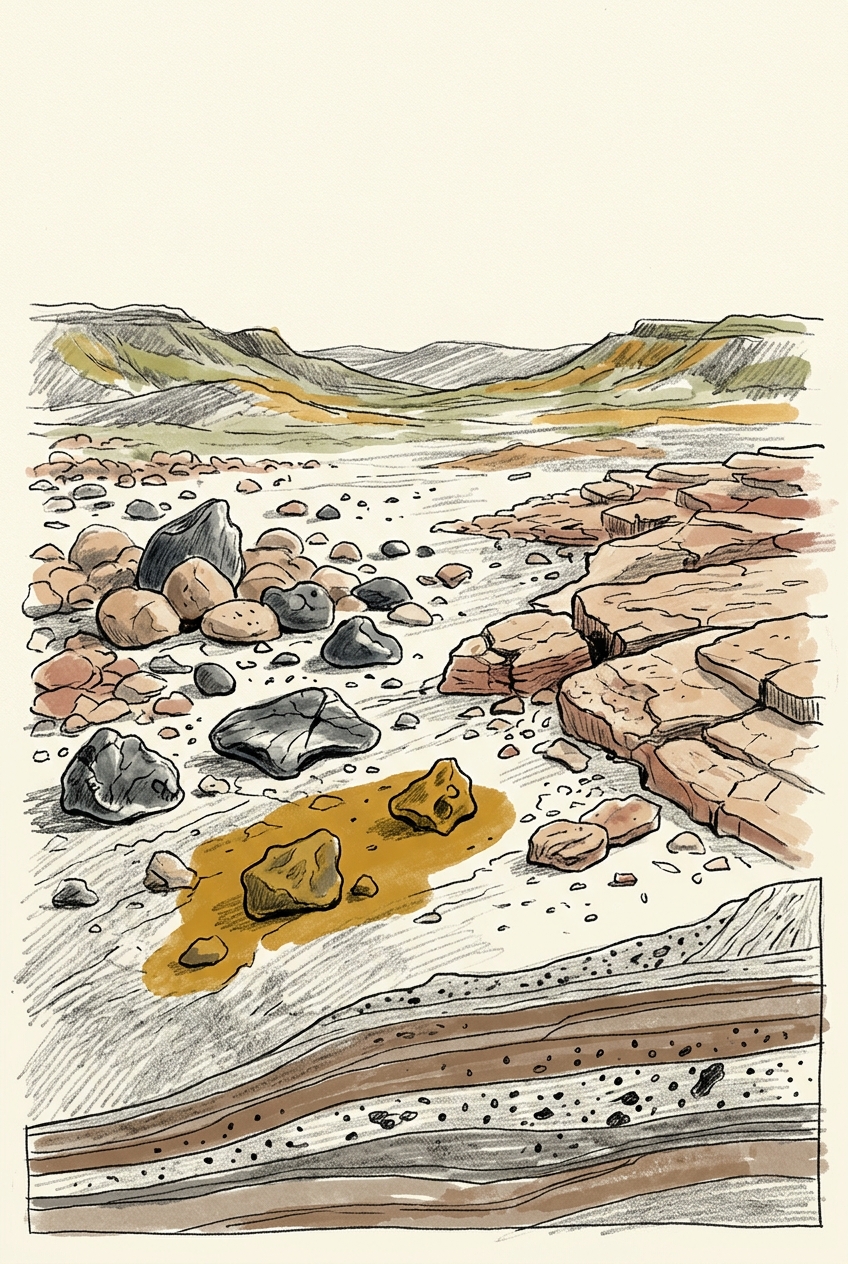
The impactor struck Proterozoic sedimentary rocks that had been laid down in a shallow inland sea. The energy was immense: the shockwave turned sandstone into glass, fractured quartz grains into microscopic planes, and hurled debris across hundreds of kilometres. In the 1970s, field geologists found blocks of impact melt rock—sandstone that had been heated enough to flow like lava—scattered across the MacDonnell Ranges.
These blocks are the key. They contain coesite and stishovite, high-pressure silica minerals that form only under the extreme conditions of a meteorite impact. Their presence confirmed that Gosses Bluff was not a volcanic crater or a collapsed salt dome, but the scar of an ancient collision.
A Landscape Erased and Preserved
Central Australia has been geologically quiet for hundreds of millions of years. No mountain building, no volcanic activity, no glacial scouring. This stability is exactly why the Gosses Bluff impact record survived at all—but it is also why the crater itself vanished.
The landscape here erodes slowly, by wind and rare rain, at a rate of perhaps a few metres per million years. Over a billion years, that is enough to remove a crater twenty-two kilometres across. What remains is the central uplift, a dome of fractured rock that resisted erosion better than the surrounding plain.
The impact melt fragments tell a more precise story. They preserve the chemical signature of the meteorite itself—a chondritic body, rich in nickel and chromium, that arrived at speeds exceeding fifteen kilometres per second. The melt rock is laced with microscopic diamonds, formed when graphite in the target rock was compressed by the shockwave.
A billion years is long enough for a mountain to become a plain, for an ocean to become a desert, for a crater to become a quiet ring of hills.
The Scattered Archive
The fragments are not confined to Gosses Bluff. Impact ejecta from the same event has been found in sedimentary rocks as far as five hundred kilometres away, in the Amadeus Basin and beyond. These distal deposits are thin—sometimes just a few centimetres thick—but they are unmistakable: shocked quartz grains, impact spherules, and fragments of melted rock embedded in Proterozoic shale.
For geologists, this is a rare archive. Most impact structures on Earth are younger than six hundred million years, because plate tectonics and erosion recycle the crust. Gosses Bluff is one of the oldest known impact sites on the planet, and its scattered debris offers a window into a time when the Australian continent was part of the supercontinent Rodinia.
The impact may have altered the local environment for millennia. The dust and sulfur aerosols thrown into the atmosphere would have dimmed the sun, cooled the climate, and acidified the shallow seas where stromatolites still grew. But life recovered. The sedimentary layers above the impact horizon show no mass extinction—only a gradual return to the slow rhythms of a Proterozoic world.
The Invisible Scar
Gosses Bluff is visible from space. The ring of hills stands out against the flat plains of the Amadeus Basin, a circular feature forty kilometres west of Alice Springs. But the true scar is invisible: the billion-year-old crater floor, buried beneath younger sediments, and the scattered fragments of melted sandstone that still lie on the surface, waiting for a patient eye.
Each fragment is a piece of a moment. A rock from space, travelling faster than any sound, met a sandstone bed that had rested undisturbed for five hundred million years. The collision lasted less than a second. The evidence has lasted a billion.
More like this
- The 555-Million-Year-Old Worm That Taught the Earth to CrawlA 555-million-year-old fossil from the Flinders Ranges preserves the trace of the first known burrowing animal—a tiny worm-like creature that learned to move.
- The 1.2-Billion-Year-Old Lake That Still Burns UndergroundIn the Stuart Shelf, 1.2-billion-year-old sedimentary rocks contain the world's oldest preserved groundwater, still chemically active and capable of generating hydrogen from radioactive decay.
- The 1.6-Billion-Year-Old Mud That Still Breathes GasIn the McArthur Basin, 1.6-billion-year-old sedimentary rocks still generate natural gas from organic matter laid down in a Proterozoic sea.