15 July 2026 · 3 min read
The 635-Million-Year-Old Seas That Rose and Fell in a Day
In South Australia, 635-million-year-old tidal rhythmites from the Elatina Formation record the precise day length and lunar distance of the Cryogenian period—preserved in sandstone.
In a quarry near the South Australian town of Whyalla, a slab of sandstone preserves something no clock could: the exact length of a day 635 million years ago. The rock records a single neap tide. It lasted 21.9 hours.
Rhythmites in the Elatina Formation
The Elatina Formation outcrops along the eastern shore of the Spencer Gulf, a sequence of fine-grained sandstone and siltstone laid down during the Cryogenian Period, when the Earth was emerging from the Sturtian glaciation—one of the most extreme ice ages the planet has ever known. In the interglacial warmth, shallow seas flooded the continental margin, and the tides wrote their signature in the sediment.
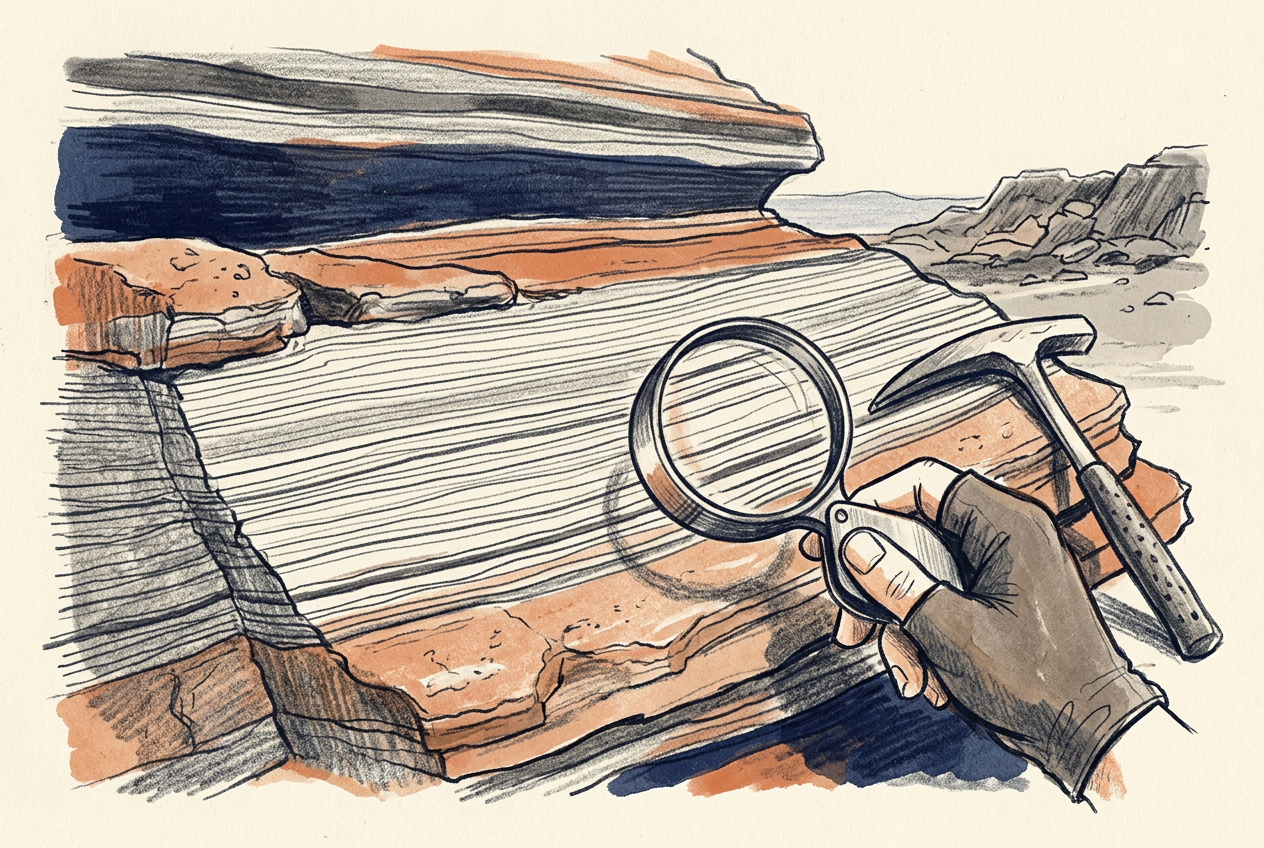
What makes the Elatina Formation extraordinary is the preservation of tidal rhythmites: alternating laminae of sand and mud deposited by individual tidal cycles. Each pair of light and dark bands represents one tide. Bundles of 28 pairs record a lunar month. The rock is a calendar, etched in silt.
Geologists in the 1980s realised they could count these bands like tree rings. By measuring the number of tidal laminae per annual sedimentary cycle, they calculated the number of days in a year—and therefore the length of a single day—during the Cryogenian. Their result: 13.1 lunar months per year, 21.9 hours per day, and the Moon 384,000 kilometres away—about 40,000 kilometres closer than today.
What the Tides Reveal About Time
The Earth's rotation slows as the Moon steals angular momentum, pushing itself into a wider orbit. Every century, the day lengthens by about 1.8 milliseconds. Project that rate backwards 635 million years, and the physics of tidal friction predicts a day length of roughly 22 hours—exactly what the Elatina rhythmites record.
The match is almost too perfect. The rock confirms a theory that would otherwise depend entirely on extrapolation: that the Moon has been receding from Earth at a consistent, measurable rate for more than half a billion years. The Elatina Formation is a witness to a slower Earth, a nearer Moon, and a world that spun faster on its axis.
The rock is a calendar, etched in silt.
These rhythmites also reveal something about the tides themselves. The fine lamination required a quiet basin, free of storm disturbance, where the daily pulse of the sea could imprint itself without interruption. The Elatina sea was likely a restricted embayment, protected from waves but open to the tidal range of an ocean. The sediment settled in still water, grain by grain, capturing the rhythm of the Moon's orbit with mechanical precision.
A Record That Nearly Vanished
The Elatina Formation survived because it was buried beneath younger sediments and later exhumed by erosion. But the outcrops are fragile. The same fine lamination that makes them valuable also makes them vulnerable to weathering. Rain and wind disaggregate the siltstone, blurring the bands. Quarrying has exposed fresh faces, but these too will fade.
In the same region, slightly younger Ediacaran fossils—the first complex multicellular life—appear in the Rawnsley Quartzite that overlies the Elatina Formation. The same shallow seas that recorded the Moon's orbit later hosted the frond-like organisms of the Ediacara biota. The rhythmites and the fossils are pages from the same book: a Cryogenian world warming into the Ediacaran, where the days were shorter, the Moon was closer, and life was about to change forever.
More like this
- The 290-Million-Year-Old Forest That Froze in LavaIn Tasmania, a 290-million-year-old lava flow preserved a Permian rainforest by chilling around it, not burning it — a fossil forest frozen in pillow basalt.
- The 1.7-Billion-Year-Old Ash That Still Feeds a DesertIn central Australia, 1.7-billion-year-old volcanic ash from the Warramunga Formation weathered into the red soils that sustain the Tanami Desert's spinifex and termite mounds.
- The 500-Million-Year-Old Sand That Travelled 3,000 Kilometres to Become a MountainFrenchmans Cap in Tasmania preserves 500-million-year-old sediment that travelled thousands of kilometres across an ancient ocean floor before being folded into a mountain.