14 July 2026 · 2 min read
The 290-Million-Year-Old Forest That Froze in Lava
In Tasmania, a 290-million-year-old lava flow preserved a Permian rainforest by chilling around it, not burning it — a fossil forest frozen in pillow basalt.
On the island of Tasmania, a 290-million-year-old lava flow still holds the silhouette of a lost temperate rainforest. The tree ferns and club mosses that once stood beside the flow were not burned. They were entombed.
The Cold Trap
In the early Permian, Tasmania lay near the South Pole. A cool, wet climate supported dense forests of glossopterids—tall seed ferns with tongue-shaped leaves—and understorey ferns that grew in peat-rich soils.
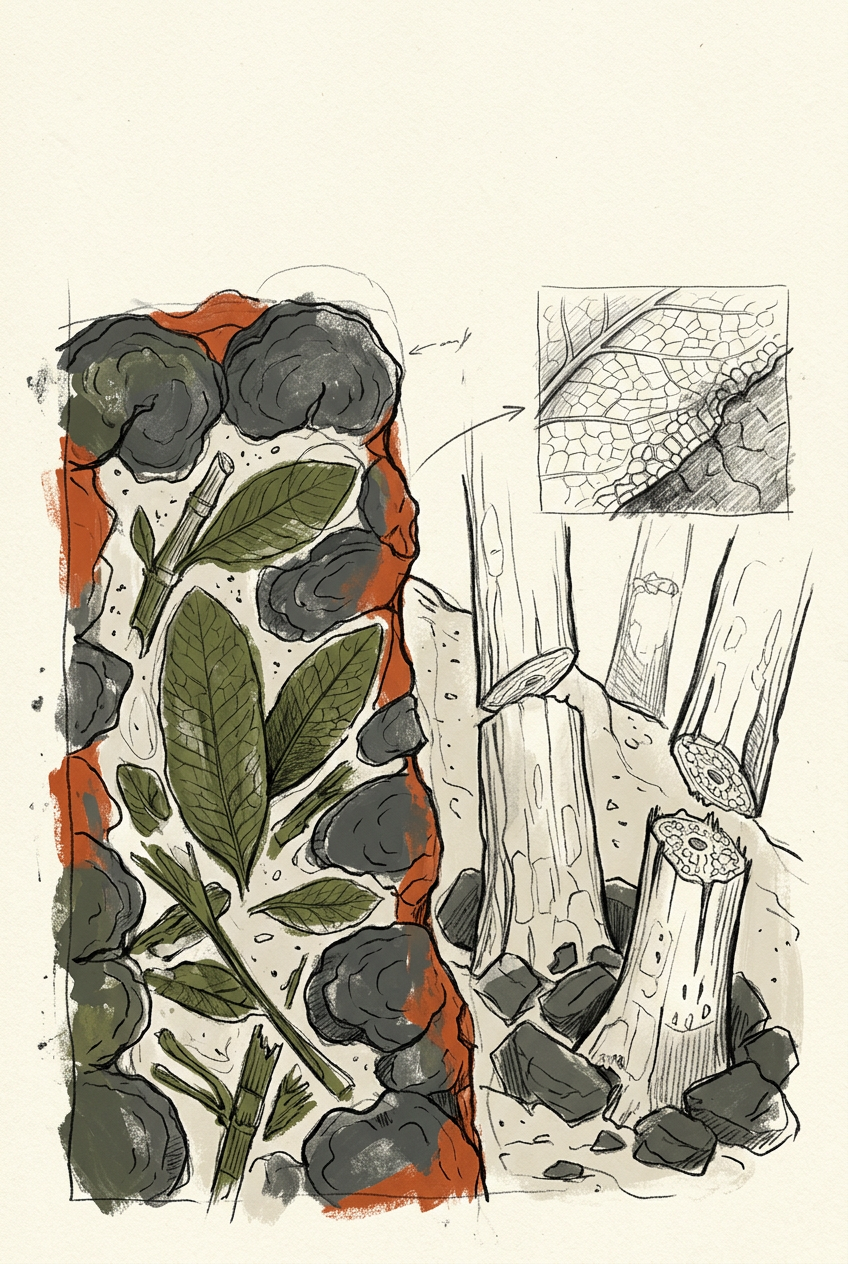
Then basalt erupted. At a site called Liffey, a flow of dark lava moved through the forest. Instead of incinerating everything, the lava chilled rapidly against the wet ground and peeled apart into pillow-like lobes. These lobes rolled over standing vegetation, sealing stems and leaves beneath a glassy rind before they could burn.
The result is a fossil forest preserved not by burial in ash or sediment, but by the very rock that should have destroyed it.
Pillows That Preserve
Pillow basalts form when lava meets water. Each pillow is a blob of molten rock that cools so fast its outer skin solidifies while the interior still flows. At Liffey, the water came from the swampy forest floor itself.
What makes the Liffey site rare is not just the pillows—it is what they contain. Between and beneath the pillows, paleontologists have found impressions of tree fern fronds, glossopterid leaves, and stems still showing cellular detail. The lava acted like a mould, casting the forest in negative relief.
The fossils are not carbonised. They are impressions left in the chilled basalt, preserving the texture of bark and the veining of leaves with remarkable fidelity. Some stems are still in growth position, as though the forest simply paused when the lava arrived.
The lava did not burn the forest. It photographed it.
A Polar Greenhouse
The Liffey fossils record a world that seems impossible: a temperate rainforest growing within a few degrees of the South Pole, under an atmosphere thick with carbon dioxide. The Permian was a greenhouse interval, warm enough to sustain forests on Antarctica.
But the Liffey site captures something more specific. The glossopterid trees shed their leaves seasonally, like northern deciduous forests today. Fossil leaves found in the pillows show autumn colours—a signal that even at high latitudes, the forest responded to the lengthening polar night.
When winter came, the trees went dormant. The lava did not wait for spring.
The Frozen Instant
What remains at Liffey is a single moment: a few hours, perhaps a day, when a lava flow moved through a living forest and preserved its last standing fronds. The pillows that hold these fossils are still there, exposed in a creek bed, weathering slowly back to soil.
Similar fossil forests exist elsewhere—in the Deccan Traps of India, in the Jurassic of Patagonia. But Liffey is among the oldest. It records not just the plants of the Permian, but the precise instant when molten rock met a living thing and stopped.
Two hundred and ninety million years later, the pillows still hold the shape of that meeting: a forest frozen in basalt, still standing where the lava found it.
More like this
- The 1.7-Billion-Year-Old Ash That Still Feeds a DesertIn central Australia, 1.7-billion-year-old volcanic ash from the Warramunga Formation weathered into the red soils that sustain the Tanami Desert's spinifex and termite mounds.
- The 1.7-Billion-Year-Old Bacteria That Built a MountainIn Western Australia's Hamersley Range, 1.7-billion-year-old stromatolites from the Duck Creek Formation record the oldest known freshwater reef—built by cyanobacteria, not corals.
- The 550-Million-Year-Old Quilt That Learned to MoveIn South Australia's Flinders Ranges, 550-million-year-old Dickinsonia fossils preserve the oldest known mobile animals—soft-bodied creatures that fed by absorbing nutrients through their quilted surf