15 July 2026 · 2 min read
The 100-Million-Year-Old Calderas That Became Paradise
The Whitsunday Islands are the eroded stumps of Cretaceous volcanoes that erupted as Australia tore away from Zealandia, preserving the only exposed record of one of Earth's great continental breakups
The Whitsunday Islands are not coral atolls or drowned hills. They are the eroded throats of a chain of supervolcanoes that erupted continuously for 25 million years as Australia tore itself away from Zealandia. What we now call paradise was once a ring of fire.
The Silicic Province That Vanished
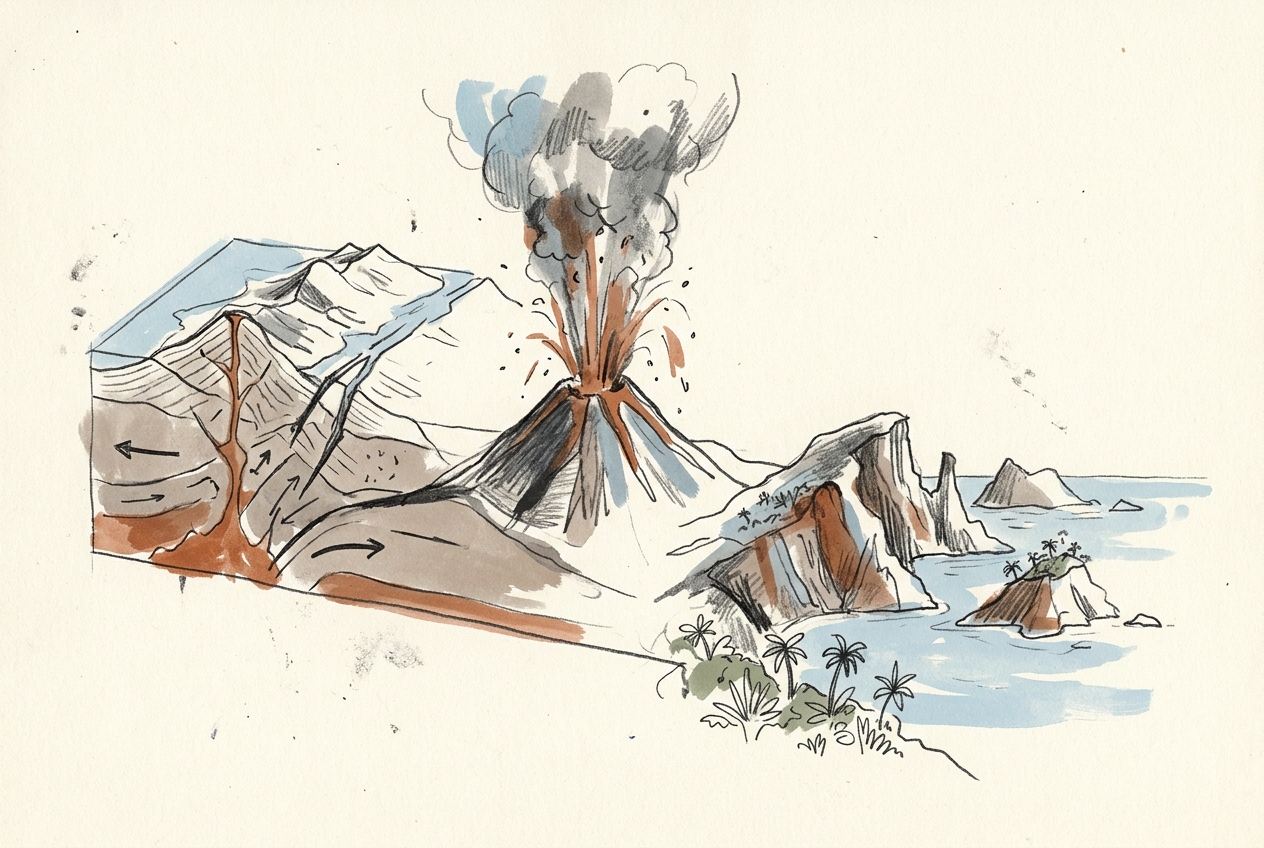
Between 120 and 95 million years ago, the eastern edge of Australia was a volcanic wasteland. A series of gigantic caldera volcanoes—similar in scale to Yellowstone or New Zealand's Taupō—stretched along what is now the Queensland coast. They erupted not the dark basalt of Hawaii but pale rhyolite and ignimbrite: viscous, silica-rich magma that built steep domes and collapsed into vast craters.
This was the Whitsunday Silicic Large Igneous Province. It produced more than 2.5 million cubic kilometres of volcanic rock over 25 million years—enough to bury Tasmania under several kilometres of ash. Today, less than five percent of that volume remains above water.
The rest lies submerged beneath the Coral Sea or has been eroded into the white sand that now lines the beaches.
What the Islands Reveal
Each Whitsunday Island exposes a different slice of the volcanic plumbing. Hill Inlet at Whitehaven Beach shows cross-bedded ignimbrite—ash flows that surged across the landscape at hundreds of kilometres per hour. The steep cliffs of Hook Island preserve layers of welded tuff, compressed by the weight of later eruptions until the glass shards fused into solid rock. On Whitsunday Island itself, the granite-like rhyolite that resists erosion was once magma that never reached the surface, cooling slowly in the conduit of a long-dead volcano.
The islands are not the volcanoes. They are the roots of the volcanoes—the parts that stayed behind when everything else washed away.
The eruption sites themselves are gone. The calderas collapsed, filled with their own debris, and were buried by later flows. Then the sea rose, the continent shifted, and 100 million years of weathering stripped away the soft ash beds, leaving only the hardest cores standing as islands.
The Breakup That Drove the Fire
The Whitsunday volcanism was not a random hot spot. It was caused by subduction—the same process that drives the Pacific Ring of Fire today. As the Phoenix Plate dove beneath eastern Gondwana, it melted at depth, generating magma that rose through the crust.
But around 95 million years ago, something changed. The subduction zone stalled. The plate boundary shifted, and the extension that would eventually split Australia from Zealandia began. The volcanoes fell silent. The continent stretched, thinned, and finally broke apart.
The Whitsunday Islands are the only place on Earth where this transition is preserved in rock: the last gasp of a subduction zone, frozen in rhyolite, now fringed by coral and visited by tourists who rarely know what they are standing on.
More like this
- The 290-Million-Year-Old Forest That Froze in LavaIn Tasmania, a 290-million-year-old lava flow preserved a Permian rainforest by chilling around it, not burning it — a fossil forest frozen in pillow basalt.
- The 1.7-Billion-Year-Old Ash That Still Feeds a DesertIn central Australia, 1.7-billion-year-old volcanic ash from the Warramunga Formation weathered into the red soils that sustain the Tanami Desert's spinifex and termite mounds.
- The 500-Million-Year-Old Sand That Travelled 3,000 Kilometres to Become a MountainFrenchmans Cap in Tasmania preserves 500-million-year-old sediment that travelled thousands of kilometres across an ancient ocean floor before being folded into a mountain.