14 July 2026 · 3 min read
The 1.7-Billion-Year-Old Ash That Still Feeds a Desert
In central Australia, 1.7-billion-year-old volcanic ash from the Warramunga Formation weathered into the red soils that sustain the Tanami Desert's spinifex and termite mounds.
In the Tanami Desert, the red soil under your boots was once ash falling through a Proterozoic sky. That ash fell 1.7 billion years ago, from volcanoes that no longer exist, onto a seafloor that has since become the dead heart of Australia. It never stopped feeding the land.
The Ash That Became a Basin
The Warramunga Formation runs beneath much of the Tanami region, a thick sequence of sedimentary and volcanic rocks laid down between 1.86 and 1.7 billion years ago. The formation contains layer after layer of tuff—compacted volcanic ash—erupted from a chain of submarine volcanoes that stood along the margin of the North Australian Craton.
Those eruptions were not gentle. The ash beds are metres thick in places, suggesting repeated Plinian-scale explosions that rained debris across thousands of square kilometres of shallow sea. Over millions of years, the ash settled, compacted, and turned to rock. Then, much later, the rock began to weather.
The red of central Australia is not the colour of the stone. It is the colour of what the stone becomes when it is left alone with oxygen and time.
The Long Unmaking
What makes the Warramunga Formation unusual is not its age but its mineralogy. The ash that fell into that Proterozoic sea was rich in iron-bearing silicates—pyroxene, amphibole, and volcanic glass. When these minerals encounter oxygen and water, they break down into iron oxides: hematite and goethite. These are the pigments that stain the soil red.
The process has been running for hundreds of millions of years. As the Tanami region slowly uplifted and the overlying sediments eroded away, the ancient tuff beds were exposed to the atmosphere for the first time since the Proterozoic. Each grain of ash began its slow chemical transformation.
The result is a soil that is thin, ancient, and extraordinarily poor in nutrients—except for iron. Spinifex, the dominant plant of the Tanami, has adapted to these conditions by developing shallow roots that capture the brief rains and silica-rich leaves that deter grazers.
What Lives in the Red
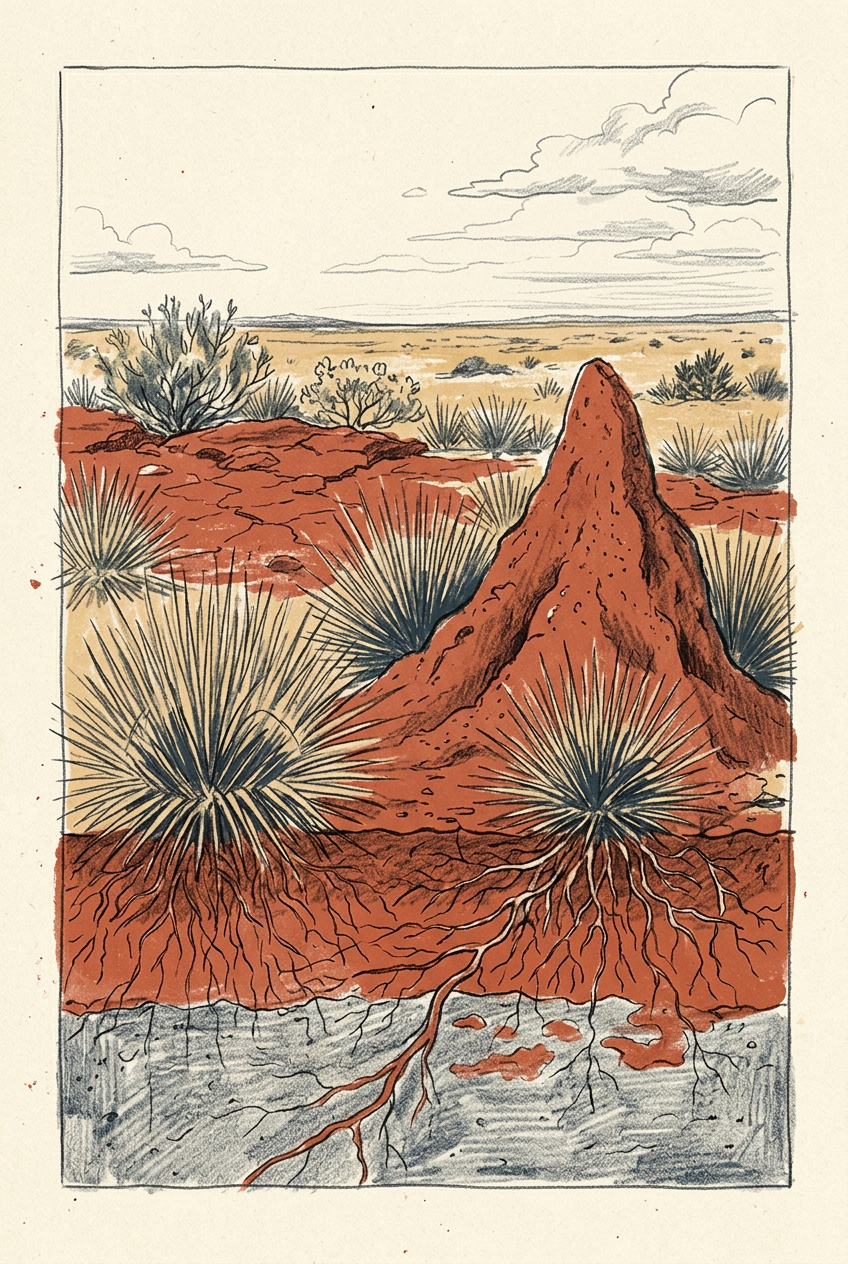
The weathered Warramunga Formation supports one of the most productive desert ecosystems on the continent. The red earth is not barren. It holds termite mounds that rise two metres above the plain, each one a chimneys of processed soil that cycle nutrients back into the system.
The termites eat spinifex. The mounds collect water. The water supports shrubs. The shrubs support birds and lizards. The entire food chain rests on a substrate that began as volcanic ash falling into a sea that vanished before multicellular life existed.
Geologists mapping the Tanami in the 1980s recognised that the Warramunga Formation also hosts gold deposits. The same volcanic systems that produced the ash also circulated hot fluids through fractures in the crust, concentrating gold in quartz veins. The weathering of those veins released gold into the soil, where it accumulates in surface lag deposits that prospectors still follow today.
The Persistence of Ash
There is something strange about eating lunch on a 1.7-billion-year-old ash bed. The rock beneath you has been exposed to every climate the continent has known—rainforest, icehouse, desert—and it is still reacting. The chemical weathering that began when the first tuff bed emerged from the sea continues in every rainstorm.
Each grain of ash is still releasing iron. Each molecule of hematite is still being born from the slow death of volcanic glass. The red soil of the Tanami is not a relic. It is an ongoing process, one that began before photosynthesis had fully oxygenated the atmosphere and will continue until the last iron atom has been oxidised.
The ash fell in an instant. It has been falling apart ever since.
More like this
- The 500-Million-Year-Old Sand That Travelled 3,000 Kilometres to Become a MountainFrenchmans Cap in Tasmania preserves 500-million-year-old sediment that travelled thousands of kilometres across an ancient ocean floor before being folded into a mountain.
- The 1.7-Billion-Year-Old Bacteria That Built a MountainIn Western Australia's Hamersley Range, 1.7-billion-year-old stromatolites from the Duck Creek Formation record the oldest known freshwater reef—built by cyanobacteria, not corals.
- The 700,000-Year-Old Meteorites That Rose From LimestoneThe Nullarbor Plain's slow-eroding limestone surface concentrates meteorites over millions of years—a natural archive of the solar system.