16 July 2026 · 3 min read
The 600-Million-Year-Old Sea That Became a Diamond Mine
In Western Australia's Kimberley region, the Argyle lamproite pipe erupted 1.2 billion years ago and preserved a rare class of diamonds — pink, from the deformation of the craton — now mined from an a
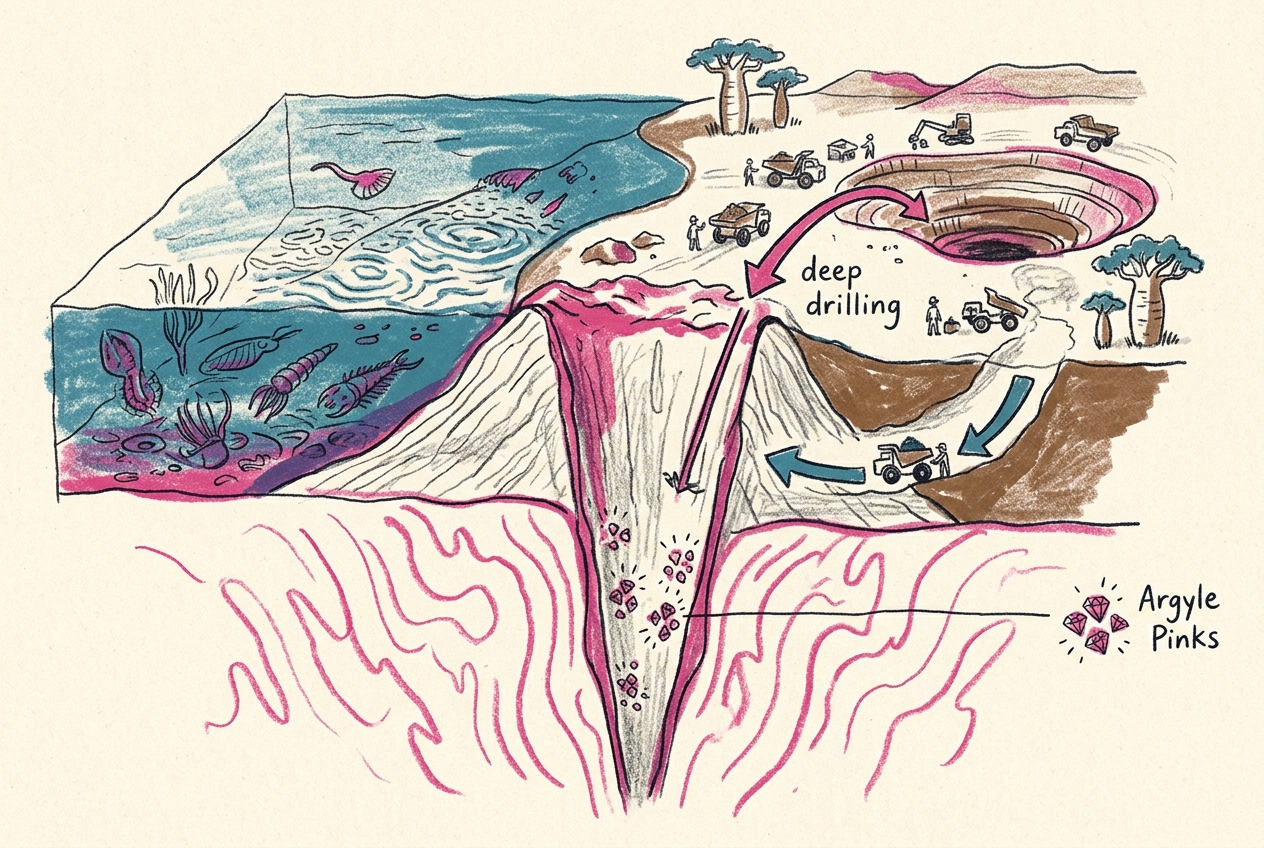
The Argyle pipe erupted not through continental crust but through the drowned floor of a Proterozoic sea. The lamproite — a rare, potassium-rich volcanic rock — punched upward 1.2 billion years ago, carrying diamonds that had crystallised deeper in the craton. Today, that same pipe sits beneath Lake Argyle, a man-made reservoir in the eastern Kimberley, and for forty years it produced more diamonds than any other mine on Earth.
A Different Kind of Volcano
Most diamonds arrive at the surface through kimberlite pipes — deep, carrot-shaped volcanoes that erupt at high speed from the mantle. Argyle used a different vehicle. Its rock type, lamproite, is chemically distinct: richer in potassium and titanium, poorer in carbon dioxide, and far rarer. Only a handful of lamproite eruptions are known worldwide, and Argyle is the only one that ever yielded commercial diamonds.
The pipe itself is not a simple cone. It is a complex tangle of volcanic breccia, fragmented wall rock, and diamond-bearing lamproite, intruded into 1.8-billion-year-old sediments of the Bow River Basin. The eruption happened underwater, in a shallow Proterozoic sea, and the volcanic debris mixed with seafloor sediment before cooling. That marine setting — the muds and sands of an ancient seabed — helped preserve the pipe from erosion for over a billion years.
What Made the Diamonds Pink
Argyle's diamonds are small. Most weigh less than a tenth of a carat. But a tiny fraction — perhaps one in a thousand — are pink.
The colour is not caused by a chemical impurity, as with blue boron-bearing diamonds or yellow nitrogen-rich ones. Pink diamonds are pure carbon, their colour arising from deformation. During their violent ascent, the crystals were subjected to intense pressure and shearing forces that warped their atomic lattice. Electrons in the deformed structure absorb green light and transmit red; the eye sees pink.
The same tectonic forces that built the continent — the collision of the Kimberley Craton with the rest of Australia — also coloured its rarest stones.
Argyle's diamonds are also old. The inclusions trapped inside them — tiny grains of silicate minerals — have been dated to between 1.2 and 1.6 billion years. That makes them among the oldest diamonds ever mined, formed deep in the lithospheric keel of the Kimberley Craton during the Proterozoic, long before plants colonised the land.
A Billion-Year-Old Seafloor Trap
The pipe sat undisturbed for most of Earth's history because it was buried. After the eruption, the shallow sea continued to deposit sediment — shales, sandstones, and eventually the limestone that caps the region. The pipe remained sealed under hundreds of metres of rock until the Cretaceous, when the breakup of Gondwana began to lift and erode the landscape.
By the time humans arrived, the pipe was exposed at the surface, its lamproite weathering into orange clay. Prospectors searching for alluvial diamonds in the Bow River in the 1970s traced the gems upstream and found the source. The mine opened in 1983.
The geology of Argyle also explains why the diamonds are so small. Lamproite eruptions are less energetic than kimberlite ones. They rise more slowly, giving diamonds more time to dissolve in the magma or fracture under changing pressure. Only the smallest, most robust crystals survived the journey intact.
What Remains
The mine closed in 2020, its open pit now a 600-metre-wide scar in the red earth. The lamproite pipe is largely exhausted. But the story it tells — of a diamond deposit born not from a deep, explosive kimberlite but from a rare, underwater lamproite eruption in a Proterozoic sea — remains one of the most unusual chapters in the geology of gems.
No other known diamond deposit formed quite this way. And no other deposit produced pink diamonds in such quantity. Of the world's pink diamonds, more than ninety percent came from a single lamproite pipe that once sat on the floor of a billion-year-old sea.
More like this
- The 33-Million-Year-Old Trail of Volcanoes That Mapped a Continent's DriftAustralia's 2,000-kilometre Cosgrove Track preserves 30 million years of continent drift over a stationary mantle hotspot, recorded in a chain of eroded volcanoes.
- The 27-Million-Year-Old Plugs That Refused to ErodeQueensland's Glass House Mountains are the exposed volcanic plugs of Oligocene volcanoes—the only remnants of a once-massive volcanic province, standing 300 metres above the weathered plain.
- The 100-Million-Year-Old Calderas That Became ParadiseThe Whitsunday Islands are the eroded stumps of Cretaceous volcanoes that erupted as Australia tore away from Zealandia, preserving the only exposed record of one of Earth's great continental breakups