16 July 2026 · 3 min read
The 33-Million-Year-Old Trail of Volcanoes That Mapped a Continent's Drift
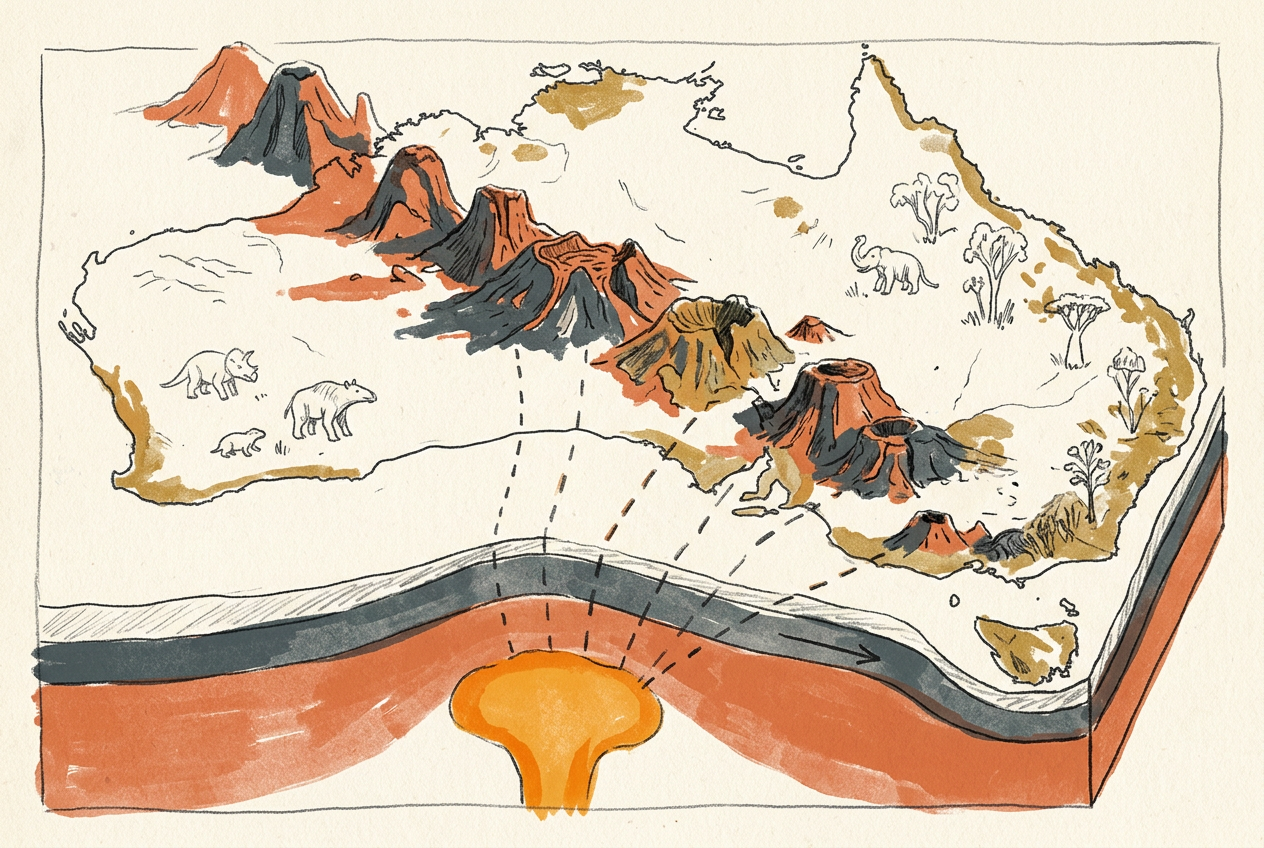
Australia's 2,000-kilometre Cosgrove Track preserves 30 million years of continent drift over a stationary mantle hotspot, recorded in a chain of eroded volcanoes.
For 30 million years, a plume of basalt bled from the crust of eastern Australia and then stopped, leaving behind the longest chain of volcanoes on land that never moved. The trail they left is 2,000 kilometres long and runs from the Whitsundays to the southern coast of Victoria, a smoking gun for a continent drifting north over a stationary hotspot.
The Cosmic Speedometer
A hotspot is a plume of magma that punches through a tectonic plate from the mantle below. If the plate moves, the volcano born above the plume is carried away and a new one forms in its place. The result is a chain — each volcano a time-stamped record of the plate's motion.
Hawaii is the classic example. But Australia's Cosgrove Track, named for the geologist who identified it in the 1970s, is far longer and older. The chain begins with 33-million-year-old volcanoes in the Whitsunday region and ends with the 6-million-year-old volcanoes of western Victoria, near Hamilton.
One volcano after another, laid out like beads on a string, each one a measurement of the continent's slow drift.
By dating the lavas along the chain, geologists have calculated that the Australian plate has moved northward at an average of 55 to 65 millimetres per year for the past 33 million years — a consistent pace that rivals the precision of GPS.
The Volcanos That Walked
The Cosgrove Track is not a straight line. It bends. The oldest volcanoes sit in central Queensland, then the chain arcs south-west through New South Wales before hooking south into Victoria. That curve records a change in the direction of plate motion around 20 million years ago, when Australia's northward drift shifted slightly westward as it collided with the Southeast Asian archipelago.
Most of the volcanoes along the track have been eroded to their basalt cores — flat-topped remnants called lava shields, or the necks of old vents. Some, like Mount Warning in northern New South Wales, still rise dramatically above the landscape. Others are barely visible, their basalt flows now buried under sediment or forest.
More than 350 volcanoes have been identified along the chain, though many more may have been completely eroded away. The youngest of them, in western Victoria, are so recent that their scoria cones and craters are still visible — some only 5,000 to 10,000 years old.
A Window Into the Mantle
The Cosgrove Track offers something rare: a continuous record of mantle chemistry over tens of millions of years. Because the hotspot source remains relatively constant while the plate above it changes, the lavas along the chain allow geochemists to sample the same mantle plume at different times and under different crustal conditions.
This has revealed that the plume beneath eastern Australia has remained surprisingly uniform in composition for 30 million years, despite the continent's crust thickening and thinning as it drifted. The basalts are mostly alkali-rich, indicating a deep mantle source, with minor variations that reflect the thickness of the crust they passed through.
In central Queensland, where the crust is thinner, the lavas erupted more easily and spread widely. In Victoria, where the crust is thicker, the magmas stalled and fractionated, producing more varied rock types — including rare leucitites, which contain high levels of potassium.
The Unfinished Story
The Cosgrove Track is still being mapped. New dating techniques have revealed that some volcanoes thought to belong to separate events are actually part of the same chain. The track may extend further north than currently recognised, possibly into the Torres Strait or even Papua New Guinea.
And the hotspot itself? It is still active. The youngest volcanoes in western Victoria are less than 5,000 years old — a blink in geological time. The next eruption along the Cosgrove Track could happen tomorrow, or in a hundred thousand years. The continent keeps moving, and the plume keeps burning.
More like this
- The 600-Million-Year-Old Sea That Became a Diamond MineIn Western Australia's Kimberley region, the Argyle lamproite pipe erupted 1.2 billion years ago and preserved a rare class of diamonds — pink, from the deformation of the craton — now mined from an a
- The 27-Million-Year-Old Plugs That Refused to ErodeQueensland's Glass House Mountains are the exposed volcanic plugs of Oligocene volcanoes—the only remnants of a once-massive volcanic province, standing 300 metres above the weathered plain.
- The 100-Million-Year-Old Calderas That Became ParadiseThe Whitsunday Islands are the eroded stumps of Cretaceous volcanoes that erupted as Australia tore away from Zealandia, preserving the only exposed record of one of Earth's great continental breakups