15 July 2026 · 3 min read
The 27-Million-Year-Old Plugs That Refused to Erode
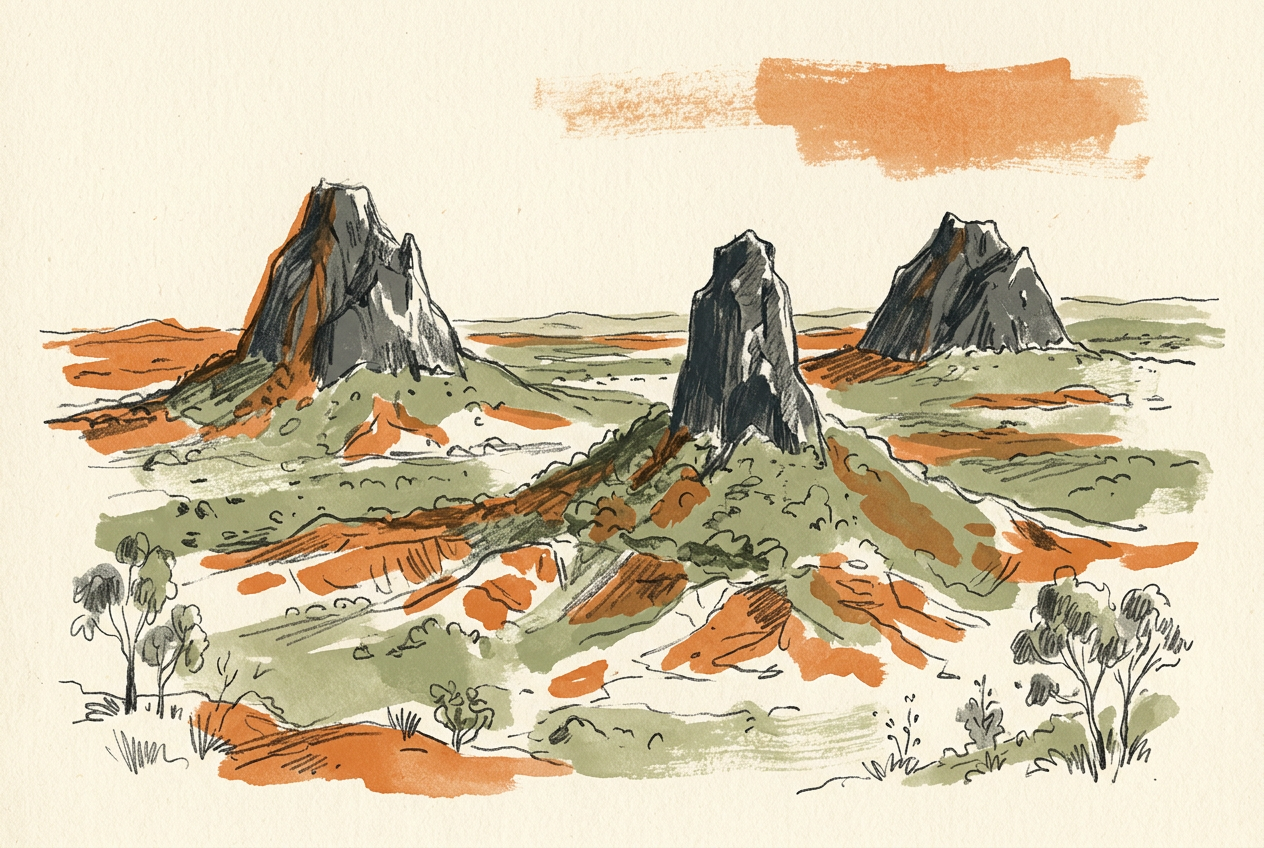
Queensland's Glass House Mountains are the exposed volcanic plugs of Oligocene volcanoes—the only remnants of a once-massive volcanic province, standing 300 metres above the weathered plain.
Captain Cook saw them from the deck of the Endeavour in May 1770 and thought they resembled the glass furnaces of his Yorkshire childhood. He named them the Glass Houses, and the name stuck. But what Cook mistook for a cluster of industrial kilns were something stranger: the petrified throats of Oligocene volcanoes, stripped of every last scrap of their original cones.
The Glass House Mountains rise from the coastal plain north of Brisbane as a dozen sudden peaks—Mount Beerwah at 556 metres, Mount Tibrogargan at 364 metres, and the smaller Tibberoowuccum, Ngungun, and Coonowrin. They are not mountains in the usual sense. They are the plumbing.
What the Erosion Left Behind
Twenty-seven million years ago, during the Oligocene, this part of Queensland was volcanically active. A series of shield volcanoes erupted basalt and trachyte across what is now the Sunshine Coast hinterland. Each volcano built a broad, gently sloping cone of lava and ash, perhaps a thousand metres high at its peak.
The magma that fed these volcanoes rose through conduits—vertical pipes carved through the underlying rock. When the eruptions ceased, the magma in these conduits cooled slowly, crystallising into hard, silica-rich trachyte. The surrounding cones, built of softer basalt and scoria, began to weather and erode.
Over millions of years, the rain and wind stripped the cones away entirely. What remained were the plugs: the dense, erosion-resistant cores of the old volcanic vents, standing now as isolated pinnacles above a flat plain. The mountain became the throat.
A shield volcano can lose its entire body to erosion. It cannot lose its throat.
Trachyte and Time
The rock of the Glass House plugs is trachyte, a fine-grained volcanic rock rich in potassium feldspar. It is tough, impermeable, and slow to weather. The surrounding plain is underlain by basalt and sedimentary rock that erodes far more readily. This contrast is the entire story.
Mount Beerwah, the tallest of the plugs, rises abruptly from the plain with no gentle approach. Its flanks are steep, jointed columns of trachyte that fracture into angular blocks. Aboriginal stories from the Kabi Kabi people tell of a family turned to stone—Tibrogargan the father, Beerwah the pregnant mother, and the other mountains as their children, facing eastward across the sea.
The plugs are not all identical. Some, like Mount Ngungun, have weathered into jagged spires. Others, like Tibrogargan, form a single smooth dome. The differences reflect variations in the original magma chemistry and cooling rate within each vent.
A Province That Nearly Vanished
The Glass House Mountains are the most visible remnants of the Main Range Volcanic Province, a region of Oligocene to Miocene volcanism that once stretched across much of southeast Queensland. The same hotspot that fed these volcanoes also built the Tweed Shield Volcano to the south, now reduced to the eroded caldera rim of the Border Ranges and the central plug of Mount Warning.
Most of the Main Range volcanoes have been erased entirely. The Glass House plugs survive because their trachyte cores were harder than anything around them. They are the last teeth of a vanished jaw.
Today they are protected within the Glass House Mountains National Park, and their distinct shapes serve as navigational landmarks visible from 50 kilometres away. They are not growing, not erupting, not changing in any way that human time can measure. But they are still eroding, grain by grain, and one day—long after the plain has lowered further—they too will fall.
More like this
- The 100-Million-Year-Old Calderas That Became ParadiseThe Whitsunday Islands are the eroded stumps of Cretaceous volcanoes that erupted as Australia tore away from Zealandia, preserving the only exposed record of one of Earth's great continental breakups
- The 290-Million-Year-Old Forest That Froze in LavaIn Tasmania, a 290-million-year-old lava flow preserved a Permian rainforest by chilling around it, not burning it — a fossil forest frozen in pillow basalt.
- The 1.7-Billion-Year-Old Ash That Still Feeds a DesertIn central Australia, 1.7-billion-year-old volcanic ash from the Warramunga Formation weathered into the red soils that sustain the Tanami Desert's spinifex and termite mounds.