16 July 2026 · 3 min read
The 540-Million-Year-Old Reef That Grew Without Animals
In the Flinders Ranges, 540-million-year-old microbial reefs built by cyanobacteria, not animals, record the last great gasp of the Ediacaran world before the Cambrian explosion.
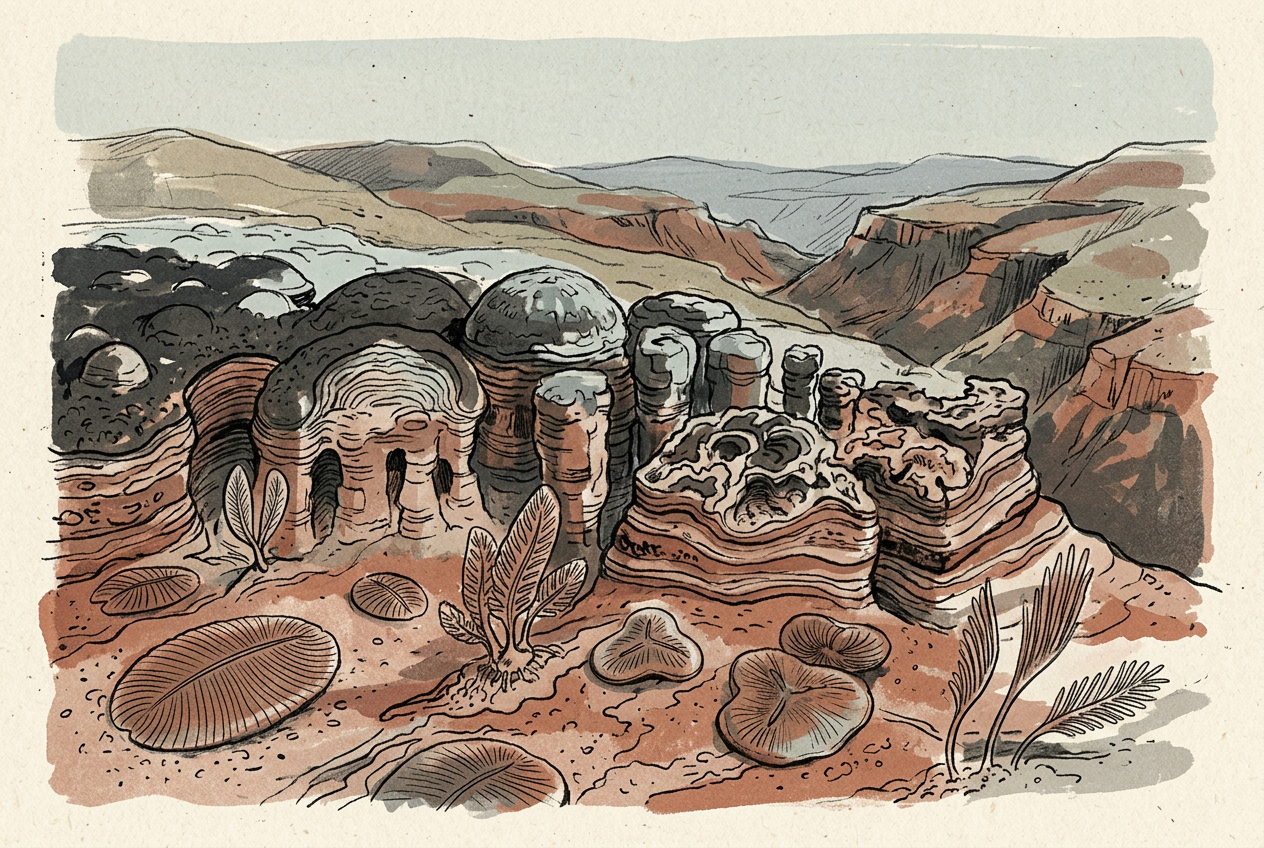
In the Flinders Ranges of South Australia, a 540-million-year-old reef rises from the desert floor—built not by corals, not by sponges, but by single-celled bacteria that learned to farm the sun.
The Ediacara Member of the Rawnsley Quartzite preserves something rare: the last great reef system built entirely by microbes, constructed just before the animal world exploded into complexity. These are not fossils in the usual sense. They are structures—laminated mounds of calcium carbonate, stacked like cauliflowers, that record the final flourish of a world run by cyanobacteria.
The Architects That Needed No Mouths
For most of Earth's history, reefs were microbial affairs. Cyanobacteria—photosynthetic bacteria—formed thin mats on the seafloor, trapping sediment and precipitating minerals in layered structures called stromatolites. By the Ediacaran period, around 575 million years ago, some of these microbial communities had evolved into more complex forms: thrombolites with clotted textures, and giant domal structures that rose metres above the seafloor.
The reefs of the Flinders Ranges represent the peak of this microbial engineering. The mounds reach up to two metres in height and extend for kilometres along bedding planes. They grew in shallow, oxygen-poor seas, where the only builders were prokaryotes that needed nothing but light, carbon dioxide, and dissolved minerals.
These reefs thrived for millions of years, capturing the chemical conditions of a world that would soon vanish.
The Moment the World Shifted
The Ediacaran-Cambrian boundary, preserved in the rocks above these reefs, marks the most dramatic biological transition in Earth's history. Within a few million years, animals with skeletons, guts, and nervous systems appeared across the globe. The microbial reefs that had dominated for nearly three billion years collapsed.
But the Flinders reefs did not simply die—they were buried. A pulse of sediment, possibly from a storm or a shifting delta, smothered the living mounds in fine sand before grazers and burrowers could tear them apart. That sand turned to quartzite, preserving the reef's three-dimensional form in exquisite detail. Walk across the outcrops today and you step on the actual surfaces of 540-million-year-old bacterial cities, their growth laminae still visible.
The animals did not outcompete the microbes. They simply inherited a world the microbes had built.
A Lost World in the Desert
The Flinders Ranges are not gentle country. The landscape is rough, red, and folded, with ridges of quartzite cutting across the skyline. The fossil reefs outcrop on the western slopes of the range, near the abandoned town of Beltana, where the heat shimmers off the stone and the only sound is wind.
What makes these reefs scientifically precious is their timing. They grew at the very end of the Ediacaran period, when the first animals—soft-bodied, quilted, and strange—already moved across the seafloor. The trace fossils of burrowing worms appear in the same beds. Yet the reefs themselves show no evidence of animal interference. No borings, no grazing marks, no breakage. The microbial world held, intact, until the moment it was buried.
This is the last photograph of an Earth without animals.
What the Reefs Remember
The chemistry of the reef carbonates records something else: the precise composition of Ediacaran seawater. Ratios of carbon isotopes in the layers track changes in the global carbon cycle across the Precambrian-Cambrian boundary. Strontium isotopes reveal the rate of continental weathering. The reefs are not just fossils—they are archives of the ocean that gave rise to animal life.
Modern microbial reefs still exist, in places like Shark Bay in Western Australia and the hypersaline lakes of the Bahamas. But they are stunted, marginal things, pushed to extreme environments where animals cannot survive. The Flinders reefs grew in the mainstream of Ediacaran seas, in waters that teemed with the first mobile creatures. They were not refuges. They were the normal world.
That world ended 540 million years ago. The stone that holds it remains.
More like this
- The 1.7-Billion-Year-Old Chimneys That Breathed PoisonIn the McArthur Basin, 1.7-billion-year-old hydrothermal vent chimneys preserve the earliest known ecosystem built entirely on toxic metals and sulfur, without sunlight.
- The 555-Million-Year-Old Garden That Learned to ReproduceIn the Flinders Ranges, 555-million-year-old Funisia dorothea fossils preserve the earliest known evidence of sexual reproduction in animals.
- The 635-Million-Year-Old Seas That Rose and Fell in a DayIn South Australia, 635-million-year-old tidal rhythmites from the Elatina Formation record the precise day length and lunar distance of the Cryogenian period—preserved in sandstone.