11 July 2026 · 3 min read
The 555-Million-Year-Old Wrinkle That Records the First Muscle
A 555-million-year-old Ediacaran fossil from the Flinders Ranges preserves the oldest evidence of muscle contraction—an animal that could shrink to one-fifth its resting size.
In South Australia's Flinders Ranges, a 555-million-year-old fossil known as Nilpena preserves an animal that could shrink its body to one-fifth its resting size — the oldest evidence of muscle contraction in the fossil record. The creature left a corrugated impression on the seafloor, each wrinkle a record of contraction, and each contraction a quiet revolution in the history of movement.
The Animal That Folded
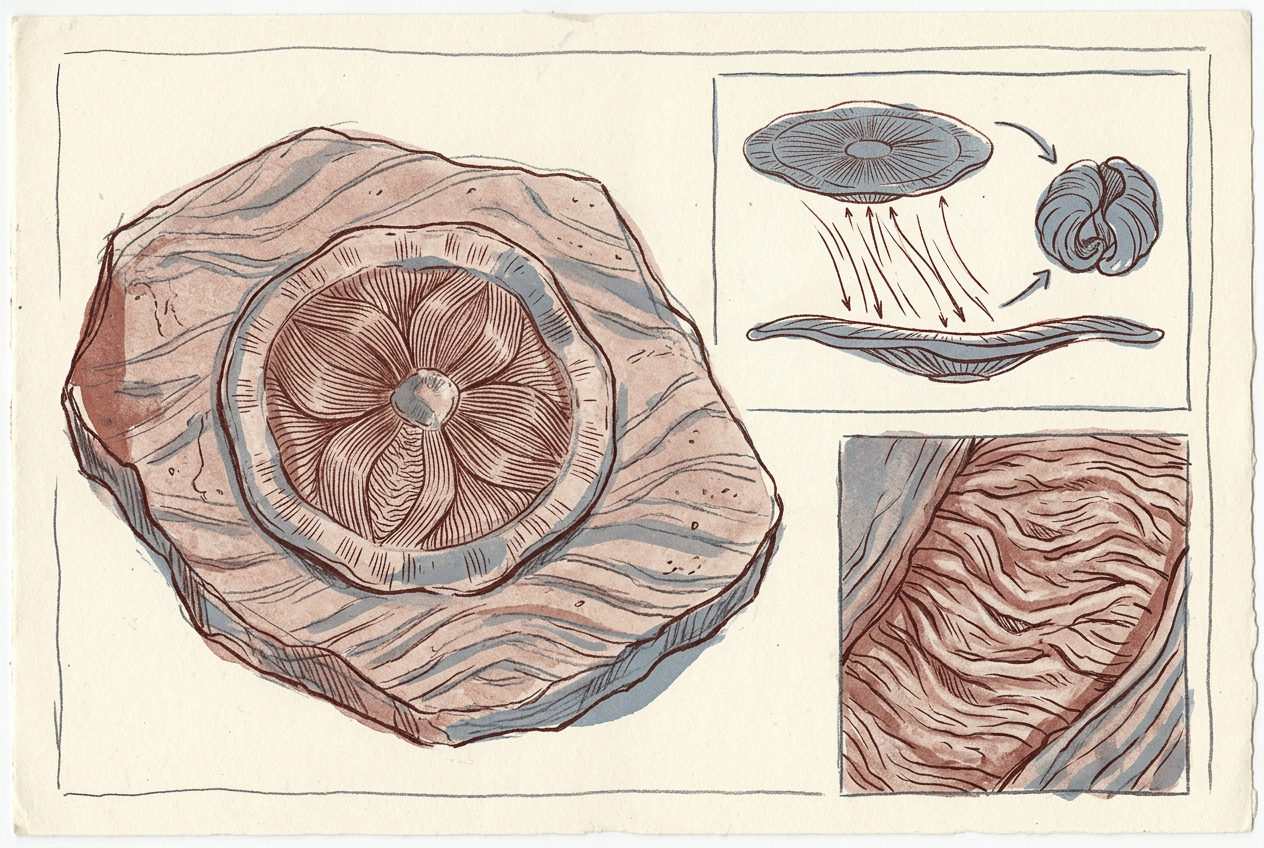
Nilpena rogersi belonged to the Ediacaran biota, the enigmatic soft-bodied organisms that lived on ancient microbial mats before the Cambrian explosion. Its body was a flat, oval quilt about the size of a human hand — segmented like a mattress, ribbed with parallel chambers that ran from a central axis to the margins.
What makes Nilpena extraordinary is not its shape but its behaviour. Palaeontologists have found multiple specimens of the same species preserved in different states of contraction. One fossil is relaxed and expanded, its chambers wide and its margins smooth. Another is tightly scrunched, its chambers compressed into narrow ridges and its outline wrinkled like a pursed lip.
The difference is dramatic: the contracted animal occupied only about 20 percent of the volume of the relaxed one. That requires muscle — specifically, circular or oblique muscles that could squeeze the body wall inward, reducing its surface area without tearing the tissue.
The First Muscle
Muscle tissue is soft. It decays quickly, rarely fossilises, and leaves almost no trace in the rock record. Before Nilpena, the oldest direct evidence of muscle came from Cambrian deposits about 520 million years old — animals with clear muscle fibres preserved in phosphate.
Nilpena pushes that date back by 35 million years. And it does so without preserving a single muscle fibre. Instead, the evidence is behavioural: the fossilised act of contraction, read from the geometry of the body itself.
The corrugated wrinkles on the contracted specimens match the pattern expected if circular muscles wrapped around the body and contracted uniformly. No other biological process produces that specific kind of folding. It is not decay, not desiccation, not trampling by currents. It is an animal squeezing itself.
Nilpena could shrink to one-fifth its size — the equivalent of a human folding into a backpack.
The World Before Predators
Why would an animal evolve the ability to contract so dramatically if nothing was trying to eat it? The Ediacaran seafloor had no predators, no jaws, no grasping appendages. The threat, if any, came from the physical environment.
One hypothesis: Nilpena lived on microbial mats that carpeted the seafloor. These mats were thin, nutritious surfaces that could be disturbed by currents or covered by sediment. By contracting, Nilpena could squeeze water out of its body cavity, flatten itself, and cling more tightly to the mat during a storm. Once the water settled, it could relax, reinflate, and resume feeding.
Another possibility: contraction allowed it to expel waste or reproductive products. The chambers in its body may have functioned like a hydraulic skeleton — inflating with seawater to hold the body rigid, then deflating to collapse it. This is not so different from how a sea anemone works today.
A Secret Mechanics
The Flinders Ranges have yielded dozens of Ediacaran species, but Nilpena is unique in recording not just anatomy but physiology — not what an animal looked like, but what it could do. Its fossils are preserved on the undersides of sandstone beds that were cast over the microbial mats, capturing the surface detail of the animals that rested there.
What we see, when we look closely, is an ancient body caught in the middle of an action it performed 555 million years ago. An animal that pulled itself tight, held the shape, and then relaxed — leaving two different impressions of the same living thing.
That ability — to change shape actively, using internal force — would become the foundation of every muscle-driven behaviour that followed: crawling, swimming, grasping, hunting, flying. All of it began here, in the quiet contraction of a soft, quilted body on a Precambrian seafloor.
The muscle has long since decayed. The wrinkle remains.
More like this
- The 540-Million-Year-Old Footprints That Record the First WalkersIn South Australia's Grindstone Range, 540-million-year-old footprints record the oldest known evidence of walking—animals with legs crossing a quiet shoreline before predators existed.
- The 560-Million-Year-Old Garden That Never Saw a PredatorIn South Australia's Flinders Ranges, 560-million-year-old Ediacara surfaces preserve entire seafloor communities of fronds, discs, and quilts — a garden of soft-bodied life that flourished before pre
- The 300-Million-Year-Old Forest That Died Standing UpIn New South Wales, a 300-million-year-old fossil forest preserves dozens of trees buried upright by a Permian volcanic eruption—an entire ecosystem frozen in ash.