11 July 2026 · 3 min read
The 540-Million-Year-Old Footprints That Record the First Walkers
In South Australia's Grindstone Range, 540-million-year-old footprints record the oldest known evidence of walking—animals with legs crossing a quiet shoreline before predators existed.
Along a quiet stretch of coast in South Australia, cliffs of pale limestone and dolomite preserve the shoreline of a sea that vanished 540 million years ago. What they hold is stranger than any fossil skeleton: the world's oldest known footprints.
The Shore That Turned to Stone
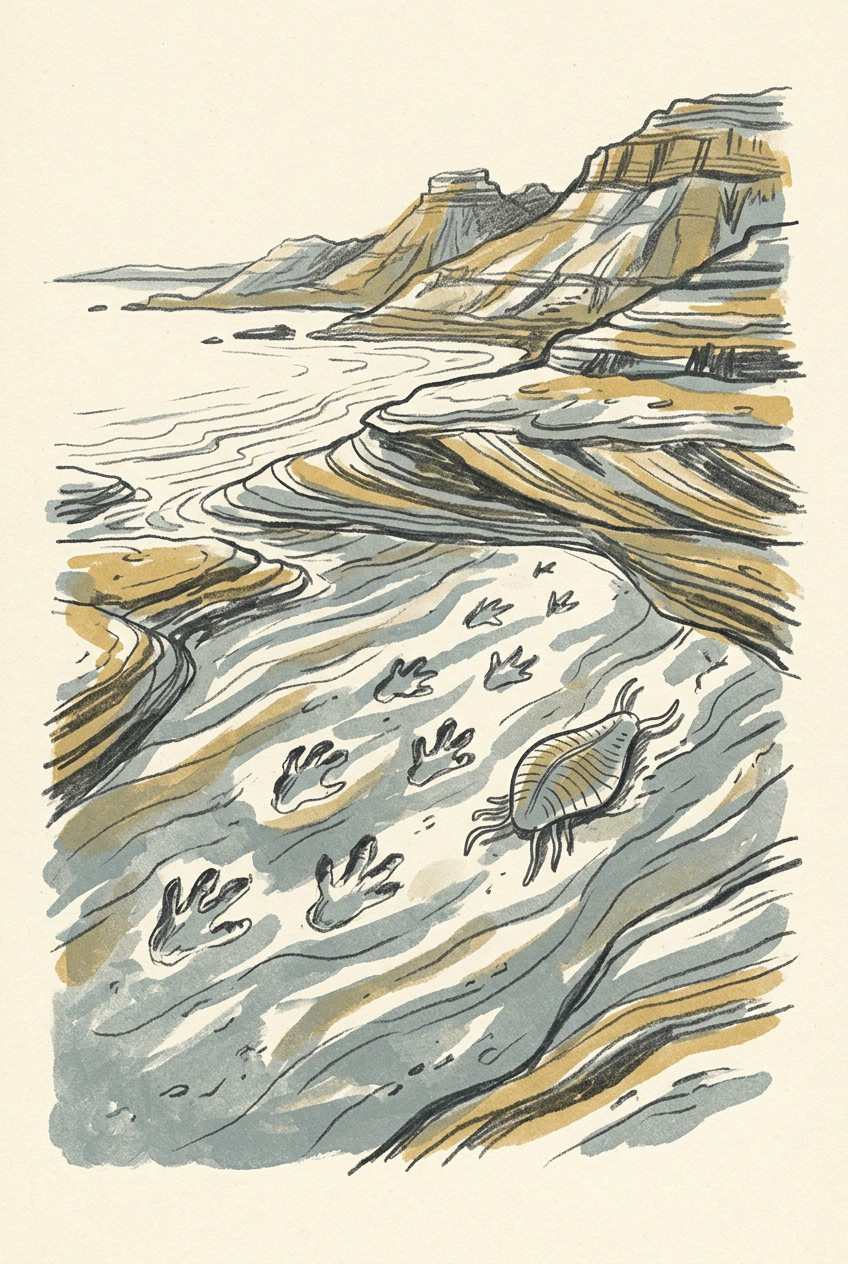
The sediments of the Grindstone Range in the Flinders Ranges were laid down on the tidal flats of a shallow Cambrian sea. Around 540 million years ago, fine muds and sands accumulated in thin layers, recording the rhythms of waves and currents. Then something walked across them.
The tracks are preserved in the Rawnsley Quartzite and the underlying Billy Springs Formation — beds of sandstone and siltstone that hardened into rock after the sea retreated. They are not impressions of feet as we know them. Each print is a small depression, a few millimetres deep, arranged in pairs or short sequences. What matters is what created them: an animal with legs, walking on a soft substrate, leaving a trace of its passage through the world.
The First Walkers
These are not vertebrate footprints. The animals that made them were arthropods — creatures related to modern horseshoe crabs and scorpions — that had developed paired, jointed appendages capable of supporting their bodies off the seafloor. Before this, animals either crawled on soft bellies or floated in the water column. Walking meant something new: weight borne on limbs, repeated motion, deliberate direction.
Paleontologists have identified several trackways in the region, including those assigned to the ichnogenus Diplichnites. The best-studied site sits in the Heysen Range, where dozens of parallel trails run across a single bedding plane — a snapshot of a crowded shoreline during low tide, 540 million years ago. The tracks are roughly 5 to 15 millimetres wide, with regular spacing that suggests a consistent gait. The walkers were not large; their bodies were likely no bigger than a human hand.
These are the oldest known evidence of an animal walking on land. The shore was not yet soil, the air had no pollen, and the only sound was the pulse of an ancient sea.
A World Without Predators
The significance of the Grindstone tracks goes beyond their age. They were made near the very beginning of the Cambrian Period, when animal life was still experimental. The Ediacaran biota — the quilted, soft-bodied fronds and discs that dominated the previous 50 million years — had recently vanished. In their place, animals with guts, skeletons, and limbs were evolving at an astonishing rate. The walkers of the Grindstone shoreline were part of that explosion.
Yet the world they inhabited was not yet the violent arena of the later Cambrian. No large predators prowled these tidal flats. The walkers were likely foraging for microbial mats or detritus, their tracks the only disturbance on a quiet shore. The prints tell us that locomotion — directed, repeated, weight-bearing — was already a solved problem before the first trilobite hardened its shell.
Why the Prints Survived
Footprints are among the rarest of fossils. They require a precise sequence of events: soft sediment firm enough to hold an impression, a rapid covering by new sediment before the print is erased by wind or water, and then millions of years of burial without tectonic destruction. The Grindstone Range delivered all three. The fine-grained sandstone that preserved the tracks was deposited in a low-energy tidal environment, then quickly buried by the next incoming tide. Later, the region was uplifted gently, without the folding and faulting that would have obliterated the delicate impressions.
Today the tracks are exposed on fallen slabs and cliff faces, still bearing the dimples of a walker's last step. In the dry light of the Flinders Ranges, you can place your hand on the rock and feel what no human eye ever saw: the footprint of a Cambrian morning, preserved in stone.
More like this
- The 450-Million-Year-Old Volcano That Holds the Great Barrier ReefThe Great Barrier Reef grows on the eroded stumps of a 450-million-year-old volcanic arc that forms its hidden foundation.
- The 110-Million-Year-Old River That Runs Backwards UndergroundWestern Australia's 110-million-year-old dune system has been slowly dissolving into a labyrinth of caves where an ancient river still flows, carrying the taste of a Cretaceous desert.
- The 5,000-Year-Old Volcanoes That Still Smoke in the SouthIn Victoria's Newer Volcanics Province, 400 volcanic vents erupted as recently as 5,000 years ago—the youngest volcanic field in mainland Australia, where craters still hold blue lakes and scoria cone