11 July 2026 · 3 min read
The 50,000-Year-Old Ash That Still Holds Human Heat
In western Victoria, 50,000-year-old volcanic ash beds at Budj Bim preserve the oldest known human-modified landscape on Earth—a system of channels and ponds carved into basalt to trap eels.
About 50,000 years ago, a volcano named Budj Bim erupted in what is now western Victoria, flooding the landscape with basalt. The lava cooled into a dark, uneven platform stretching across the foothills. Thousands of years later, human hands began reshaping that stone.
The Volcano That Built a Pantry
Budj Bim is part of the Newer Volcanics Province, the same young volcanic field that produced Victoria's scoria cones and crater lakes. Its eruption sent basaltic lava flowing down the slopes of what was then a broad, grassy plain. The flow cooled into a complex of ridges, depressions, and natural terraces.
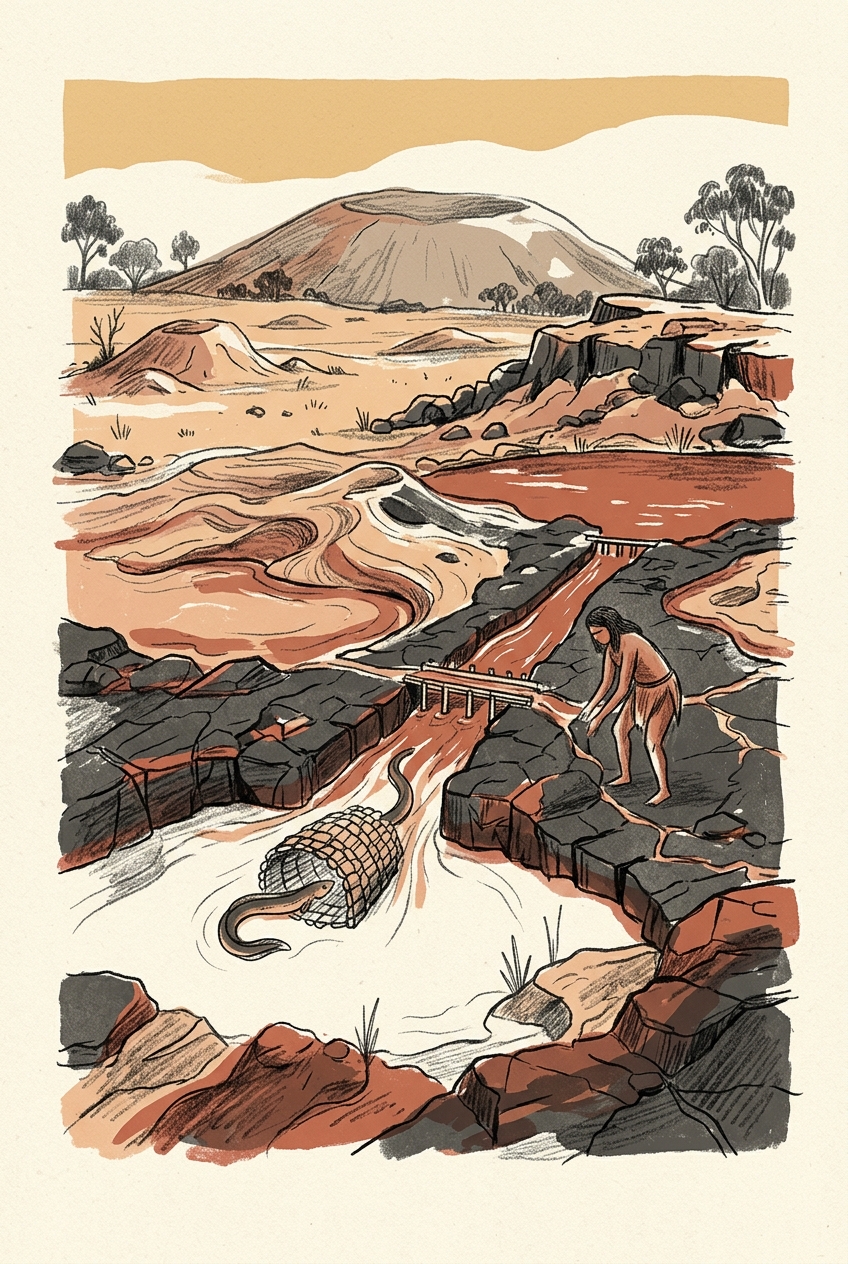
To the Gunditjmara people, those terraces were not random. The basalt plateau sat beside the Darlot Creek, and each year when the rains came, short-finned eels migrated upstream from the sea. The Gunditjmara noticed that the uneven lava surface could hold and divert water. They began to modify it.
Using only stone tools and fire, they channelled the creek into the basalt. They built races—narrow stone-lined waterways—to guide eels into ponds. They carved spillways to control flow. They stacked basalt blocks to create weirs. The result was a vast aquaculture system covering some 100 square kilometres.
The oldest known human-built water management system on Earth is not in Mesopotamia or Egypt. It is a network of stone channels in a 50,000-year-old lava field in southwest Victoria.
The Stone That Remembers Fire
The basalt at Budj Bim is vesicular—full of small holes left by escaping gas when the lava was still molten. That spongy texture made it ideal for the Gunditjmara's purposes. Water seeped through the rock slowly rather than rushing away, keeping the ponds stable through dry spells.
Archaeologists have dated charcoal from the earliest channels to at least 6,600 years ago, but oral tradition and other evidence push human occupation of the site back much further. The Budj Bim eruption itself is dated to roughly 50,000 years ago, and Gunditjmara oral histories describe the eruption as if it were witnessed. The eruption story tells of a great ancestral being who turned into the volcano and whose blood became the lava.
If the Gunditjmara were present when Budj Bim erupted, their relationship with this landscape extends to the very edge of human presence on the continent. That would make Budj Bim one of the oldest continuously occupied places on Earth.
A Landscape That Still Works
The channels and ponds at Budj Bim still function. They were in use when British colonisers arrived in the 1830s, and they have been partially restored by the Gunditjmara in recent decades. Each autumn, eels still swim up the Darlot Creek and into the stone races, where they can be guided into traps.
The site was inscribed on the UNESCO World Heritage list in 2019, recognised not for its age alone but for its design. The Gunditjmara did not simply use the landscape—they engineered it, responding to the specific properties of volcanic basalt with precision and patience.
The stone itself is ordinary. Basalt is the most common volcanic rock on Earth, the cooled remains of countless eruptions across every continent. But at Budj Bim, ordinary basalt became something else: a pantry, a map, a record of human attention to the particular behaviour of water on a particular kind of stone.
The volcano erupted fifty millennia ago. The eels still come. And the channels still hold them.
More like this
- The 540-Million-Year-Old Footprints That Record the First WalkersIn South Australia's Grindstone Range, 540-million-year-old footprints record the oldest known evidence of walking—animals with legs crossing a quiet shoreline before predators existed.
- The 450-Million-Year-Old Volcano That Holds the Great Barrier ReefThe Great Barrier Reef grows on the eroded stumps of a 450-million-year-old volcanic arc that forms its hidden foundation.
- The 110-Million-Year-Old River That Runs Backwards UndergroundWestern Australia's 110-million-year-old dune system has been slowly dissolving into a labyrinth of caves where an ancient river still flows, carrying the taste of a Cretaceous desert.