16 July 2026 · 2 min read
The 555-Million-Year-Old Garden That Learned to Reproduce
In the Flinders Ranges, 555-million-year-old Funisia dorothea fossils preserve the earliest known evidence of sexual reproduction in animals.
On the floor of the Flinders Ranges, 555-million-year-old sandy beds are covered in what look like giant, coiled ferns pressed into stone. They are not plants. They are Funisia dorothea—the oldest known sexually reproductive animals on Earth, and their rubbery stands once rose from the Ediacaran seafloor like living quilts.
The First Animal That Had Sex
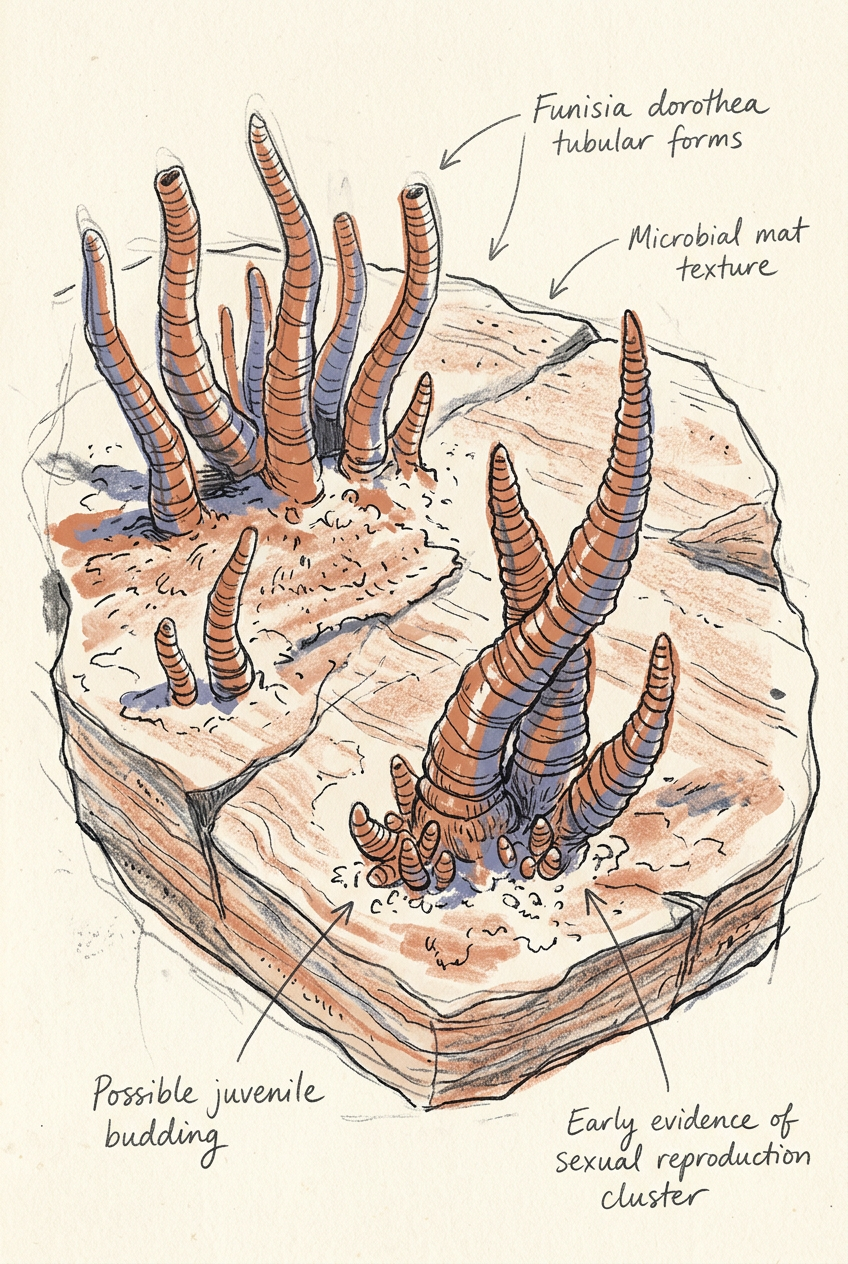
Funisia lived in the shallow seas that covered South Australia 555 million years ago, during the Ediacaran Period. Unlike the simpler, flat Dickinsonia that absorbed nutrients through their skin, Funisia built upright, branching tubes up to 30 centimetres long. The tubes were modular—each one assembled from repeated, sausage-shaped segments stacked end to end.
What makes Funisia remarkable is preserved in the arrangement of its fossils. The tubes cluster in tight, evenly spaced groups, suggesting they settled as larvae that had been fertilised externally—a pattern of reproduction that requires males and females, or at least the shedding of sperm and eggs into the water. This is the earliest evidence of sexual reproduction in the fossil record, a biological strategy that would come to dominate animal life.
The fossils also show signs of regeneration. Some tubes are broken and regrown, indicating that Funisia could repair itself after injury—another sign of sophisticated tissue biology.
A Seafloor Garden of Tubes
The Ediacara Member of the Rawnsley Quartzite preserves an entire community of Funisia in life position. The fossils occur in beds that were rapidly buried by storm-driven sand, freezing the seafloor in place. Individual tubes stand upright in the rock, their internal cross-sections visible as circular rings.
Funisia did not move. It was a suspension feeder, catching organic particles from the water column with its tiered branches. In some beds, dense meadows of Funisia covered hundreds of square metres of seafloor—the first animal ecosystems.
555 million years ago, the seafloor was not a hunting ground. It was a garden.
Why It Matters
Funisia fills a gap in our understanding of early animal evolution. Between the simple, quilted Ediacaran fronds and the hard-shelled organisms of the Cambrian explosion lies a transitional world of modular, tissue-grade animals that had mastered sex but not yet predation. Funisia is the best-preserved example of this middle ground.
The Flinders Ranges contain the richest known assemblage of Ediacaran fossils on Earth, and Funisia is among the most abundant. Its fossils are so plentiful that paleontologists can study population dynamics: tube spacing, size distribution, and even evidence of competition for space on the seafloor.
No other known fossil record preserves the reproductive biology of animals this old. Funisia is not just an ancient organism—it is proof that complex life cycles existed long before the first shells, eyes, or jaws appeared.
More like this
- The 1.7-Billion-Year-Old Chimneys That Breathed PoisonIn the McArthur Basin, 1.7-billion-year-old hydrothermal vent chimneys preserve the earliest known ecosystem built entirely on toxic metals and sulfur, without sunlight.
- The 635-Million-Year-Old Seas That Rose and Fell in a DayIn South Australia, 635-million-year-old tidal rhythmites from the Elatina Formation record the precise day length and lunar distance of the Cryogenian period—preserved in sandstone.
- The 290-Million-Year-Old Forest That Froze in LavaIn Tasmania, a 290-million-year-old lava flow preserved a Permian rainforest by chilling around it, not burning it — a fossil forest frozen in pillow basalt.