16 July 2026 · 3 min read
The 1.7-Billion-Year-Old Chimneys That Breathed Poison
In the McArthur Basin, 1.7-billion-year-old hydrothermal vent chimneys preserve the earliest known ecosystem built entirely on toxic metals and sulfur, without sunlight.
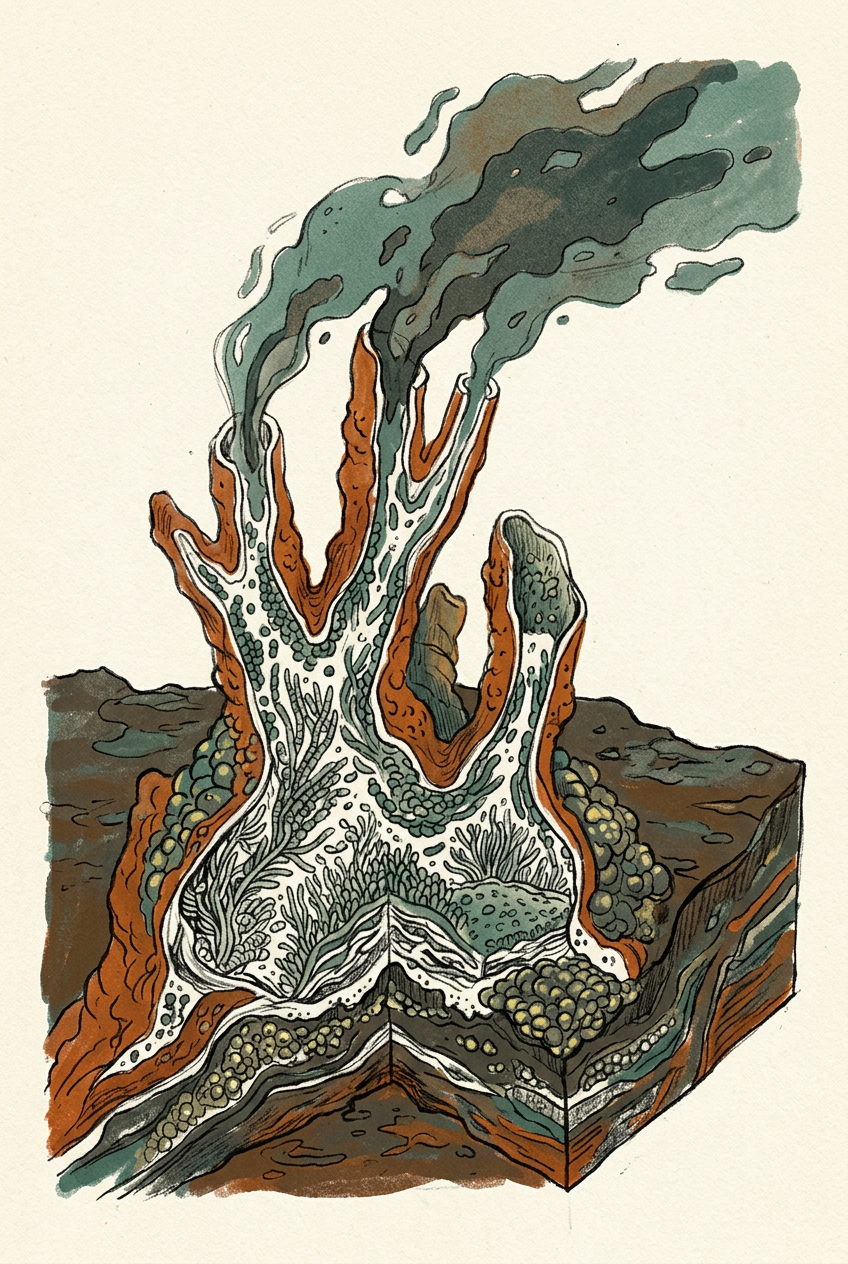
Deep in Australia's remote McArthur Basin, 1.7-billion-year-old chimneys rise from the ancient seafloor—towers of iron, lead, zinc, and sulfur that never saw the sun. These are not geological curiosities. They are the preserved bodies of hydrothermal vents, and within their mineral walls lies the earliest known record of life that fed entirely on poison.
The Chimneys That Built Themselves
The McArthur River deposit sits in the Batten Fault Zone, a 1,000-kilometre-long scar in northern Australia where the Earth's crust once pulled apart. Between 1.7 and 1.6 billion years ago, hot brines rose through these fractures and met the cold Proterozoic ocean. The sudden temperature drop forced dissolved metals to precipitate instantly, building chimney-like structures from the seafloor upward.
Some chimneys reached ten metres tall. They grew in fields, like a forest of stone organ pipes, each one a chemical reactor where superheated water—up to 300 degrees Celsius—mixed with the ancient seawater above. The minerals that formed are still there: galena for lead, sphalerite for zinc, pyrite for iron. The deposit holds more than 30 million tonnes of ore.
What makes these chimneys extraordinary is that they did not collapse. Most hydrothermal vents collapse under their own weight or dissolve back into the sea. Here, rapid burial by fine-grained siltstone preserved the vent structures in three dimensions, exactly as they stood.
Life That Never Saw Light
In the 1970s, when biologists first discovered hydrothermal vent ecosystems in the Pacific Ocean, they found entire communities thriving on chemosynthesis—bacteria that convert hydrogen sulfide into energy, feeding tube worms, clams, and crabs. The McArthur chimneys suggest this trick is at least 1.7 billion years old.
The evidence is subtle but specific. Within the chimney walls, geochemists have found traces of organic carbon with isotopic signatures that match those of sulfur-metabolising microbes. The vent minerals themselves contain tiny filaments, preserved in pyrite, that resemble the chain-like structures of modern thermophilic bacteria. These filaments are less than a micrometre wide—far too small to be seen without a microscope, but unmistakable in their biological origin.
The oldest known ecosystem on Earth may not have been a sunlit reef or a tidal pool. It was a field of black chimneys, breathing sulfur in the dark.
This matters because it changes how we search for life elsewhere. If life can begin and sustain itself in hydrothermal vents, then Jupiter's moon Europa—with its subsurface ocean and volcanic seafloor—looks less like a frozen ball and more like a second chance.
The Ore That Built a Town
The McArthur River deposit is not just a fossil. It is one of the world's largest zinc-lead-silver mines, operating since 1995 from the remote town of Borroloola. The ore is so fine-grained—individual zinc sulphide particles smaller than a human hair—that it must be processed with a unique grinding and flotation method developed specifically for this site.
This fine-grained texture is itself a clue. It tells geologists that the chimneys formed quickly, in a deep basin where currents were weak and the water column was stratified. The Proterozoic ocean had almost no oxygen in its depths, which meant the organic matter from vent microbes did not decay. It sank, layer upon layer, enriching the sediment with carbon that would later help concentrate the metals.
The same process that built the chimneys also sealed them. Over hundreds of thousands of years, the vent fields were buried by silt, then by shale, then by sandstone. The pressure turned the silt to stone, and the stone preserved the chimneys exactly as they were.
A Window into a Different Earth
The McArthur Basin offers something rare: a direct view of a planet where life had not yet learned to breathe oxygen, where the continents were barren rock, and where the only thriving ecosystems were clustered around volcanic vents on the seafloor. This was Earth before photosynthesis dominated the biosphere.
Today, the chimneys sit 200 metres underground, accessible only by mine shaft. But their story is visible on the surface too. The same fault lines that fed the ancient vents still cut across the landscape, marked by ridges of dolomite and outcrops of black shale that weather into rust-coloured soil. The land above the deposit is scrubby, dry, and unremarkable—but beneath it, the oldest chemical reactors on Earth still hold their shape.
More like this
- The 555-Million-Year-Old Garden That Learned to ReproduceIn the Flinders Ranges, 555-million-year-old Funisia dorothea fossils preserve the earliest known evidence of sexual reproduction in animals.
- The 635-Million-Year-Old Seas That Rose and Fell in a DayIn South Australia, 635-million-year-old tidal rhythmites from the Elatina Formation record the precise day length and lunar distance of the Cryogenian period—preserved in sandstone.
- The 290-Million-Year-Old Forest That Froze in LavaIn Tasmania, a 290-million-year-old lava flow preserved a Permian rainforest by chilling around it, not burning it — a fossil forest frozen in pillow basalt.