16 July 2026 · 3 min read
The 542-Million-Year-Old Storm That Buried a World
A 542-million-year-old sandstone bed in the Flinders Ranges preserves the instant a storm buried the last Ediacaran organisms just as the Cambrian explosion began.
In the Flinders Ranges of South Australia, a 542-million-year-old seafloor preserves the instant the Ediacaran world ended — a bed of sand that buried the last soft-bodied organisms just as the Cambrian explosion was beginning.
The Edge of Two Worlds
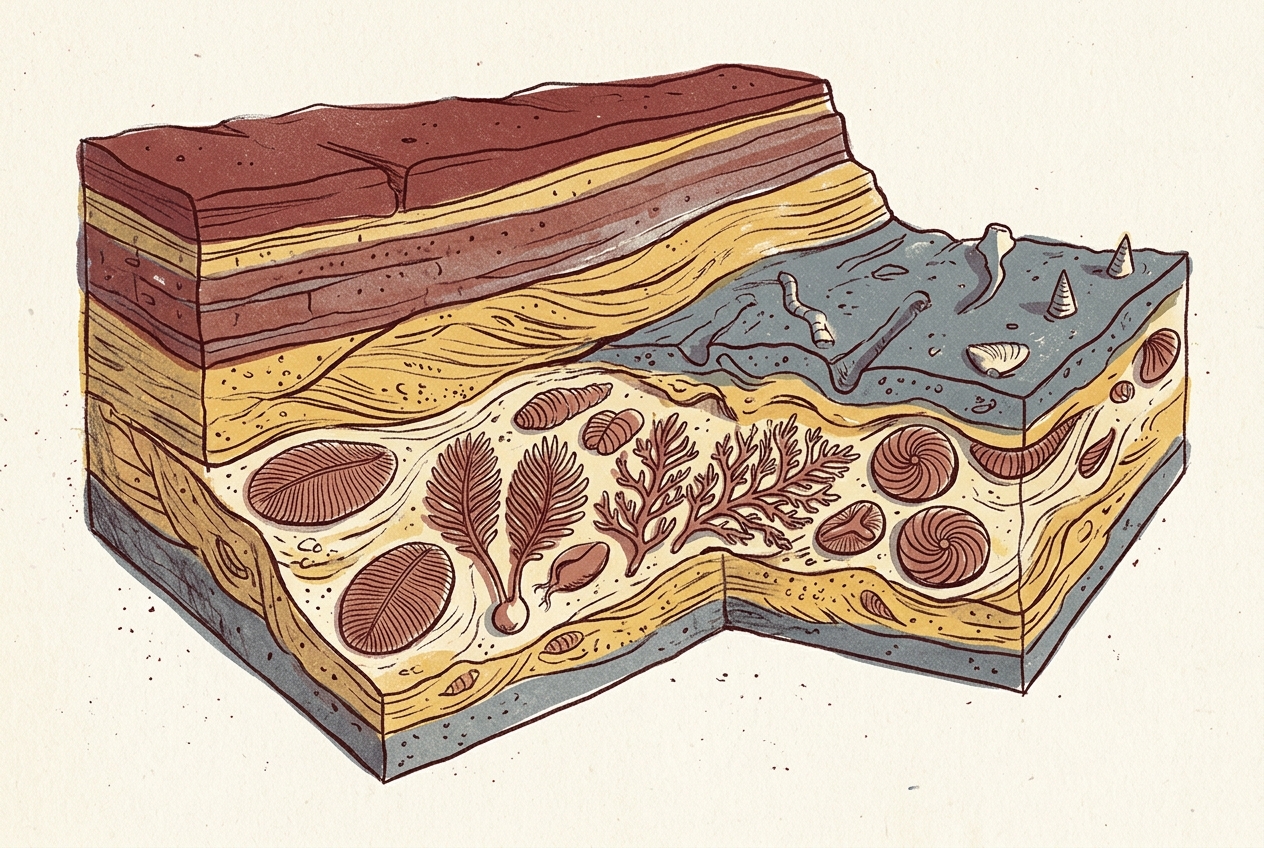
The Ediacara Member of the Rawnsley Quartzite is a sandstone bed no thicker than a city block, but it marks a boundary between two eras of life. Below it lie the fronds, discs, and quilted forms of the Ediacaran biota — strange creatures that ruled the seas for 30 million years. Above it begins the Cambrian, a world of skeletons, predators, and burrowing animals. The bed itself is a storm deposit, a single event that swept sand across the seafloor and entombed the Ediacaran community where it lived.
Geologists call this the Ediacaran–Cambrian transition, and nowhere is it preserved more cleanly than here. The fossils are not compressed or distorted. They lie on bedding planes like leaves pressed in a book, their soft tissues replaced by iron oxide and clay minerals that outline every lobe and ridge.
The boundary is not a gradual fade but a knife-cut — a single storm that ended one world and began another.
What the Sand Preserved
The fossils are dominated by Dickinsonia, a ribbed oval that grew up to a metre across, and Spriggina, a segmented form that may have been among the first animals capable of movement. But the most striking are the frond-like Rangea and Charniodiscus, which stood anchored to the seafloor like kelp, filtering particles from the water. None had shells, legs, or mouths. They absorbed nutrients through their skin or grew symbiotic bacteria on their surfaces.
What makes the Ediacara Member extraordinary is the quality of preservation. The sand that buried these organisms was fine-grained quartz, deposited by a pulse of sediment from a nearby delta. It filled every fold of their bodies before they could decay, creating natural moulds that survive today. In some specimens, you can still see the three-dimensional shape of the organism — the raised central ridge of Dickinsonia, the branching pattern of Rangea's fronds.
A Window Into the Cambrian
Just centimetres above the Ediacaran bedding planes, the same formation contains trace fossils — burrows and trails made by bilaterian worms that could move through sediment. These are the earliest evidence of animals with a through-gut and body symmetry, the ancestors of every mollusc, arthropod, and vertebrate alive today. The Ediacara Member captures the moment these two worlds overlapped, if only briefly.
The Cambrian animals did not suddenly appear. They evolved in the late Ediacaran, but they were small and rare. The storm that buried the Ediacaran community also preserved the first traces of their successors. In the same slab of sandstone, you can find a Dickinsonia lying beside a burrow — the old world and the new, frozen together.
Why This Bed Matters
The Ediacara Member is not the oldest fossil bed in Australia, but it is the most informative. It records the last 10 million years of the Ediacaran period, when the first animals were experimenting with mobility, predation, and hard parts. The fossils here show that the Ediacaran biota did not go extinct all at once. Some species persisted into the Cambrian, overlapping with the new fauna for several million years.
But the bed also contains a warning. The Ediacaran community was adapted to a stable, low-oxygen world. When the Cambrian animals began burrowing and stirring the sediment, they disrupted the microbial mats that held the seafloor together, collapsed the Ediacaran ecosystem, and triggered a cascade of extinctions. The storm that preserved the Ediacara Member was a single event, but the extinction it captured was a process — a slow replacement of one way of life by another.
Today, the Ediacara Member is exposed in the Flinders Ranges, a two-hour drive from the town of Hawker. The fossils are protected in the Ediacara Conservation Park, where visitors can walk on the same bedding planes that contain the last breath of the Ediacaran world. The sand that buried them half a billion years ago still holds their shapes, waiting for someone to turn the page.
More like this
- The 540-Million-Year-Old Reef That Grew Without AnimalsIn the Flinders Ranges, 540-million-year-old microbial reefs built by cyanobacteria, not animals, record the last great gasp of the Ediacaran world before the Cambrian explosion.
- The 1.7-Billion-Year-Old Chimneys That Breathed PoisonIn the McArthur Basin, 1.7-billion-year-old hydrothermal vent chimneys preserve the earliest known ecosystem built entirely on toxic metals and sulfur, without sunlight.
- The 555-Million-Year-Old Garden That Learned to ReproduceIn the Flinders Ranges, 555-million-year-old Funisia dorothea fossils preserve the earliest known evidence of sexual reproduction in animals.